

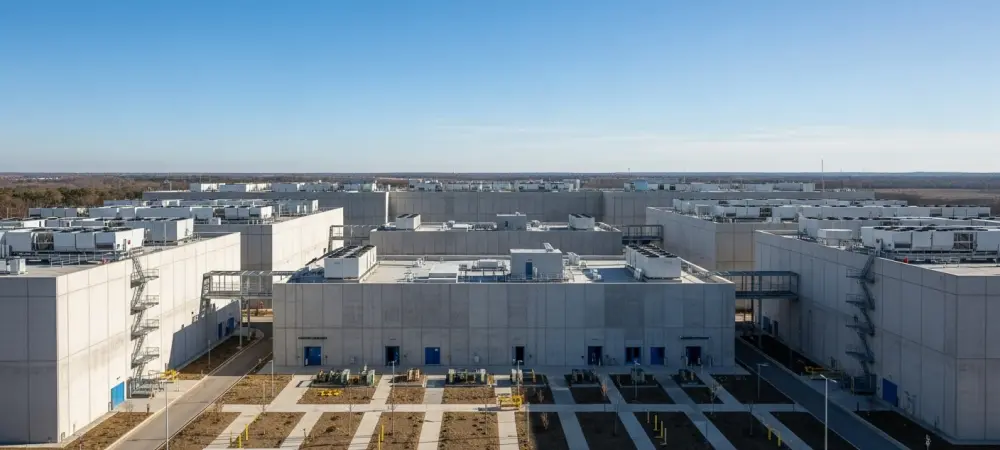
The global data center industry has officially entered an era where atmospheric instability is no longer a peripheral risk but a core operational metric that dictates the survival of the digital economy. As the foundational layer for artificial intelligence and global commerce, these facilities are undergoing a radical architectural and philosophical transformation to remain functional amid a climate that has become increasingly hostile. This shift represents a move toward climate-hardened designs and a deep integration into the public power grid, where data centers now serve as critical stabilizers during environmental emergencies. The focus is no longer just on maintaining a specific uptime percentage but on ensuring systemic resilience that can withstand the compounding pressures of extreme heat, flash flooding, and unprecedented seismic activity.
The Economic and Statistical Reality of Climate Volatility
Financial Projections: The Cost of Atmospheric Instability
The fiscal landscape for digital infrastructure is being reshaped by the rising costs of environmental defense and recovery. Projections for the coming decades suggest that climate-related disruptions could account for nearly 10% of the total asset value of global data center infrastructure by 2055. This financial burden is primarily driven by extreme heat, which specialists expect will represent two-thirds of all climate-related expenditures. As server densities increase to accommodate power-hungry AI workloads, the cost of maintaining optimal thermal environments during regional heatwaves is skyrocketing. Furthermore, the Uptime Institute has noted that while past outages were typically caused by isolated mechanical failures, the modern risk profile is dominated by systemic climate threats that can compromise entire regions simultaneously.
Regional Adaptation: Hardening Infrastructure Against Local Threats
Real-world applications of climate resilience are becoming highly localized, with operators tailoring their builds to the specific geological and atmospheric threats of a given region. In the tornado-prone plains of Oklahoma, the industry is seeing a decisive move away from lightweight, prefabricated modular units. Instead, providers are investing in massive, reinforced concrete bunkers designed to resist high-velocity debris and extreme pressure changes. This shift toward “fortress architecture” ensures that even if the surrounding area suffers significant damage, the critical data processing capabilities remain intact. These regional strategies demonstrate that the one-size-fits-all model of data center construction is effectively over, replaced by a bespoke approach to survival.
Coastal and Tropical Resilience: Lessons From Recent Disasters
Infrastructure in coastal and tropical regions is undergoing a significant overhaul to address vulnerabilities exposed by recent catastrophic weather events. In Brazil, the devastating floods in Rio Grande do Sul served as a catalyst for a major industry shift toward underground fiber cabling. Major providers like AWS and Google are increasingly prioritizing buried connectivity to avoid the aerial line failures that left millions without digital access during the flooding. Simultaneously, coastal facilities such as the “Mega Lobster” campus are pioneering the use of advanced salinity-resistant materials. These innovations prevent the rapid corrosion of cooling systems and electrical components caused by salt-heavy marine air, while base isolation systems provide a critical buffer against the seismic activity common in the Pacific and Atlantic margins.
Expert Perspectives on Industry Transformation
Geophysical Risk: The New Priority in Site Selection
Thought leaders in the infrastructure space, including representatives from ValorC3, argue that the traditional criteria for site selection—such as proximity to fiber hubs or tax incentives—are being overshadowed by complex geophysical risk assessments. In the current landscape, an operator’s first priority is to evaluate the long-term viability of a location based on floodplain mapping, wildfire corridors, and projected water scarcity. This evolution has turned site selection into a discipline of environmental science as much as one of real estate. Experts emphasize that a facility located in a high-risk zone, regardless of its technological sophistication, faces an uphill battle against rising insurance premiums and the potential for total loss during a catastrophic event.
Grid Interaction: From Consumers to Active Participants
There is a significant paradigm shift occurring in the relationship between hyperscale facilities and the public electrical grid. Technical specialists highlight that data centers are moving from being passive energy consumers to active partners in grid stability through load-shedding participation. During periods of extreme stress, such as intense heatwaves or polar vortices, data centers are increasingly required to transition to on-site power generation to alleviate pressure on residential energy supplies. This “interruptible load” model is becoming a standard requirement in many jurisdictions, forcing operators to view their massive battery arrays and backup generators not just as safety nets for their own servers, but as distributed power plants that support the broader community.
Operational Vigilance: Managing Physical Hardware Under Stress
Resilience is not merely a feature of building design; it requires constant human vigilance and a deep understanding of how hardware behaves under extreme conditions. Engineers are warning about “operational gelling” during severe cold snaps, where diesel fuel and liquid coolants can thicken and cause backup systems to fail. Conversely, during heatwaves, the necessity of “derating” hardware—running servers at lower speeds to prevent thermal runaway—is becoming a common operational procedure. These challenges highlight the fact that resilience is an ongoing process of monitoring and adaptation. It demands that staff be trained to handle physical variables that were rarely considered a threat to digital systems only a decade ago.
The Future Outlook of Resilient Digital Infrastructure
Digital Twins: Simulating Disaster Before Groundbreaking
The next phase of infrastructure development is defined by the widespread adoption of digital twin technology. These high-fidelity virtual replicas allow engineers to run complex simulations of extreme weather scenarios, such as 500-year floods or sustained temperatures above 115 degrees Fahrenheit, before a single brick is laid. By testing the facility’s response to these variables in a digital environment, companies can identify structural weaknesses and optimize cooling paths without risking actual hardware. This proactive approach to design is becoming the gold standard for risk mitigation, ensuring that new campuses are built with a granular understanding of their future environmental environment.
Liquid Cooling: The Standard for Density and Scarcity
As the industry grapples with the dual pressures of high-density AI workloads and regional water restrictions, hybrid and closed-loop liquid cooling systems are set to become the global standard. Unlike traditional evaporative cooling, which can consume millions of gallons of water daily, closed-loop systems recycle their coolant, making them ideal for drought-prone areas. These systems are also significantly more efficient at handling the intense heat generated by modern GPUs. The transition to liquid cooling represents a necessary technological pivot that aligns the industry’s performance requirements with the growing necessity of environmental conservation and resource management.
The Economic Trade-off: CAPEX and Uptime Guarantees
While the transition to climate-resilient designs offers long-term stability, it presents a significant challenge in terms of rising capital expenditures. Hardening a facility against every possible atmospheric threat is an expensive endeavor that may conflict with the industry’s drive for rapid expansion. Furthermore, the move toward “interruptible load” mandates could disrupt traditional “five-nines” uptime guarantees. Companies must find a balance between the high costs of hardened architecture and the expectations of a global market that demands constant availability. This tension is likely to lead to a tiered service model, where different levels of resilience are offered based on the criticality of the data being hosted.
Summary of Key Resiliency Strategies
The analysis of the current infrastructure landscape demonstrated that data center resilience evolved from a simple power backup requirement into a holistic posture involving architectural hardening and geographical intelligence. This transition was necessitated by the realization that the “always on” nature of the digital economy stood in direct conflict with an increasingly volatile natural world. The sector successfully recognized that site selection must be treated as a geophysical risk assessment and that the integration of facilities into the public grid was an essential step for social and operational stability.
Moving forward, the industry prioritized the use of sophisticated modeling tools and water-independent cooling technologies to maintain its trajectory of growth. The most successful operators were those who moved away from reactive maintenance and embraced a disciplined, simulation-driven approach to daily operations. These strategies ensured that even as the margin for error shrank, the sector could sustain modern commerce by anticipating atmospheric shifts before they manifested as outages. Ultimately, the survival of global digital systems was secured through a commitment to building infrastructure that worked in harmony with its environment rather than attempting to ignore it.