

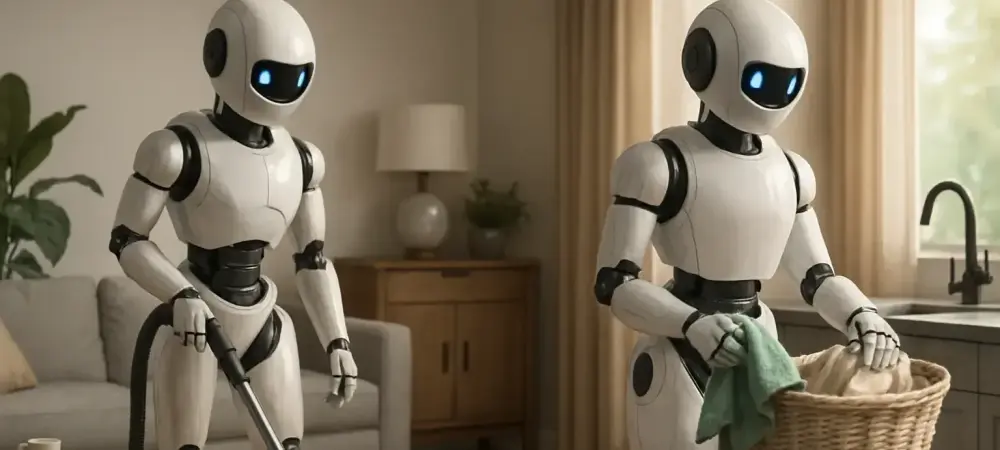
The long-held cultural vision of a future where autonomous, all-purpose household robots like “Rosie the maid” cater to our every need has remained a fixture of popular imagination for generations, yet the reality in our homes is starkly different. While artificial intelligence has mastered complex digital realms, from defeating grandmasters in chess to generating intricate art, the physical world of a simple household remains a formidable frontier. This gap between abstract intelligence and physical dexterity is not merely a matter of delayed convenience; it represents one of the most significant challenges in modern technology. This analysis will dissect the theoretical paradoxes, practical environmental hurdles, expert insights into the evolution of robotics, and the future trajectory of our long-awaited autonomous helpers.
The Core Challenge a Paradox of Perception and Dexterity
The central difficulty in creating a true household robot is rooted in a fundamental disconnect between what humans find easy and what machines find easy. This paradox explains why an AI can write a sonnet but cannot yet reliably load a dishwasher. The everyday world, so intuitive to us, is a chaotic minefield of variables for a machine built on logic and predictability.
Moravec’s Paradox Why Easy is Hard for Robots
First posited in the 1980s, Moravec’s Paradox observes that high-level reasoning tasks that require years of human training, like advanced mathematics or strategic games, are relatively simple for AI. Conversely, basic sensorimotor skills that a toddler acquires with ease, such as walking on uneven ground, recognizing objects from different angles, and grasping them with appropriate force, are monumentally difficult for robots to master. This counterintuitive reality highlights the chasm between computational intelligence and embodied, physical competence.
The explanation for this paradox is Darwinian in nature. Humans have a multi-million-year evolutionary head start in which natural selection has relentlessly refined our physical abilities. Skills like intuitive physics—knowing how a towel will drape or how much pressure to apply to a sponge—are deeply embedded in our biology. For a machine, these innate human skills represent an immense programming challenge, as every subtle interaction with the physical world must be explicitly learned or coded from scratch.
The Real World Gauntlet The Unstructured Home
The average home is an automation nightmare, a fact confirmed by leading AI models themselves, which describe it as a “nasty combo of messy perception + tricky hands + endless edge cases.” A domestic robot must operate in a perpetually changing environment with unpredictable lighting, cluttered spaces, and dynamic obstacles. Its perception system must be robust enough to identify a vast array of objects, while its planning software must navigate safely around unpredictable elements like wandering pets and children.
Further complicating this is the challenge of manipulation. Unlike the standardized parts on an assembly line, household objects are often “squishy, slippery, and crinkly.” Items like laundry, garbage bags, and food have no fixed shape or predictable physical properties, making them incredibly difficult for rigid grippers to handle. This is compounded by the lack of standardization across homes; every layout is unique, demanding a level of generalization and adaptability that remains a significant technological and cost-related hurdle.
Expert Insights on the Evolutionary Path of Robotics
According to roboticist Navid Aghasadeghi, formerly of Boston Dynamics, the core problem is the synthesis of sophisticated software with capable hardware at a scalable cost. The robot’s intelligence must flawlessly interpret sensor data to plan a sequence of actions, which must then be executed by actuators that apply precise forces to the environment. This delicate integration has evolved through distinct stages, each marking a significant step toward greater autonomy.
Stage One Brainless Pre Programmed Machines
The first generation of robotics consisted of “brainless” machines capable only of simple, pre-programmed, repetitive movements. These robots, common on factory assembly lines, operated without any perception of their surroundings. Lacking sensors or safety features, they could only function in highly controlled, structured environments where every object was in a predetermined location, making them entirely unsuited for the dynamic chaos of a home.
Stage Two The Introduction of Perception and Planning
A major leap occurred with the second stage, which equipped robots with sensors, granting them the ability to “see” and understand their environment. This introduction of perception and planning allowed machines to reason about their surroundings, enabling them to execute complex, multi-stage tasks with a greater degree of autonomy. This was the critical step that moved robotics beyond simple repetition and toward performing useful work in less structured settings.
Stage Three The Current Era of AI Powered Generalization
The current, third stage is defined by AI-powered robots that leverage the same general learning algorithms found in advanced systems like Large Language Models. The key capability of this modern era is generalization. A user can now issue a complex command in natural language, such as “clean the kitchen,” and the robot can understand the intent behind the words.
This represents a profound shift in capability. The robot can now decompose that high-level command into a sequence of actionable sub-tasks, such as closing a cabinet, picking up a sponge, and loading a dishwasher. It then uses its advanced perception systems to execute that plan in the real world, demonstrating a form of intelligence that begins to approach the flexibility required for household chores.
Future Outlook The Hurdles and Horizons
Despite the remarkable progress, the dream of a fully autonomous household robot remains just over the horizon. The final barriers are not just matters of engineering refinement but are tied to a fundamental resource that is abundant in the digital world but scarce in the physical one: data.
The Data Bottleneck Robotics Biggest Barrier
While an AI like ChatGPT can train on the vast, near-infinite repository of text and images available on the internet, no equivalent, massive dataset exists for real-world physical interactions. To learn how to properly hold a delicate wine glass versus a heavy pan, a robot needs extensive data on how to apply force, adjust its grip, and account for varying weights, textures, and material properties.
This specific type of physical interaction data is extraordinarily difficult and expensive to generate. The sheer number of objects in a home and the infinite ways one can interact with them create a data scarcity problem that has become the single biggest barrier to progress in the field.
Forging the Path Forward Through Teleoperation
To solve the data bottleneck, researchers are increasingly turning to teleoperation. This method involves humans remotely controlling robots to perform a wide variety of household tasks. As the human operator guides the robot’s arms and grippers, every movement, every application of force, and every successful manipulation is recorded. This process is crucial because it generates the high-quality, large-scale datasets needed to train the next generation of robot AI. By learning from countless hours of human-guided actions, these systems can begin to build the intuitive understanding of physical dynamics that they currently lack, paving the way for true autonomy.
The Palm Pilot Stage an Impending iPhone Moment
The current state of robotics can be compared to the “Palm Pilot” stage of personal digital assistants—functional, impressive to early adopters, but not yet seamlessly integrated into everyday life. The technology works, but it often remains clunky, limited, and far from the intuitive experience consumers expect.
However, this stage is a necessary precursor to a revolutionary leap. The field is on the cusp of its “iPhone moment,” a breakthrough that will combine advanced hardware and intelligent software into a product that is not only powerful but also intuitive and ubiquitous. This moment will mark the transition of the household robot from a futuristic concept to an indispensable part of modern living.
Conclusion More Than Convenience a Mirror to Humanity
The long road toward the autonomous household robot was defined by profound challenges, from the conceptual hurdle of Moravec’s Paradox to the practical chaos of the unstructured home environment. Progress was fundamentally constrained by the critical need for vast datasets of physical interaction, a barrier that has only recently begun to be addressed through innovative methods like teleoperation.
Ultimately, the quest to build these machines became a mirror to humanity. In striving to replicate our physical competence, we were forced to gain a deeper appreciation for our own intelligence and the millions of years of evolution that gifted us an effortless mastery of the physical world. The ultimate goal, it turned out, was not simply a cleaner house, but the creation of technology that frees human potential and allows society to flourish.