

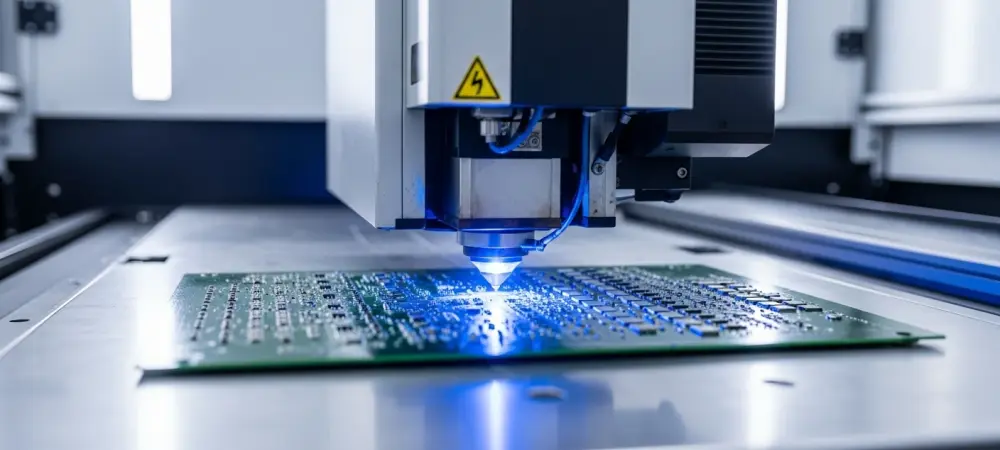
The era where a master technician spent hours squinting at focal lengths and manual material test cards has rapidly faded into industrial history as smart algorithms take over the heavy lifting of precision work. This shift represents the death of manual calibration, marking a decisive move away from the “trial and error” era that once defined laser craftsmanship. Today, the market has transitioned from viewing high-tech upgrades as optional luxuries to recognizing them as essential industrial standards. In a precision-obsessed landscape, the integration of artificial intelligence is the primary catalyst for growth, driving a comprehensive change in market adoption and manufacturing trajectories.
The Evolution of Precision: Market Trends and Integration
Data-Driven Shifts from Manual to Autonomous Control
The transition from human-led parameter setting to AI-driven real-time calibration has fundamentally altered the production floor. Previously, operators had to manually adjust power and speed settings for every new material, a process that was both time-consuming and prone to inconsistency. Modern systems now utilize vision sensors and machine learning to detect material density and surface variations instantly. This allows for autonomous adjustments that ensure perfect results on the first pass, effectively eliminating the waste associated with setup testing. Market data indicates a significant growth surge in the UV laser sector, primarily fueled by the increasing demand for damage-free engraving on delicate materials. As glass, specialized polymers, and thin-film electronics become more prevalent in consumer products, the cold-processing capabilities of UV lasers are indispensable. AI further enhances this by maintaining strict thermal control, ensuring that the integrity of the material is never compromised. Consequently, small and medium-sized enterprises are adopting these tools as force multipliers to reduce labor costs while maintaining high output capacity.
Real-World Applications and the Customization Surge
In the jewelry and electronics sectors, AI is now used to manage intricate, personalized data without interrupting high-speed production lines. This capability has moved customization from a niche service to a mainstream industrial expectation. Systems can now ingest unique customer data and adapt the engraving path for each individual item in a batch. This seamless integration ensures that every unit maintains the same level of quality, regardless of how complex or unique the specific design might be.
A notable case study involves XLaserlab’s integration of UV and fiber laser systems, which successfully bridged the gap between industrial power and desktop intelligence. By combining high-output hardware with smart software, they allowed manufacturers to perform complex marking tasks that were previously reserved for specialized facilities. This development has empowered the “batch-of-one” manufacturing model, where unique serial numbers and complex artistic patterns are applied at scale. The result is a manufacturing environment that is both flexible and incredibly fast.
Expert Perspectives on the Intelligent Manufacturing Paradigm
There is a strong professional consensus that intelligence-driven precision is now the only viable path to meeting modern quality benchmarks. Experts argue that as product designs become more complex, the margin for error in sectors like medical device manufacturing and aerospace components has effectively vanished. AI solves this problem by providing a level of consistency that human operators simply cannot replicate over long shifts. This shift ensures that every component meets rigorous safety and performance standards without exception.
Furthermore, thought leaders emphasize the transition of the laser engraver from a standalone tool to a cognitive node within a larger business ecosystem. Rather than operating in isolation, these machines now communicate with inventory systems and design databases to optimize production schedules. This interconnectivity allows businesses to respond to market trends in real-time. By treating the engraver as an intelligent asset, companies can achieve a level of operational transparency that was previously impossible, leading to better resource allocation.
Future Outlook: Self-Learning Systems and Cloud Connectivity
The next phase of innovation involves the emergence of self-learning hardware that uses experience analysis to optimize pathing and energy consumption. These systems do not just follow a script; they learn from every engraving task to improve future performance. By analyzing successful outcomes, the machine can automatically refine its energy delivery, reducing wear on components and lowering utility costs. This level of autonomy moves the industry closer to a state where manufacturing systems are truly self-optimizing. Cloud-based ecosystems are also playing a vital role by enabling remote management and real-time data sharing across distributed manufacturing hubs. A designer in one country can send a verified engraving profile to a machine in another, ensuring identical results across global production lines. However, this high-tech integration brings new challenges, such as the need for updated digital skill sets and the management of complex software synergies. Companies must invest in training to ensure their workforce can navigate this data-centric environment. Predictive analysis suggests that the total elimination of setup times will soon redefine the speed of the global product-to-market cycle. As machines become faster at identifying and processing new tasks, the time between a consumer’s order and the finished product’s shipment will continue to shrink. This speed will be the defining factor in market leadership, favoring those who have fully embraced autonomous manufacturing. The transition toward these intelligent systems is no longer a future possibility but a current industrial necessity.
Summary: Redefining the Boundaries of Digital Production
The transformation from labor-intensive mechanical processes to data-centric intelligent automation redefined the manufacturing landscape. This evolution allowed the industry to move beyond the limitations of manual craftsmanship, establishing AI-powered engraving as the cornerstone of modern customization. Manufacturers discovered that the fusion of high-precision hardware and smart software was the only way to remain competitive in a fast-paced global market. The adoption of these technologies secured a future where flexibility and precision were no longer mutually exclusive.
The shift toward autonomous systems successfully eliminated the inconsistencies that once hindered high-stakes production. Organizations that integrated cognitive nodes into their ecosystems saw a marked improvement in both output quality and operational efficiency. This progression proved that the marriage of artificial intelligence and laser technology was the most significant advancement in digital production of the decade. Moving forward, the focus remains on deepening these synergies to further shorten the path from digital concept to physical reality.