

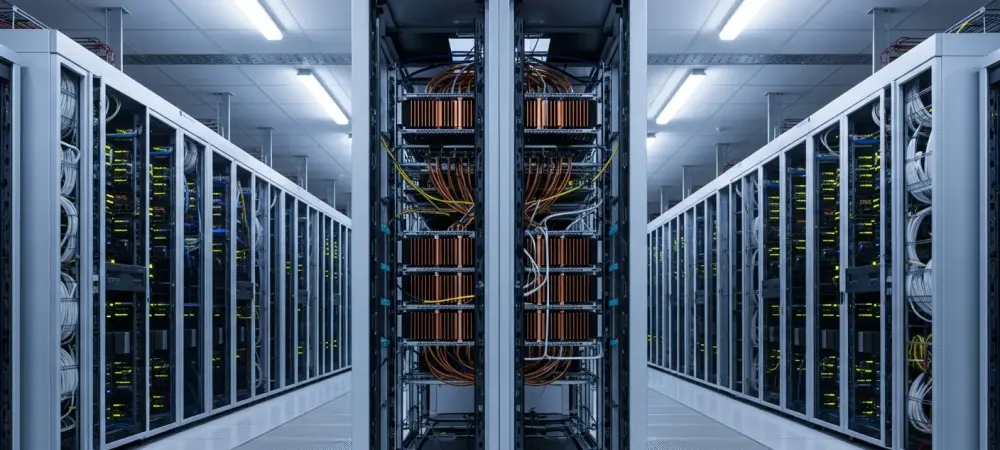
The rapid metamorphosis of the global digital landscape has fundamentally repositioned raw computational power from a hidden utility in the basement of a data center to the most critical strategic asset for the modern enterprise. This transition marks a departure from the era of traditional software, where general-purpose processing was sufficient to handle the logic-heavy but mathematically light demands of legacy applications. Today, the meteoric rise of artificial intelligence has rewritten the rules of engagement, forcing organizations to view their server racks not just as support tools, but as the engines driving their core competitive advantage. As these entities integrate sophisticated machine learning models into every facet of their operations, the underlying infrastructure must evolve to handle workloads that are magnitudes larger than anything previously encountered.
As artificial intelligence workloads demand exponential increases in processing power, understanding the evolution of hardware and deployment strategies has become a prerequisite for maintaining a market edge. The sheer density of data required to train a contemporary large language model or a computer vision system renders standard server configurations obsolete almost as soon as they are commissioned. Consequently, the strategic focus has shifted away from simply adding more servers toward architecting specialized environments that can handle massive parallelization. This paradigm shift requires a deep dive into the physical limitations of current technology and a proactive approach to resource allocation that balances performance with fiscal responsibility.
This analysis explores the transition to specialized silicon, the economic optimization of cloud procurement, and the technical architectures required to support the next generation of artificial intelligence. By examining the current trajectory of hardware development, it becomes clear that the path forward involves a departure from the “one-size-fits-all” mentality of the past. Instead, the focus is now on a diversified hardware portfolio that includes graphics processing units, tensor processing units, and highly efficient containerized deployment strategies. Understanding these components is essential for any technical leader looking to bridge the gap between ambitious AI goals and the physical reality of the data center.
The Shift to Specialized Compute Architectures
Market Dynamics and the Surge in GPU Adoption
Data indicates a fundamental departure from CPU-centric environments, with graphics processing unit and specialized silicon markets experiencing unprecedented growth due to the parallel processing requirements of deep learning. While the central processing unit remains the master of sequential logic and general task management, it is structurally ill-equipped to handle the trillions of simultaneous mathematical operations that define neural network training. This has led to a gold rush for high-end accelerators that can partition complex tasks into thousands of smaller threads, executing them all at once to achieve results that were once thought impossible.
Recent industry reports highlight that the mathematical complexity of neural networks has led to a “compute crisis,” where traditional sequential processing is no longer viable for modern model training. The industry is witnessing a scenario where the demand for specialized cycles is outstripping the immediate supply of high-performance silicon. This scarcity has transformed the way organizations approach their hardware lifecycles, moving away from standard three-year replacement cycles toward more agile, performance-driven upgrades. Moreover, the focus has shifted from raw clock speed to memory bandwidth and interconnectivity, as the ability to move data between processors is now as important as the processing itself.
Real-World Applications of Advanced Silicon
Leading technology firms and research labs are increasingly utilizing Tensor Processing Units and Field Programmable Gate Arrays to accelerate specific artificial intelligence operations. These specialized chips are designed with a singular focus: to execute the matrix multiplication and vector processing that underpin modern AI models with maximum efficiency. Unlike general-purpose chips that must maintain compatibility with a wide range of legacy instructions, these advanced silicon architectures strip away the unnecessary overhead to provide a lean, high-throughput environment. This specialization allows for a significant reduction in both power consumption and physical footprint, which is crucial as data centers hit the limits of their cooling and electrical capacities.
Case studies in autonomous driving and natural language processing show how migrating from general-purpose CPUs to massive GPU clusters has reduced training timelines from months to days. For instance, companies developing self-driving platforms require the ability to simulate millions of miles of driving data in virtual environments to train their perception models. Attempting this on traditional hardware would result in a developmental bottleneck that could stall innovation for years. By leveraging the parallel power of thousands of interconnected cores, these organizations can iterate on their models at a pace that keeps them at the forefront of the industry. This speed is not just a luxury; it is the deciding factor in who reaches the market first with a safe and reliable product.
Industry Perspectives on Infrastructure Strategy
Infrastructure experts emphasize that the “one-size-fits-all” approach to hardware is obsolete, advocating for a nuanced balance between Central Processing Units for logic and Graphics Processing Units for scale. The most effective architectures today are those that treat the CPU and the GPU as a symbiotic pair, where the CPU manages the complex data orchestration and the GPU handles the heavy computational lifting. This hybrid model ensures that neither component becomes a bottleneck, allowing the system to operate at peak efficiency. Experts suggest that the primary task for modern infrastructure architects is no longer just procurement, but the precise tuning of these two disparate architectures to ensure they work in perfect harmony.
Thought leaders suggest that the greatest challenge for technical executives is not just acquiring raw power, but managing the “overhead vs. isolation” trade-off within virtualized and containerized environments. While virtualization provides the security and management ease that enterprises crave, it often introduces a layer of abstraction that can degrade the performance of high-end hardware. Conversely, running workloads directly on “bare metal” hardware offers the highest performance but lacks the flexibility to quickly scale or move workloads between different physical locations. The prevailing trend is moving toward sophisticated container orchestration that allows for near-native hardware access while maintaining the portability and isolation required for modern software development pipelines.
Industry consensus indicates that the most successful organizations are those that treat compute as a dynamic resource, matching specific hardware philosophies to the unique demands of their AI models. This means that a model designed for real-time edge inference on a mobile device requires a completely different infrastructure strategy than a model being trained on a massive global dataset. Those who fail to make this distinction often find themselves overspending on power they do not need or under-provisioning for tasks that are mission-critical. By adopting a more granular approach to hardware selection, businesses can ensure that their infrastructure is perfectly sized for the task at hand, maximizing both performance and return on investment.
Future Projections and Economic Implications
The future of artificial intelligence infrastructure will likely see a convergence of “burst” and “sustained” compute models, where training occurs in the cloud while inference is optimized on-premises or at the edge. This hybrid approach allows companies to leverage the massive, on-demand power of hyperscale cloud providers for the initial, resource-heavy training phase without being tied to high operational costs for the long term. Once a model is fully trained, it can be deployed to localized hardware that is specifically tuned for the specific latency and data privacy requirements of the end-user. This creates a more resilient and cost-effective ecosystem that can adapt to the changing needs of the business as the AI matures from a research project to a production tool.
Potential developments include the democratization of high-performance hardware through more efficient containerization and the rise of “spot instance” strategies to slash training costs by up to 90%. Spot instances, which represent the spare capacity of cloud providers, offer a unique opportunity for organizations to run large-scale training jobs at a fraction of the standard price. While these instances can be reclaimed by the provider at any time, modern AI training frameworks are increasingly designed with “checkpointing” capabilities that allow a job to pause and resume without losing progress. This financial engineering allows smaller startups to compete with industry giants by accessing the same level of computational power at a much more accessible price point.
Challenges remain regarding energy consumption and the physical limits of silicon, prompting a move toward even more specialized, energy-efficient AI chips. As the environmental impact of massive data centers comes under increased scrutiny, the industry is searching for ways to deliver more “flops per watt.” This search is driving innovation in liquid cooling technologies and new semiconductor materials that can operate at higher temperatures with less resistance. The long-term sustainability of the AI revolution depends on the ability of hardware manufacturers to decouple computational growth from energy growth. Failure to do so could result in a ceiling where the cost of power becomes the primary limiting factor for the advancement of the technology itself.
The broader implication is a shift toward “financial engineering” in IT, where procurement models like Reserved Instances become as vital to project success as the code itself. In this new reality, the Chief Information Officer must act as much like a commodities trader as a technical leader. By locking in compute capacity years in advance or leveraging complex multi-cloud strategies to arbitrage the cost of cycles, organizations can protect themselves from price volatility and hardware shortages. This strategic layer of infrastructure management ensures that the development team always has the resources they need to innovate, while the finance department has the predictability required for long-term planning.
Conclusion: Synchronizing Infrastructure with AI Ambition
The transition toward a more robust and specialized compute environment represented a fundamental shift in how the industry approached technological growth. It became clear that the evolution of artificial intelligence was inextricably linked to the physical hardware that supported it. This analysis determined that the move toward massive parallelism and specialized silicon was not merely a trend but a structural requirement for the survival of data-intensive organizations. The research showcased how the balance between high-performance GPUs and the orchestrating logic of CPUs became the foundation of modern digital strategy.
Organizations recognized that they had to move beyond basic hardware acquisition to develop comprehensive strategies that accounted for the distinct phases of the AI lifecycle. It was observed that those who successfully synchronized their infrastructure with their broader ambitions were the ones who treated compute as a fluid, manageable resource rather than a static expense. The shift from general-purpose computing to highly specialized architectures provided the necessary speed for training while maintaining the efficiency needed for widespread inference. This strategic alignment allowed for a more sustainable growth model that could withstand the pressures of an increasingly competitive market.
To maximize the return on investment and operational agility, leadership prioritized the right-sizing of their environments to ensure that infrastructure could scale in lockstep with rapid advancements. The historical trajectory indicated that the democratization of high-performance hardware was achieved through creative procurement and the adoption of containerized deployment models. These actions ensured that the technical capabilities of the enterprise remained ahead of the curve, providing a stable platform for future innovations. By viewing infrastructure as a dynamic pillar of success, the industry was able to bridge the gap between theoretical potential and practical, real-world applications of artificial intelligence.