

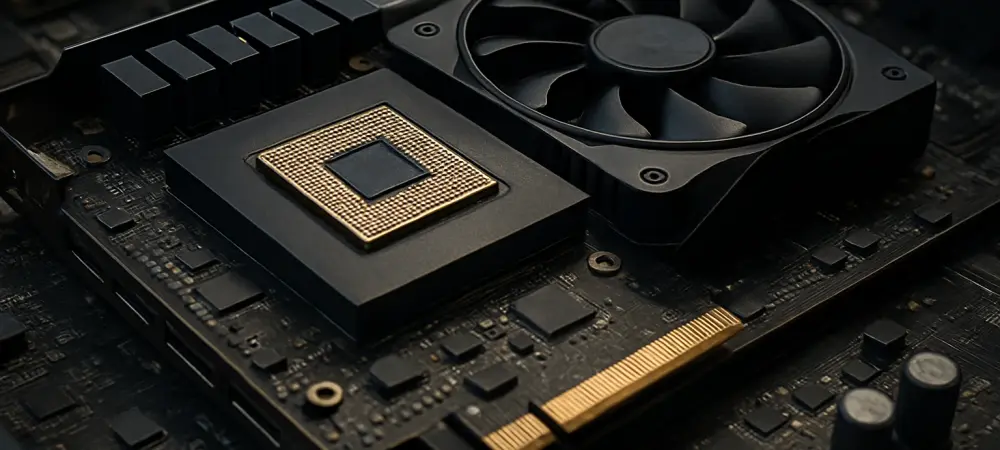
The realm of artificial intelligence is undergoing a seismic shift, with hardware advancements becoming the linchpin for unlocking the full potential of next-generation applications in an era where data processing demands are skyrocketing. AI inference, the process of deploying trained models to make real-time decisions, has emerged as a cornerstone of modern data centers, driving transformations across industries from healthcare to finance. This analysis dives into the cutting-edge trends in AI hardware, spotlighting Euclyd’s revolutionary CRAFTWERK system, a potential disruptor that could redefine performance and efficiency standards while reflecting broader industry movements toward sustainable and powerful computing solutions.
Unveiling Euclyd’s CRAFTWERK: A Leap in AI Inference Hardware
Staggering Specs and Performance Claims
Euclyd, a lesser-known European startup based in Eindhoven, Netherlands, with a presence in San Jose, California, has introduced the CRAFTWERK SiP (System-in-Package), a module that packs an astonishing 16,384 custom SIMD processors alongside 1TB of ultra-bandwidth memory. This memory reportedly achieves a bandwidth of 8,000 terabytes per second, while the compute performance hits 8 petaflops at FP16 precision and scales to 32 petaflops at FP4 precision. Such specifications position the system as a formidable contender against established industry benchmarks.
Building on this, the CRAFTWERK STATION CWS 32, a rack-scale platform integrating 32 SiPs, pushes the boundaries further with a claimed 1.024 exaflops of FP4 compute power and 32TB of memory. It boasts a processing capability of 7.68 million tokens per second in multi-user mode, all while operating at a power draw of just 125 kilowatts. Euclyd asserts that these figures translate to a hundred-fold gain in energy and cost efficiency over competitors, as modeled on the Llama 4 Maverick benchmark. These claims, if validated, suggest a significant leap forward in handling the intense computational loads required for AI inference tasks. The emphasis on low power consumption alongside high performance hints at a design philosophy that could challenge the status quo in data center hardware. However, the absence of independent testing leaves these numbers as promising yet unproven assertions.
Real-World Potential and Initial Applications
The design of CRAFTWERK specifically targets agentic AI workloads, which are critical for managing multi-user, high-demand inference tasks in data centers. Such workloads are pivotal for applications requiring rapid, simultaneous processing, such as virtual assistants or real-time analytics in large-scale environments. Euclyd’s system aims to address the escalating need for efficient infrastructure as AI adoption surges globally. Showcased at the KISACO Infrastructure Summit in Santa Clara, the system has been positioned as a direct competitor to giants like Nvidia, drawing attention for its bold performance promises. Industry observers noted the buzz around its debut, with many intrigued by how it could potentially shift market dynamics. Yet, the lack of operational data means discussions about its impact remain speculative at this stage.
Theoretical use cases for CRAFTWERK include powering extensive AI-driven platforms, from autonomous systems to personalized user experiences on a massive scale. Until real-world deployments provide concrete evidence, the system’s ability to meet these ambitious goals remains a topic of cautious optimism among experts tracking AI hardware trends.
Industry Voices on Euclyd’s Innovation
CEO Bernardo Kastrup has articulated a vision of “Crafted Compute,” a philosophy centered on bespoke design to maximize efficiency and minimize power consumption. This approach, according to Kastrup, involves tailoring processors, memory, and packaging to achieve unparalleled performance with the lowest energy footprint in the sector. His perspective underscores a growing recognition of the need for specialized hardware in AI inference.
Investor Peter Wennink, previously at the helm of ASML, has voiced strong confidence in CRAFTWERK’s potential to transform the economics of AI inference. He predicts that such innovations could make agentic AI more accessible and position inference-focused silicon as a dominant force in data center technology over the coming years. His endorsement highlights the high stakes and optimism surrounding Euclyd’s entry into the market.
Despite the enthusiasm, a note of caution persists due to the absence of third-party validation or operational evidence. Industry analysts emphasize that while the specifications and philosophies are compelling, independent testing is essential to confirm whether Euclyd’s claims hold up under real-world conditions. This gap in substantiation remains a critical point of discussion among stakeholders.
Future Prospects and Challenges for AI Inference Hardware
If Euclyd’s performance assertions for CRAFTWERK are proven, the system could fundamentally alter data center operations by offering unprecedented cost reductions and sustainability benefits. The potential to handle massive inference workloads with minimal energy use aligns with pressing demands for greener technology solutions. Such a shift might encourage widespread adoption across sectors seeking to balance performance with environmental responsibility.
This development mirrors a larger trend in AI hardware toward energy efficiency and environmentally conscious engineering. As data centers grapple with soaring power consumption, innovations prioritizing low-energy designs are gaining traction. Euclyd’s focus on minimal power usage reflects an industry-wide push to address the ecological footprint of AI infrastructure, setting a precedent for future advancements.
However, startups like Euclyd face formidable hurdles, including scaling manufacturing to meet demand, building a robust software ecosystem to support their hardware, and ensuring seamless integration with existing data center setups. Additionally, unverified claims risk fostering skepticism, which could dampen early adoption. Balancing these challenges with the transformative potential of their technology will be crucial for Euclyd to establish a foothold against entrenched competitors.
Balancing Promise and Uncertainty in AI Hardware
Looking back, Euclyd’s unveiling of the CRAFTWERK system marked a bold statement in the AI inference hardware landscape, with specifications and efficiency promises that stood out as potential game-changers. The emphasis on high compute power paired with low energy consumption positioned it as a rival to industry leaders, while reflecting a critical need for sustainable innovation in data centers. Yet, the unverified nature of its claims casts a shadow of uncertainty over its immediate impact.
Moving forward, the next steps hinge on rigorous real-world testing and successful deployment to validate Euclyd’s assertions. Stakeholders should closely monitor pilot projects and independent assessments over the coming months to determine whether this hardware can deliver on its ambitious goals. Additionally, fostering partnerships for software compatibility and manufacturing scalability will be vital to overcoming startup challenges and cementing a lasting presence in the market.