

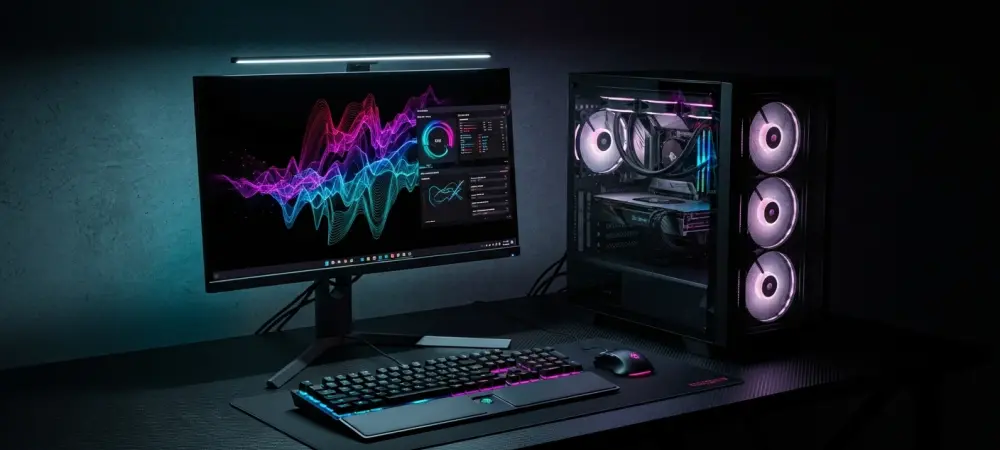
The long-standing benchmark of gaming supremacy, once measured purely by clock speeds and core counts, is now being fundamentally redefined by the integration of on-device artificial intelligence. From simple graphics acceleration to intelligent, adaptive performance, gaming hardware is undergoing a profound transformation. This latest frontier promises to redefine user experience by making systems smarter, faster, and more intuitive. This article analyzes the rise of AI-enhanced gaming hardware, examining the market drivers, real-world applications, and future implications of this technological shift, spotlighting a key industry partnership as a case study.
The Rise of On Device AI in Gaming
Market Momentum and Strategic Partnerships
A pivotal indicator of the market’s new direction is the strategic partnership between Gigabyte and AMD, a collaboration designed to accelerate on-device AI integration across gaming laptops, motherboards, and monitors. This alliance signals a major industry shift toward localized AI processing. By moving away from cloud-dependent solutions, manufacturers can deliver lower latency and enhanced performance directly on user hardware, creating a more responsive and powerful experience without relying on an internet connection for core intelligence.
The growing momentum is further evidenced by the launch of dedicated product lines built specifically for AI workloads. The emergence of Copilot+ PCs, equipped with built-in Neural Processing Units (NPUs), reflects a significant investment from manufacturers and a growing consumer appetite for AI-native hardware. This trend illustrates that on-device AI is not a niche feature but is rapidly becoming a foundational component of modern computing and gaming systems.
Real World Implementations A New Hardware Ecosystem
This shift is already yielding tangible products that form a new, intelligent hardware ecosystem. In the laptop space, the AORUS MASTER 16, with its AMD Ryzen 9 processor and 3D V-Cache, and the GIGABYTE AERO X16, featuring an AMD Ryzen AI 400 Series NPU, exemplify how AI is being leveraged. These systems use artificial intelligence for both raw gaming performance and efficient background task management. Software-hardware synergy is further showcased by Gigabyte’s proprietary AI agent, GiMATE, which automates and streamlines power and performance settings for the user.
On the desktop, the GIGABYTE X870E X3D Series motherboards are engineered to support AMD’s next-generation processors, but their true innovation lies in targeted AI applications. The integration of Gigabyte’s AI-powered X3D Turbo Mode 2.0 automatically optimizes performance for AMD’s specialized cache technology, reducing the need for complex manual tuning by gamers. Meanwhile, GIGABYTE OLED monitors like the MO27Q28GR and MO32U24 build upon the AMD FreeSync Premium Pro foundation with AI-driven Tactical Features. Features such as Aim Stabilizer and Game Assist use intelligent processing to sharpen visuals and provide a tangible competitive edge in gameplay.
Industry Insights Engineering Intelligent Performance
The joint effort between AMD, a leader in platform innovation, and Gigabyte, an expert in system engineering, validates the critical importance of AI in next-generation hardware. Their combined expertise underscores a core belief within the industry: deep hardware-software integration is essential to unlocking the full potential of on-device AI. This is no longer about simply adding a processor but about building a cohesive ecosystem where every component works intelligently together.
This partnership highlights an industry-wide consensus that the future of high-performance gaming and content creation lies in systems that can intelligently manage resources. The goal is to create hardware that can predict user needs and optimize performance in real time without requiring direct intervention. Such intelligent systems promise a seamless experience where the hardware adapts to the user, not the other way around.
The Future Trajectory What’s Next for Smart Hardware
Looking ahead, the industry will likely see a deeper integration of NPUs across all hardware tiers, not just premium products. This will enable more sophisticated AI features, such as real-time, AI-driven graphic upscaling, predictive frame generation, and personalized system tuning that learns from individual gaming habits. These advancements will push performance beyond the limits of raw processing power alone. The primary benefits of this trend include superior performance, enhanced power efficiency, and a smoother, more responsive user experience. However, challenges remain, including the need to ensure broad software and game developer support for new AI hardware. Manufacturers must also manage the increased cost and complexity of manufacturing while avoiding the pitfall of “AI-washing,” where features are marketed as intelligent but offer little tangible benefit to the end user.
Conclusion A New Era of Intelligent Gaming
The integration of on-device AI into gaming hardware is no longer a futuristic concept but a current, market-driving trend, powerfully illustrated by the strategic collaboration between Gigabyte and AMD. This shift is producing tangible products that deliver smarter, more adaptive performance across laptops, desktops, and peripherals, moving the industry into a new phase of innovation.
As AI becomes further embedded in the silicon itself, the line between hardware and software will continue to blur, ushering in an era where gaming rigs are not just powerful, but truly intelligent partners in the gaming experience. The focus is now on creating a seamless, optimized, and intuitive ecosystem where a system’s intelligence is as critical a metric as its clock speed.