

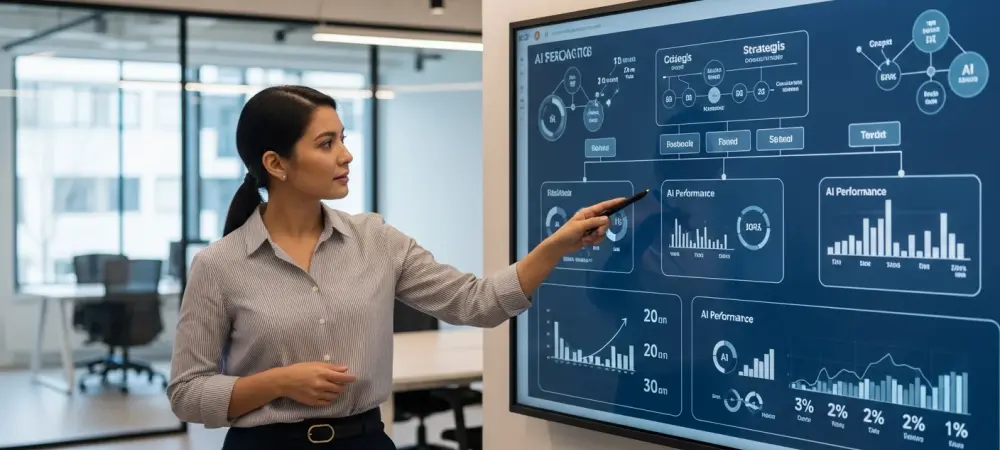
In the current corporate environment, the ability to seamlessly integrate artificial intelligence is no longer merely a supplementary skill but has become the primary catalyst for reaching senior leadership positions and securing substantial wage premiums. As AI literacy becomes a core metric for evaluating employee value, understanding the balance between technical mastery and human intuition is essential for anyone seeking upward mobility in an increasingly competitive market. This shift has redefined the traditional career ladder, replacing seniority-based progression with a meritocracy centered on technological fluency. This analysis explores current adoption statistics, the real-world financial rewards for AI skills, expert perspectives on the human-AI partnership, and the evolving ethical standards governing modern hiring practices.
The Statistical Surge: Data and Real-World AI Integration
Quantifying the Correlation Between AI Proficiency and Promotion
Recent data from the McKinsey 2025 report reveals a significant jump in regular business AI use, rising from 78% to 88% within a single year. This near-total adoption indicates that basic usage is no longer a competitive advantage but a baseline requirement for professional survival. In this environment, the differentiator for advancement is not just using the tools, but achieving high-quality integration that produces measurable business value.
Findings from the Novorésumé survey confirm this trend, showing that 15.3% of the total workforce and over 26% of Gen Z employees have already secured promotions through AI-enhanced outputs. These individuals are moving beyond simple automation to create sophisticated deliverables that were previously impossible for single contributors. The quality gap is widening as organizations begin to identify and reward those who can bridge the divide between raw technical capability and refined professional execution.
Market Value and Practical Mastery in the Modern Workforce
The financial incentives for mastering these tools are becoming more pronounced across all industries. According to the PwC 2025 Global AI Jobs Barometer, workers with advanced prompt engineering skills now command a 56% salary increase, reflecting a massive premium on technical expertise. This wage surge highlights how companies are willing to pay for precision and the ability to solve complex problems without extensive human oversight.
Top performers are utilizing resources like the Anthropic Academy to engage in iterative “pro” prompting, which allows them to tackle high-level strategic tasks. These professionals prioritize results-oriented applications, using AI to hit quarterly goals and expand customer bases rather than just saving time on administrative duties. This strategic focus ensures that their contributions remain visible to decision-makers who value bottom-line impacts over mere technological novelty.
Professional Perspectives: Expert Insights on the Human-AI Hybrid
Strategic Interactivity and the Role of the Human Driver
The Microsoft 2026 Work Trend Index identifies four specific modes of interaction: delegation, collaboration, asking, and exploration. Within these frameworks, AI acts as a navigation tool, similar to a GPS, while the human professional remains the driver who determines the final destination. This hierarchy ensures that the final output aligns with corporate goals and human ethics.
Leadership intuition remains a critical component of this partnership because machines lack the situational awareness required for high-stakes judgment. Experts emphasize that the transition from technical execution to expert judgment is the hallmark of a modern leader. Those who can steer AI tools through complex scenarios while maintaining a clear strategic vision are the ones being fast-tracked for executive roles.
The Counter-Trend: Maintaining Value in an AI-Saturated Environment
A counter-movement is emerging as organizations seek to verify the foundational skills of their employees. Gartner predicts that 50% of organizations will soon require “AI-free” skill assessments to ensure that workers possess the critical thinking required to troubleshoot AI errors. This paradox means that while AI skills are necessary for speed, traditional human capabilities are becoming more valuable as safeguards against automated mistakes.
Soft skills like leadership and complex problem-solving are gaining status as “superpowers” in an era of ubiquitous automation. Furthermore, the industry is moving toward mandatory AI proficiency certifications in 75% of hiring procedures by 2027. This shift suggests that the future workforce must be dual-track, demonstrating both a mastery of the machine and an independent competence that functions without digital assistance.
Future Trajectories: The Long-Term Outlook for AI-Enhanced Careers
Cultural Integration and Ethical Workplace Standards
Navigating corporate culture requires a nuanced approach to AI adoption, as innovation-driven startups often have different expectations than traditional “brick-and-mortar” environments. In more conservative firms, employees must align their AI use with established corporate personalities to ensure their efficiency is not perceived as a shortcut. Transparency is becoming the new ethical standard for professional integrity.
The distinction between using AI as a legitimate tool and using it as an unethical “crutch” is a major point of focus for HR departments. Employees who maintain clear communication about their processes and adhere to corporate policy literacy are viewed as more trustworthy and reliable. This alignment between individual innovation and organizational ethics is crucial for long-term career sustainability.
Long-Term Implications for Global Hiring and Skill Sustainability
The evaluation metrics for annual performance reviews are shifting toward “strategic intentionality,” where workers are judged on how they apply technology to achieve specific milestones. This change favors individuals who can prove that their AI use was a deliberate choice aimed at enhancing quality rather than a lazy attempt to reduce workload. Internal talent scouting now prioritizes this proactive mindset.
The sustainability of the AI edge depends on continuous learning, as basic skills will eventually yield diminishing returns as the technology becomes standardized. Professionals must remain independently competent to ensure they do not become obsolete if a particular tool changes or disappears. The goal is to become an indispensable expert who happens to be empowered by AI, rather than a replaceable operator of a program.
Conclusion: Mastering the Balance for Sustained Career Success
The exploration of AI-driven career advancement revealed that while technology provided a significant speed and wage advantage, it functioned as a collaborator rather than a replacement for human intellect. The analysis showed that the most successful professionals were those who treated AI as a strategic partner while maintaining deep expertise in their respective fields. The findings highlighted that technical literacy must be paired with leadership growth to ensure long-term stability. The path forward involved a two-pronged development strategy that prioritized both technical mastery and the preservation of soft skills. The final perspective suggested that professionals who moved from passive users to intentional collaborators secured the strongest positions. This strategic shift was what allowed them to navigate the complexities of the modern workforce with confidence and agility. This proactive approach turned technological disruption into a sustainable professional advantage.