

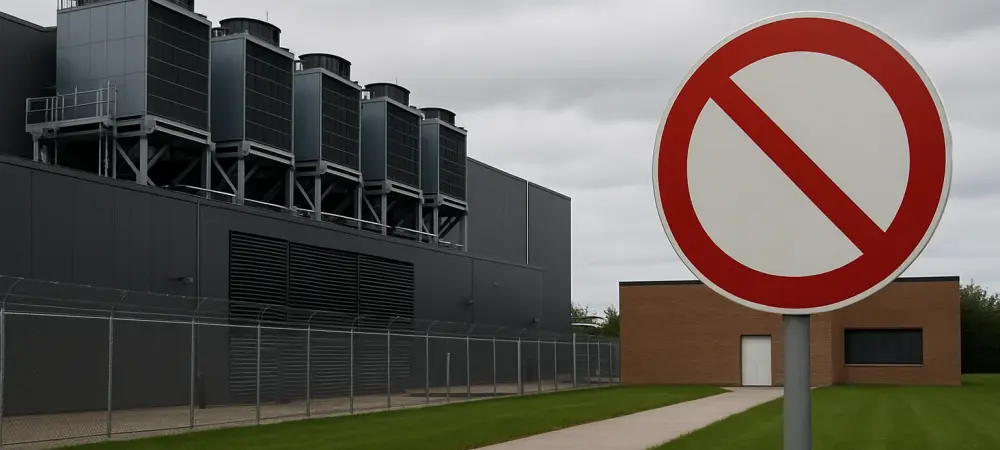
The seemingly unstoppable march of artificial intelligence is now confronting a very physical barrier as communities and now federal lawmakers question the unchecked construction of the massive data centers powering the revolution. As AI models grow exponentially more complex, their hunger for computational power and the vast infrastructure to support it has ballooned, raising a critical question: should this expansion continue without limits? The debate escalated significantly when Senator Bernie Sanders called for a nationwide moratorium on AI data center construction, transforming what was once a series of local logistical disputes into a matter of national policy. This proposal forces a broader examination of the trend, from existing local pauses to the fundamental societal questions now being asked at the federal level.
The Precedent A Growing Wave of Localized Moratoriums
An Emerging Global and Local Pattern
The proliferation of data centers, accelerated by the demands of AI, is a global phenomenon. In recent years, cities and nations have begun to push back. International hubs like Amsterdam, Singapore, and parts of Ireland have enacted moratoria, citing overwhelming strain on their power grids, scarcity of industrial land, and significant environmental footprints. These decisions are rooted in the practical realities of resource management, where the insatiable energy and land requirements of data centers clash with the needs of the local populace and national sustainability goals.
This pattern is not isolated to overseas markets. A similar trend has emerged across the United States, creating a patchwork of local pauses on new data center development. From Virginia to Arizona, local councils are responding to community pushback. Residents and officials are increasingly concerned about the immense consumption of electricity and water, the constant noise from cooling systems, and the aesthetic impact of sprawling industrial campuses. These local moratoria represent the first line of societal resistance, driven by tangible, on-the-ground impacts.
Case Studies in Infrastructure Pushback
In Loudoun County, Virginia, often called “Data Center Alley,” local officials have been forced to pause new development approvals to reassess zoning and infrastructure capacity. The sheer density of facilities began to tax the regional power grid to its limits, creating concerns about blackouts and the ability to serve residential and other commercial needs. This case highlights how even in a region economically dependent on the industry, the physical limitations of infrastructure can force a halt.
Similarly, Ireland’s utility operator instituted what was effectively a moratorium on new data center connections in the Dublin area. The decision was not driven by an opposition to technology but by a stark calculation of national energy security. Data centers were projected to consume an unsustainable portion of the country’s electricity supply, jeopardizing the grid’s stability for the entire nation. This action established a clear precedent for large-scale pauses based on pragmatic national interest.
Sanders Proposal A Fundamental Shift in Rationale
The Core Socio Economic Arguments
In contrast to these resource-based moratoriums, Senator Sanders’ proposal introduces a fundamentally different set of concerns. His primary argument centers on the threat of mass job elimination posed by advanced AI and robotics. He argues that Congress has no plan to support the millions of workers who could be displaced, questioning whether society should build the infrastructure for a technology that could hollow out the workforce without a safety net in place.
Furthermore, Sanders directly challenges the motives of the tech billionaires driving the AI boom, suggesting their primary goal is the accumulation of immense wealth and power, not necessarily the betterment of society. This critique shifts the focus from the practical consequences of data centers to the ethical and economic justice implications of AI itself, asking who benefits from this technological leap and who pays the price.
The Broader Ethical and Societal Risks
Beyond the economic arguments, the call for a national pause raises concerns about the social fabric. One such risk is the potential for “digital isolation,” a scenario where human-to-human interaction is increasingly supplanted by engagement with AI systems, from companionship chatbots to automated customer service. This raises profound questions about the future of community and human connection.
The crucial distinction of this federal proposal is its rationale. It is not about land use, water rights, or the capacity of a local power grid. Instead, it is a deliberate call to halt physical expansion to create space for democratic oversight. The goal is to initiate a national conversation on the purpose of AI, its ethical guardrails, and its role in society before its development becomes an irreversible force shaped by a small handful of corporations.
Future Outlook The National Debate on AIs Trajectory
Potential Consequences of a Federal Pause
A federally mandated moratorium on AI data centers would not come without significant challenges. Opponents argue that such a move could stifle American innovation, ceding leadership in a critical technological race to global competitors. It could also hinder economic growth tied to the tech sector and delay the development of beneficial AI applications in fields like medicine and climate science. These arguments frame the debate as a choice between caution and competitiveness.
However, proponents see immense benefits in a strategic pause. A moratorium would provide invaluable time for lawmakers to develop comprehensive regulatory frameworks for AI safety, ethics, and deployment. It would also allow the public to engage more deeply in the debate, ensuring that the technology’s trajectory is shaped by democratic values. Most importantly, it could lead to policies designed to ensure that the productivity gains from AI are broadly shared across society, rather than being concentrated at the top.
The Evolving Landscape of AI Governance
This proposal has effectively elevated the moratorium trend from a series of disconnected local infrastructure disputes into a national referendum on the future of artificial intelligence. It reframes the data center not just as a building, but as a symbol of a larger technological movement whose direction and control are now up for debate. The conversation is no longer just about where to build, but whether to build at all, pending a clearer societal consensus. This trend signals a new chapter in technology governance. Just as past industrial revolutions prompted new labor laws and environmental regulations, the AI revolution is beginning to trigger calls for proactive oversight. The focus on data centers could be just the beginning, potentially inspiring broader federal action on the development of AI models themselves, their training data, and their ultimate deployment in society.
Conclusion A Crossroads for Technology and Society
The debate over data center moratoriums represented a critical juncture. A distinction was drawn between local pauses driven by finite resources like power and land, and the proposed national moratorium grounded in the profound socio-economic and ethical questions posed by AI itself. This fundamental shift in rationale signaled a growing public and political awareness that the development of such a transformative technology could not proceed without deliberate societal guidance. The conversation moved beyond logistical constraints and became a larger inquiry into the kind of future society aimed to build with these powerful new tools. This trend underscored the necessity of a proactive national strategy, one that ensures technological advancement serves the common good rather than the narrow interests of a few, shaping a future where innovation and human values advance together.