

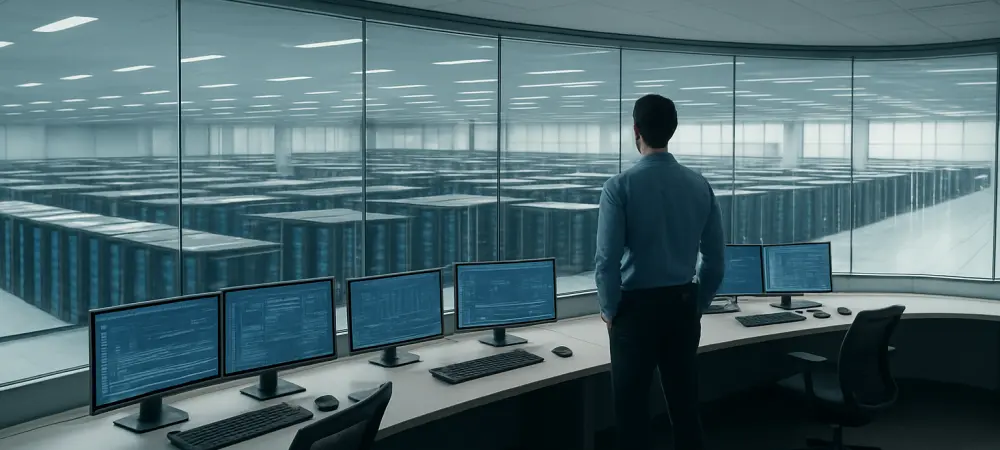
The sleek, ephemeral promise of artificial intelligence has finally collided with the uncompromising laws of physics as the industry pivots from software optimization to massive industrial engineering. In the current landscape of 2026, the digital dream is increasingly a matter of concrete, copper, and cooling. This shift marks the dawn of the “Machine Age,” where the ability to scale intelligence is no longer just an algorithmic challenge but a logistical and architectural one. As developers push for more capable reasoning agents, the infrastructure supporting these models must undergo a radical transformation to prevent a total stagnation of progress.
The Physical Foundation of the Machine Age
Market Dynamics and the Scaling Crisis
The transition from the NVIDIA #00 architecture to the Rubin series has introduced a staggering 28-fold increase in compute density, fundamentally altering how data centers are designed. This surge in density is not merely a theoretical milestone; it represents a physical reality where the space required to generate a single “token” of intelligence has shrunk, while the intensity of that space has skyrocketed. Consequently, the industry is witnessing a dramatic shift in power consumption metrics. While traditional racks once operated at 10 kW, modern high-end configurations are demanding closer to 250 kW, with reliable projections indicating a rise toward 1 MW per rack by 2029.
This escalation in power demand has forced a migration away from traditional megawatt-scale data centers toward massive, gigawatt-scale campuses. These facilities are no longer simple warehouses for servers but complex industrial hubs that often require their own dedicated energy sources. To mitigate the strain on aging public grids, many operators are turning to “behind-the-meter” captive energy solutions, such as small modular reactors or specialized solar arrays. This infrastructure crunch has fundamentally reshaped the venture capital landscape, where hardware startups, once a negligible sliver of the market, now represent over 20% of modern deal flow as investors realize that software cannot exist without a robust physical substrate.
Real-World Applications and Infrastructure Pioneers
The launch of specialized investment vehicles, such as the Andreessen Horowitz “Machine Age Fund,” signals a broader industry effort to rearchitect the AI compute stack from the ground up. This $1.1 billion initiative recognizes that the bottlenecks of 2026 are found in silicon, memory, and networking rather than just model weights. Companies like Unconventional AI are actively pursuing new chip architectures that move beyond traditional GPU constraints, while Nexthop is developing innovative networking protocols to handle the massive internal traffic generated by distributed training. These pioneers are essentially building the nervous system of the new global intelligence utility.
Addressing the energy density challenge has also given rise to a new generation of power-focused firms like Heron Power and Volta. These organizations are working to provide the high-capacity, reliable electricity required to keep gigawatt-scale campuses operational without collapsing local utility networks. Furthermore, the push for “American Dynamism” has integrated domestic manufacturing into the core of the AI strategy. Companies like Anduril and Skydio are leveraging these hardware advancements to build autonomous systems that require localized, high-performance compute. This convergence of defense, energy, and semiconductors ensures that the physical infrastructure remains resilient and domestically controlled.
Expert Perspectives on the Hardware Renaissance
Industry veterans, including former Intel CTO Guido Appenzeller, emphasize that the era of siloed development has ended, making the co-design of hardware and software a fundamental necessity. In his view, the complexity of modern workloads requires a deep understanding of how specific silicon instructions interact with high-level reasoning algorithms. Without this level of integration, the industry risks wasting immense amounts of energy on inefficient computations. This perspective suggests that the next generation of AI leadership must be as proficient in materials science and electrical engineering as they are in computer science.
Venture leaders like Ben Horowitz have identified a literal “wall” where current supply chain constraints and the laws of physics threaten to halt scaling. The industry is currently calibrated for a 30% annual growth rate, yet the “token intensity” of high-reasoning agents demands triple-digit growth to sustain progress. Overcoming this wall requires more than just capital; it demands a total reinvention of the computing platform itself. This sentiment is echoed across the hardware sector, where the consensus is that the traditional path of incremental improvements is no longer sufficient to meet the exponential appetite for intelligence output.
Future Outlook and Global Implications
As AI evolves from simple chatbots into high-reasoning agents, the demand for compute output will likely face another exponential surge. These agents do not just provide answers; they simulate scenarios, write complex code, and perform autonomous research, all of which require significantly more “thinking time” per interaction. To support this, the industry must transition toward revolutionary technologies such as optical interconnects, which replace traditional copper cabling to eliminate data bottlenecks. Advanced liquid cooling systems will also become standard, as air-based methods are increasingly unable to dissipate the heat generated by 1 MW racks. The broader economic and geopolitical implications of this shift are profound, as localized, high-capacity infrastructure becomes a primary indicator of national strength. Energy independence is no longer just a matter of fuel prices but a prerequisite for maintaining a competitive edge in artificial intelligence. While the “Machine Age” requires massive capital investment and carries significant technical risks, the rewards involve the creation of a global intelligence utility. Countries and corporations that successfully navigate these physical constraints will essentially control the most valuable resource of the 21st century: scalable, automated reasoning.
Conclusion: Building the Intelligence Utility
The shift from a software-centric world to one defined by physical infrastructure marked a turning point in the history of technology. It became clear that the pace of innovation was no longer dictated solely by the elegance of code, but by the availability of semiconductors, the stability of energy grids, and the efficiency of thermal management. The industry recognized that digital intelligence was deeply tethered to the material world, necessitating a massive reinvestment in domestic manufacturing and industrial engineering. This transition represented a move toward a more grounded form of progress, where the success of a model was inseparable from the hardware that sustained it.
The “Machine Age” ultimately redefined the relationship between digital intelligence and physical reality by turning compute into a fundamental utility. As infrastructure matured, the focus shifted toward building resilient systems that could scale indefinitely without depleting global resources. Leaders in the field successfully navigated the intersection of materials science and AI reasoning, ensuring that the infrastructure was prepared for the next leap in agentic capabilities. By treating hardware as the foundation rather than an afterthought, the industry established a new baseline for global productivity and technological sovereignty that lasted for decades.