

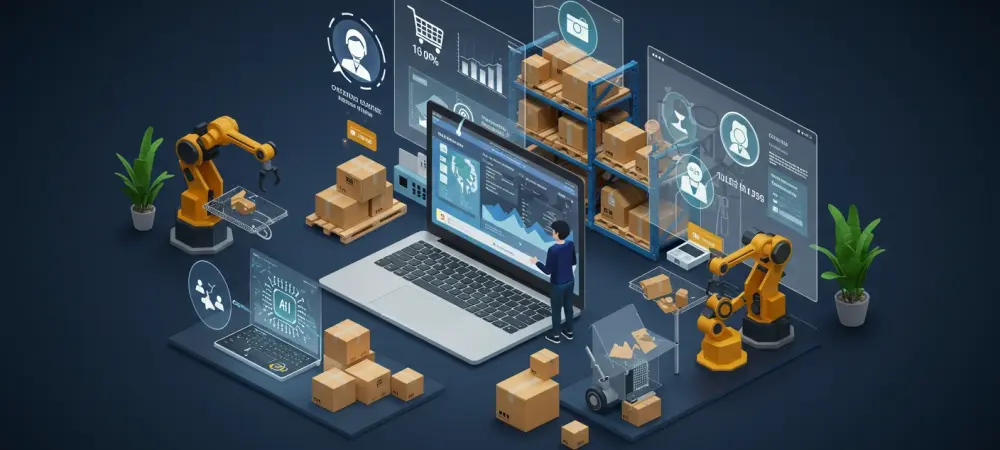
In the contemporary e-commerce landscape, artificial intelligence (AI) is not just an innovation; it is a transformative force reshaping how businesses operate, enabling remarkable feats once deemed impossible for single entrepreneurs. The advent of AI automation is revolutionizing how products are launched and managed, significantly altering the strategic dynamics of trade. As AI continues to permeate e-commerce, business founders find themselves empowered to focus more on creative pursuits rather than the traditional logistics and operations that previously demanded extensive manpower.
Current Landscape of AI Automation
Growth Trends and Statistics
The deployment of AI in e-commerce has seen substantial growth, reflecting its rising adoption in business operations. Recent statistics highlight that over half of e-commerce enterprises now incorporate AI automation into their processes, underscoring its indispensable role in modern commerce. Reports from reputable sources illustrate the progression of AI technologies, pointing toward an era where machine learning and predictive analytics drive consumer personalization, inventory management, and logistical efficiency. These advancements reflect a broader acceptance of AI as central to competitive business strategies.
Real-World Applications
One platform exemplifying AI’s transformative potential in e-commerce is Pietra, which has introduced AI Assistants to handle the demanding tasks of managing brand operations. With Pietra, single entrepreneurs can efficiently manage supplier relationships, track inventory, and execute marketing campaigns without requiring extensive human teams. Successful implementations of AI in this domain are seen in companies like Houseplant and Grip Baby, where AI automation has drastically shortened timeframes for product launches. This showcases AI’s capability to streamline processes traditionally constrained by human workforce limitations.
Expert Insights and Industry Opinions
Industry experts and thought leaders recognize both the challenges and opportunities AI presents. Specialists like Pietra’s co-founder Ronak Trivedi emphasize the operational efficiencies AI brings, allowing businesses to scale rapidly with minimal resources. Nonetheless, professionals acknowledge the hurdles such as the need for initial investment in technology and the risk of over-reliance on automation that could overlook human creativity. The consensus suggests AI has transformative potential but must be coupled with strategic human oversight to maximize the benefits it offers.
The Future of AI Automation in E-Commerce
Potential future advancements in AI suggest a landscape where automation becomes increasingly sophisticated, facilitating even greater levels of business innovation and efficiency. Experts anticipate developments such as more advanced predictive analytics and seamlessly integrated AI systems capable of autonomous decision-making. These innovations promise to further enhance strategic planning, reduce operational costs, and improve customer experiences. However, AI’s expansion also poses challenges, including ethical considerations and the need for ongoing human oversight. Projections point to a mixed future where AI becomes more entwined with daily e-commerce operations while necessitating careful management to balance autonomy and control.
Conclusion and Call to Action
AI automation in e-commerce has ushered in a new era of possibilities, transforming business operations through strategic efficiencies and innovative capabilities. The insights presented reveal the profound impact AI has had on the e-commerce arena by enabling entrepreneurs to execute complex operations with ease and precision. Looking ahead, businesses must explore ways to integrate AI effectively, understanding its multifaceted implications while securing a balance between technological automation and human-driven creativity. Stakeholders should consider incorporating AI into their strategic planning to harness its transformative power for an enduring competitive advantage.