

The conversation surrounding artificial intelligence in enterprise operations is rapidly shifting from a focus on how AI can assist human users to how it can autonomously execute core business processes on their behalf. This evolution marks a pivotal moment for dynamic industries, particularly those navigating the complexities of subscription and recurring revenue models where constant change is the norm. The purpose of this analysis is to examine the progression from assistive AI, exemplified by tools like Microsoft Copilot, toward a more sophisticated agentic AI within ERP systems like Dynamics 365 Business Central. It argues that this transformative leap cannot be achieved through a simple software update; it demands a new, structured architectural foundation to ensure its success and reliability.
The Current State and Emerging Evolution of AI in ERP
The Baseline: Microsoft Copilot as an Assistive Productivity Tool
Microsoft Copilot has become the widely adopted face of AI within Dynamics 365 Business Central, operating primarily at the user interface layer to enhance productivity. Its core functions are designed to streamline how users interact with the system, offering capabilities like accelerating report generation, assisting with routine data entry, and providing conversational summaries of complex datasets. Copilot acts as an intelligent partner, making the ERP more accessible and efficient for the end-user.
However, it is crucial to position Copilot as a foundational first step on a longer evolutionary path. While it significantly improves user productivity by simplifying tasks and providing insights, it does not fundamentally alter the underlying business processes. Copilot helps people perform their jobs better and faster within the existing operational framework, but the responsibility for executing and validating core process logic remains squarely in human hands.
The Next Frontier: Defining Agentic AI for Process Execution
In stark contrast to the assistive model of Copilot, the next frontier is agentic AI, which operates at the core process layer of the ERP. An agentic AI is not designed merely to help a user; its purpose is to proactively monitor business events, recognize critical patterns, and initiate governed, automated actions. This capability drastically reduces the latency between a business signal—such as an incoming order or a customer request—and the required operational response, moving the system from passive data storage to active execution.
This distinction becomes critically important in managing recurring revenue. Subscription-based business models are defined by constant flux: contracts are amended, services are upgraded, plans are renewed, and customers churn. An assistive AI like Copilot can help a finance team analyze the impact of these changes, but it cannot autonomously manage the intricate downstream consequences. This is where agentic AI is needed—to execute the necessary adjustments to billing schedules, revenue recognition, and forecasting in real time, based on a structured set of rules.
The Foundational Imperative for Effective Agentic AI
The Architectural Gap: Why a Governed Foundation is Non-Negotiable
For agentic AI to function responsibly and add value, it cannot be deployed onto a standard, unstructured ERP environment. In complex recurring revenue scenarios, where a single contract change can have cascading financial implications, an autonomous agent operating without clear boundaries would introduce unacceptable levels of risk. This highlights a significant architectural gap in many standard ERP implementations. To close this gap, a subscription-native architectural layer that provides the rules, governance, and structure for the entire contract lifecycle is non-negotiable. This layer serves as the “rails” on which an agentic AI can safely run. A solution like LISA Business by Bluefort exemplifies this approach by embedding a governed foundation for subscription management directly within Business Central, creating the structured environment necessary for reliable automation.
Bridging the Gap: How Structure Enables Autonomous Action
A structured foundation such as the one provided by LISA Business creates the consistent, auditable framework required for an agentic AI to act with confidence. It codifies the complex logic of subscription management—from pricing and billing to revenue recognition—into a predictable system. This structure provides the defined boundaries within which an autonomous agent can make decisions and execute tasks without ambiguity or the risk of error.
With this foundation in place, the potential of agentic AI can be fully realized. For example, an agentic AI monitoring events within the LISA Business framework can detect a customer’s mid-cycle plan upgrade. It can then automatically validate the downstream impacts of this change, trigger the correct proration workflows, and ensure that billing and revenue logic remain perfectly aligned, all without requiring manual intervention. This structure is what transforms the ERP from a passive system of record into an active, responsive operational hub that drives the business forward.
The Future Vision: A New Operating Model for Recurring Revenue
The Layered Operating Model for Scalable Growth
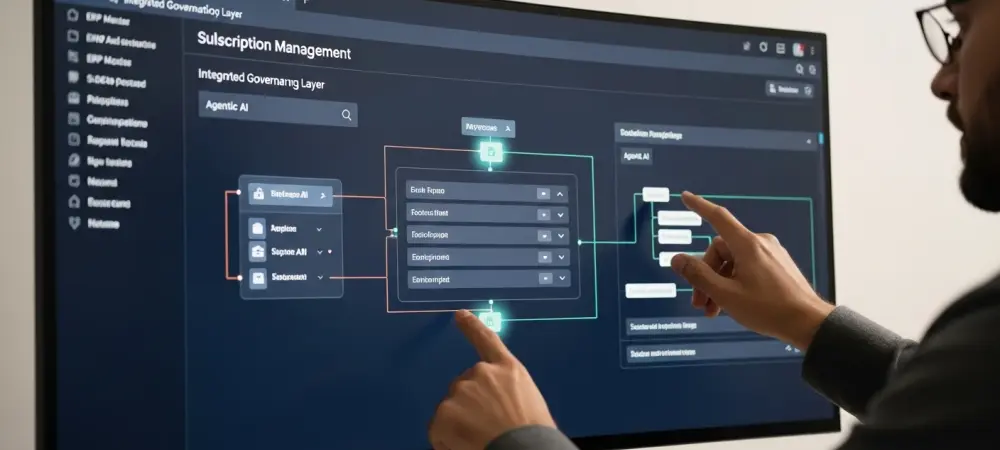
The future of modern finance operations can be conceptualized as a four-layer operating model. At the base is Dynamics 365 Business Central, serving as the core financial system of record. The second layer is a governance and logic engine like LISA Business, which provides the essential structure for subscription and recurring revenue processes. On top of this sits Microsoft Copilot, acting as the user productivity and insight layer. Finally, Agentic AI operates as the process automation and execution layer, actively monitoring events within the governed structure below.
This layered approach directly addresses the critical scalability challenges inherent in high-volume subscription businesses. As a company grows, reliance on manual oversight, alert-driven workflows, and delayed period-end reconciliations becomes a significant drag on efficiency and a source of operational risk. This model provides a clear pathway to scaling operations without a proportional increase in manual effort.
Future Impact: Shifting from Reactive Correction to Proactive Execution
The long-term benefits of this integrated model are profound. It promises significant reductions in operational risk by eliminating the error-prone manual tasks that currently dominate recurring revenue management. This, in turn, empowers human teams, freeing them from the repetitive work of reconciliation and data validation to focus on higher-value strategic initiatives like customer retention, pricing strategy, and market analysis.
However, adopting this model presents its own set of challenges, including the initial investment in the foundational architecture and the cultural shift required for an organization to trust automated, agent-driven processes. Despite these hurdles, this trend is set to redefine operational efficiency. It will allow businesses to respond to market changes and customer needs in real time, moving from a reactive posture of correcting issues at month-end to a proactive state of continuous, automated execution.
Conclusion: Preparing for an Agent-Driven Future
Summary of Key Findings
The evolution from assistive to agentic AI was not merely a technological upgrade but a maturation of the entire business operating model. It represented a fundamental shift in how organizations leverage their ERP systems. While tools like Copilot made ERPs easier for people to use, agentic AI was engineered to make business operations more intelligent and responsive. The critical finding, however, was that the latter was only possible when built upon a governed and highly structured data foundation.
A Strategic Call to Action
Organizations operating in the recurring revenue space were urged to look beyond surface-level AI tools that simply enhanced user productivity. The key to unlocking true, scalable automation lay in investing in the underlying architecture needed to support it. The strategic combination of a core ERP, a specialized governance layer for business logic, and a dual-pronged AI strategy—leveraging both assistive and agentic capabilities—proved to be the definitive path toward achieving resilient and sustainable growth in an increasingly autonomous world.