

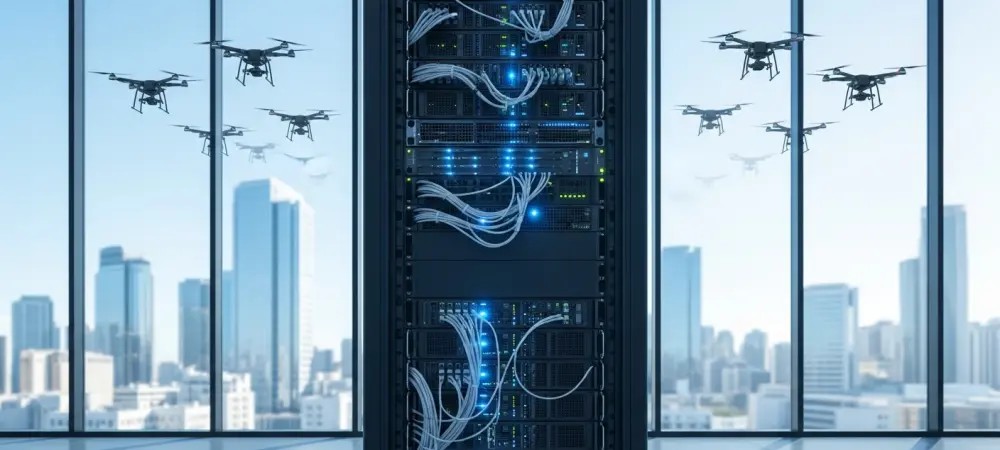
The rapid evolution of artificial intelligence has officially moved beyond the stage of simple text generation, ushering in a period where digital systems are beginning to inhabit the physical world with startling precision. For years, the industry viewed large language models as sophisticated encyclopedias, but the current landscape suggests they have become the cognitive engines for a new generation of autonomous labor. This convergence of high-level reasoning and physical actuation is not merely a technical upgrade; it is a fundamental shift in how human intent is translated into tangible results. As we witness this transition, the boundary between software instructions and mechanical movement is dissolving, creating a unified ecosystem where agents think, plan, and execute.
The Shift from Information Retrieval to Autonomous Execution
Tracking the Growth and Adoption of Agentic Systems
Current market data indicates a rapid transition from static Large Language Models to agentic workflows, with a projected inflection point in 2027 for full autonomy. This evolution represents a departure from the traditional search engine model, which relied on users to filter through results and synthesize their own conclusions. Instead, modern systems are designed to manage multi-step processes without constant human oversight. Organizations are increasingly deploying these “persistent” agents to handle duties that previously required dozens of manual interventions, effectively turning the AI from a reference tool into a digital employee.
Statistics from internal deployments, such as the “Jet Ski” platform utilized within major tech corridors, show a dramatic reduction in manual research hours and coding cycles. By allowing the AI to inhabit the development environment directly, teams are finding that the “copy-paste” friction of the past is vanishing. Adoption rates are climbing as industries move from information-seeking queries to task-completing threads, signaling a new era of persistent digital labor. This shift suggests that the primary value of AI is no longer its ability to talk, but its capacity to do, bridging the gap between a conceptual plan and a finished product.
Real-World Applications and Strategic Implementations
In the realm of software engineering, tools like Antigravity and Claude Code are closing the loop by allowing AI to write, test, and fix code autonomously. Rather than merely suggesting a snippet of syntax, these agents operate within the codebase, identifying bugs and deploying patches in real-time. This level of integration ensures that the software development lifecycle becomes a continuous stream of improvement, where human developers shift their focus from syntax to architecture and high-level strategy. The result is a massive acceleration in product cycles and a significant decrease in the cost of technical debt.
Logistics and delivery sectors are also seeing the immediate impact of this convergence, particularly as projects like Wing scale drone delivery to reach millions of households. These are not simple remote-controlled aircraft; they are agent-led robotic systems that navigate complex urban environments using the same spatial reasoning models that power high-end chatbots. Furthermore, executive use cases involve agents performing high-level sentiment analysis and product feedback synthesis. These systems can digest thousands of customer reviews and identify specific pain points, replacing traditional research teams with a streamlined, autonomous intelligence layer that operates around the clock.
Expert Perspectives on the Cognitive-Physical Synergy
Industry leaders emphasize that the missing ingredient in robotics was not the mechanical hardware, but the lack of advanced spatial reasoning now provided by Gemini-class models. For decades, robots were confined to repetitive tasks in controlled environments because they lacked the “common sense” to handle the unpredictability of the real world. Now, however, the integration of vision-language-action models allows machines to understand context, such as the difference between a glass of water and a glass of wine, or how to navigate a crowded hallway without colliding with humans.
Thought leaders highlight the importance of first-party hardware to ensure safety and regulatory compliance as agents interact with the physical world. While third-party integrations are valuable, the consensus is that a “full-stack” approach—similar to the development of autonomous vehicles or specialized AI chips—is necessary to push the limits of what a robot can do. Experts observe that while only a tiny fraction of the population currently builds personalized automations, the democratization of open-source agentic systems will soon turn every consumer into an agent manager. This shift will move AI from the cloud into the very devices we carry and the environments we inhabit.
Future Horizons: Autonomy, Risks, and Industry Implications
Self-Improving Systems and Hardware Evolution
The rise of post-training methods allows agents to optimize their own utility, potentially leading to exponential growth in machine productivity without human prompting. We are entering a phase where the AI can analyze its own performance, identify inefficiencies in its logic, and update its weights to perform better on the next task. This self-referential loop means that the gap between a “capable” system and an “expert” system is narrowing faster than previously anticipated. As these agents become more self-sufficient, the need for human intervention in the training loop will diminish, leading to a surge in autonomous machine output. This technological leap necessitates a shift in device form factors, as hardware is redesigned to support continuous, always-on agentic interactions rather than intermittent search queries. The smartphones and laptops of the past were designed for human fingers and eyes, but the next generation of hardware will likely prioritize sensors and persistent connectivity for AI agents. We might see the emergence of wearable “agent hubs” or home-based robotic assistants that do not require a screen to function, as the primary mode of interaction moves toward background execution and voice-based status updates.
Challenges and Constraints of the Convergent Era
Despite the rapid progress, the convergence faces hurdles in identity management, secure access control, and the “copy-paste” friction where humans still act as manual bridges between systems. For an agent to truly be useful, it must have the authority to act on a user’s behalf—booking flights, moving money, or accessing private medical records. This creates a massive security surface that current internet protocols are not fully equipped to handle. Establishing a secure “agent identity” is a critical requirement that must be addressed before mass adoption can occur without risking widespread data breaches.
By 2027, the distinction between digital search and physical execution will likely blur, redefining the global workforce and the concept of tools. The broader impact will be felt in the labor market, where traditional entry-level research and administrative roles may be entirely subsumed by agentic workflows. However, this also opens the door for new types of “agent orchestration” roles, where humans manage fleets of digital and physical workers. The transition will require a robust regulatory framework to ensure that as machines gain the ability to act in the world, they do so within the bounds of safety and ethical alignment.
Conclusion: Navigating the Agentic Era
The transition from reactive software to autonomous operators required a fundamental rethinking of how organizations integrate intelligence into their daily operations. Leaders recognized that simply adding a chatbot to an existing workflow was insufficient; instead, they began rebuilding processes from the ground up to support agents that could move between digital environments and physical hardware. This necessitated an investment in secure identity frameworks and a shift toward “agent-first” hardware designs that prioritized persistent sensing over intermittent user input. As the 2027 inflection point approached, the focus shifted from teaching AI how to speak to teaching it how to safely navigate the complexities of the human world.
Moving forward, the primary challenge shifted toward the management of autonomous systems and the ethical oversight of machines that improve themselves. Companies and individuals began to adopt decentralized protocols for agent verification to prevent unauthorized actions while maintaining the efficiency of automated labor. The global workforce started to prioritize high-level orchestration, focusing on setting objectives and guardrails rather than executing micro-tasks. This transformation proved that the true power of the agentic era lay not in the machines themselves, but in the new capabilities they afforded to those who learned to direct them effectively.