

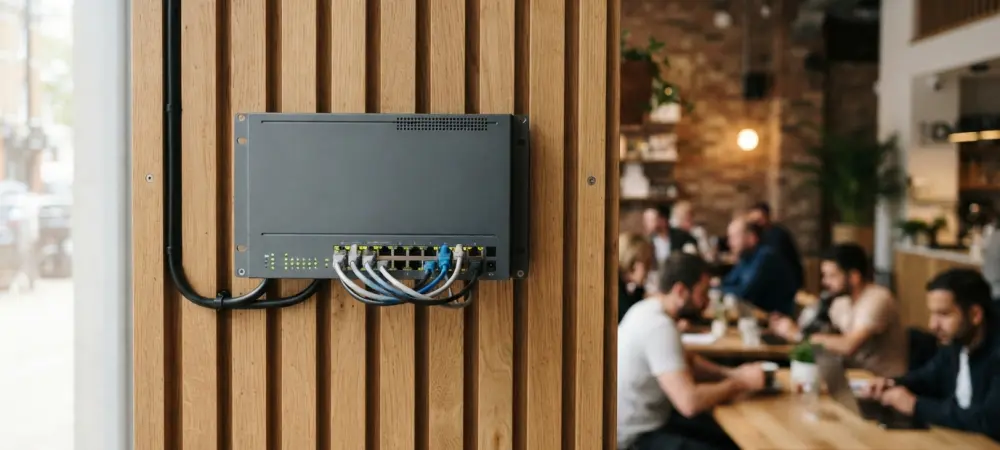
While many high-performance access points carry enterprise-level price tags, the BE5000 delivers professional management features at a cost comparable to consumer-grade electronics. This shift in the networking landscape reflects a growing demand for sophisticated connectivity solutions that do not require massive capital expenditures or recurring subscription fees. In 2026, the transition to Wi-Fi 7 has accelerated, leaving many organizations searching for a balance between cutting-edge speed and budget-friendly scalability. The introduction of the Omada BE5000 addresses this specific need by offering a high-throughput environment within a standardized enterprise framework. By targeting the mid-range market, this device provides a path for small businesses to modernize their local area networks without sacrificing corporate-grade control. This release signifies a departure from models where high-end protocols remained exclusive to premium hardware for many years after the initial debut.
Performance Metrics: Throughput and Connectivity
At the heart of this hardware is a theoretical combined throughput of approximately 5,000 Mbps, categorized under the BE5000 designation to provide a substantial leap over standard entry-level models. A significant technical achievement in this model is the integration of a 2.5GbE Ethernet port, which serves as a critical bridge between the wireless airwaves and the wired backbone. Without this multi-gigabit interface, the high-speed potential of the Wi-Fi 7 radio would be severely constrained by the legacy limitations of a standard Gigabit connection. This design choice ensures that the wired backhaul can comfortably accommodate the bursts of data generated by modern mobile devices and high-definition streaming applications. Furthermore, the inclusion of Multi-Link Operation allows compatible hardware to aggregate multiple frequency bands simultaneously. This capability results in lower latency, particularly in environments where spectral interference often degrades performance for users.
Beyond raw speed, the implementation of 4096-QAM modulation allows for a twenty percent increase in data density compared to the previous Wi-Fi 6 standard. This efficiency is further bolstered by Preamble Puncturing, a technique that allows the access point to utilize portions of a channel even if interference is present on a specific frequency slice. In practical terms, this means that in a crowded urban office or a retail space, the BE5000 maintains a stable connection where older technology would experience significant packet loss. The device is engineered to handle the high-density requirements of 2026, supporting dozens of concurrent users while managing the intricate overhead of modern security protocols like WPA3. By focusing on these technical refinements, the hardware provides a consistent user experience that mirrors the stability of a wired connection. This level of optimization ensures that professional workflows remain uninterrupted and that bandwidth is distributed fairly.
Management Features: Stability and Scalability
The logistical advantages of the Omada platform provide a compelling case for administrators who must manage multiple sites without a large IT staff. Free lifetime cloud management eliminates the ongoing financial burden of license renewals, which has traditionally been a deterrent for smaller organizations looking to move away from consumer-grade mesh systems. Through a centralized dashboard, administrators can push firmware updates, monitor real-time traffic statistics, and configure guest portals from any remote location. This level of visibility is paired with hardware longevity, as evidenced by the five-year warranty that accompanies the professional-grade Omada Pro line. Such a commitment to durability suggests that the hardware is built to withstand the rigors of continuous operation in commercial settings. By removing the need for an expensive cloud subscription, the total cost of ownership remains low, allowing businesses to reallocate their technology budgets toward other critical infrastructure needs.
Because the BE5000 functioned as a dedicated access point rather than a standalone router, IT departments successfully integrated it into existing gateway infrastructures to maximize current investments. This approach allowed for a modular upgrade cycle from 2026 to 2028, where individual nodes were replaced to meet localized demand without overhauling the entire network topology. To achieve the best results, organizations should have prioritized the deployment of these units in high-traffic zones while ensuring that the underlying switches supported Power over Ethernet Plus to simplify installation. Future considerations involved evaluating the compatibility of the client device fleet, as the full benefits of Wi-Fi 7 were realized only when paired with updated mobile hardware. Decision-makers were advised to conduct site surveys to determine optimal placement, mitigating dead zones before completing a rollout. This strategy ensured that the transition to new standards was efficient.