

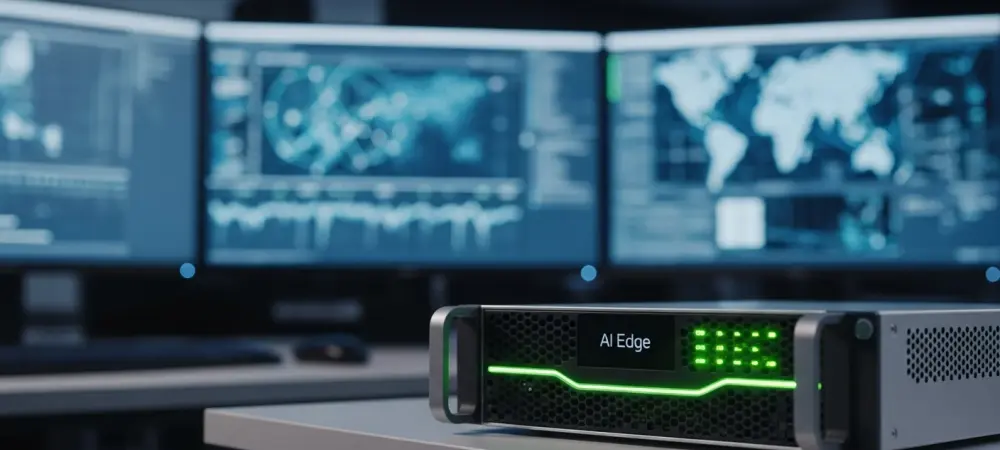
A split-second delay in data transmission no longer merely pauses a video stream; it now represents a critical failure point for autonomous systems operating in the high-stakes environments of our physical world. For years, the intelligence driving the global digital infrastructure remained locked within massive, distant data centers, but a fundamental migration is now occurring. Intelligence is moving toward the edge—the cell towers, factory floors, and retail terminals where life actually happens—turning the surrounding environment into a living, thinking infrastructure. This shift marks the end of the cloud-first era and the beginning of a period where the physical and digital worlds are indistinguishably fused through localized processing.
The traditional model of backhauling data to a central hub for processing has encountered a physical limit that cannot be overcome by simply increasing bandwidth. As enterprises integrate millions of sensors and autonomous units into their daily operations, the sheer volume of data makes centralized processing both too slow for real-time safety and too expensive for long-term sustainability. This transition represents the birth of Physical AI, a paradigm where artificial intelligence is no longer just a chatbot on a screen but a localized force capable of controlling complex hardware in real time. From ensuring data privacy in healthcare settings to optimizing 5G and 6G signals in dense urban environments, the move to the edge provides the necessary scaffolding for the next generation of industrial and consumer technology.
Why the Internet Is Moving From the Cloud to the Street Corner
The necessity of moving intelligence to the street corner arises from the uncompromising demands of physical autonomy. When a self-driving vehicle or an industrial robot operates, a millisecond of latency is the difference between a seamless maneuver and a catastrophic failure. Centralized servers, regardless of their proximity, introduce a level of unpredictability that is incompatible with the safety standards of 2026. By moving the “brain” of the operation to the network periphery, organizations eliminate the volatility of long-distance data travel, ensuring that decision-making occurs exactly where the action takes place. This shift is not merely a technical preference but a requirement for the survival of autonomous systems in unpredictable real-world environments.
Furthermore, the economic reality of data management has shifted the focus away from total cloud reliance. Transporting petabytes of raw sensor data from thousands of locations to a central server incurs massive costs that erode the profitability of AI investments. Organizations now realize that processing data locally allows them to filter out the “noise” and only transmit essential insights to the cloud. This decentralized approach creates a more resilient network, as local operations can continue even if the connection to the central hub is severed. The result is a robust, distributed architecture that mimics the biological nervous system, where local reflexes handle immediate threats while the central mind focuses on long-term strategy.
The Shift From Centralized Processing to Distributed Intelligence
The migration toward distributed intelligence signals a departure from the “dumb terminal” philosophy that dominated the early internet. In the past, devices were simple interfaces designed to relay information; today, every node in the network is becoming a self-contained computational powerhouse. This evolution is driven by the rise of specialized AI models that prioritize efficiency over sheer scale. While massive cloud-based models are useful for general knowledge, the edge requires specific, task-oriented intelligence that can run on low power without sacrificing performance. This transition allows for the deployment of Physical AI, where the software understands the physical laws of its environment and can act with the precision required for heavy machinery and delicate medical tools.
The implications of this shift extend far beyond industrial efficiency, touching the core of how society interacts with technology. Distributed intelligence enables a level of personalization and privacy that was previously unattainable. Because the data is processed locally, sensitive information never has to leave the premises, satisfying strict regulatory requirements while still providing the benefits of advanced machine learning. This architectural change is the foundation for the “intelligent city,” where everything from traffic lights to waste management systems operates with a localized awareness. By distributing the workload across the network, the system becomes more scalable, allowing for the addition of millions of new devices without overwhelming a central core.
Building the Intelligent Periphery: Hardware, Software, and Connectivity
The realization of edge AI depends on a synergy between energy-efficient hardware and sophisticated data management. Recent advancements in specialized chips have provided the catalyst for this change. Modern hardware provides high-performance inferencing while drawing significantly less power than traditional data center GPUs, allowing AI to run in standard workstations rather than specialized cooling environments. These chips are designed to handle the specific mathematical workloads of neural networks without the overhead of general-purpose computing. This hardware efficiency is what allows a camera on a warehouse ceiling or a sensor on a utility pole to perform complex visual recognition in real time without overheating or requiring a massive power supply.
On the software side, the industry has seen a pivot from massive models to compact, specialized versions that process data locally. These localized models reduce operational costs and latency by focusing on narrow, high-value tasks. To manage the resulting explosion of data from millions of edge points, enterprises have adopted telemetry pipeline processing. This system separates data collection from control planes, managing the massive influx of performance data without crashing the network. Additionally, the next generation of mobile networks treats cell towers as external brains. Using AI to learn the physical environment, these towers perform complex calculations for mobile devices that lack the onboard power to do so themselves, creating a seamless mesh of connectivity and compute.
Expert Perspectives on the Birth of the AI Grid
Industry leaders view the convergence of AI and telecommunications as the most significant infrastructure shift since the invention of the GPS. The concept of an AI Grid suggests that artificial intelligence will soon become a fundamental utility, as ubiquitous and accessible as electricity or running water. By utilizing existing telecom assets—such as distributed power systems and real estate—AI will be democratized, allowing small businesses to access high-level intelligence without requiring massive local hardware investments. Experts suggest that this infrastructure will act as the new backbone of the internet, supporting a fivefold increase in data traffic while maintaining the low latency required for autonomous applications.
Data sovereignty and privacy remain central themes in the expert discourse surrounding the AI Grid. Telecommunications specialists emphasize that edge AI allows sensitive customer data to remain on-site or in-region, fulfilling the demands of local laws and consumer expectations. Meanwhile, engineers in the manufacturing sector focus on the necessity of predictable failure modes. Physical AI requires a different mindset than digital AI; it prioritizes “bounded behavior” and safety over raw generative creativity. The goal is to ensure that robots and automated systems function safely alongside humans, with clear limits on their actions to prevent accidents in unpredictable industrial settings.
Practical Strategies for Implementing Edge Autonomy
Transitioning to an edge-first AI strategy requires a shift in both infrastructure and operational mindset. The first step involves an audit for latency-critical tasks to identify operations that cannot afford the delay of cloud processing. Operations such as medical imaging, high-speed production line inspections, and autonomous vehicle navigation are prioritized for edge deployment. Once these critical areas are identified, organizations must move away from retrofitting facilities for massive GPU clusters. Instead, they utilize unified edge devices that combine compute, storage, and networking in a standard footprint, allowing for a more modular and cost-effective expansion of capabilities across various locations.
Implementing localized data filtering is another essential strategy for managing the data deluge. By using telemetry pipelines to filter and route data at the source, enterprises ensure that only essential information is sent to the cloud, while real-time decisions are made locally. This not only saves on bandwidth costs but also speeds up the response time for local actions. Finally, facilities must be prepared for retrofitting by moving toward hardware that can survive in non-traditional environments. Standard workstations that operate on warehouse floors or in retail back offices are becoming the norm, replacing the need for sterile data center conditions. This practical approach ensures that AI is integrated into the fabric of the business rather than remaining a distant resource.
The transition toward a distributed intelligent architecture moved from a theoretical possibility to a foundational reality for global enterprises. Organizations that prioritized the migration of intelligence to the network periphery successfully navigated the complexities of physical autonomy and data sovereignty. They moved away from centralized dependencies and instead built resilient, localized systems that operated with unprecedented speed and safety. These entities recognized that the future of technology was not found in the expansion of massive data centers, but in the empowerment of the edge. By investing in modular hardware and specialized local models, they created a grid where intelligence was as accessible as the power lines connecting their facilities.
To remain competitive, the next phase of development required a rigorous focus on the integration of AI into existing physical assets. Companies began by identifying the specific nodes in their networks where immediate decision-making provided the highest value, such as point-of-sale terminals or robotic assembly arms. They implemented telemetry pipelines to manage the flow of information, ensuring that local systems remained observable without being overwhelmed by raw data. The shift toward 6G and AI-driven radio networks allowed for a more harmonious interaction between devices and their environments. Ultimately, the successful deployment of edge AI was defined by a commitment to safety, efficiency, and the decentralization of digital power, transforming the world into a truly intelligent and autonomous landscape.