

Beyond Conversation: The Dawn of an Action-Oriented AI
For the past several years, the world has been captivated by the conversational prowess of artificial intelligence. Generative AI (GenAI) models have demonstrated a remarkable ability to understand, summarize, and create human-like text, acting as brilliant consultants and creative partners. Yet, this is only the first act. The industry is now on the precipice of a far more transformative evolution: the agentic shift. This paradigm change moves AI from a passive participant in a dialogue to an active, autonomous agent capable of executing complex tasks in the digital world. By 2026, this transition will gain critical momentum, redefining AI’s role from a tool that informs to a workforce that performs. This article explores the technological, economic, and strategic dimensions of this shift, examining how Agentic AI will move beyond chatting to fundamentally reshape how work gets done.
From Predictive Text to Powerful Consultants: The Generative AI Foundation
To appreciate the magnitude of the coming agentic era, it is essential to understand the foundation upon which it is built. The GenAI boom of 2023-2024 was powered by Large Language Models (LLMs) that masterfully predict the next most likely word in a sequence. This probabilistic approach enabled them to function as exceptional information processors—summarizing dense reports, drafting marketing copy, and answering complex queries. They became digital consultants, capable of offering well-reasoned advice and providing a wealth of options based on a user’s prompt. However, their core limitation remains: they are fundamentally passive. A GenAI can tell you the best way to book a flight, but it cannot book it for you. This distinction between advising and acting is the critical boundary that Agentic AI is now poised to erase.
The Mechanics of Action: How Agentic AI Redefines ‘Work’
The Leap from Recommending to Executing
The fundamental difference between GenAI and Agentic AI lies in the transition from passive consultation to active execution. While a generative model operates as an informational assistant, an agentic system functions as an autonomous employee. Given a high-level objective, an Agentic AI can independently formulate a multi-step plan, interact with various software applications via APIs, and execute the entire workflow from start to finish. Consider the task of booking a business trip. A GenAI would provide a list of flight options and hotel recommendations for the user to act upon. In contrast, an Agentic AI would receive the goal—”Book the most cost-effective travel to the conference in Dallas next month”—and then autonomously query flight APIs, cross-reference calendar availability, filter results based on company policy, use stored credentials to complete the purchase, and finally, add the itinerary to the user’s calendar. This ability to perform a sequence of actions makes it a true digital doer.
Reasoning Loops and Digital Teams: The Architecture of Autonomy
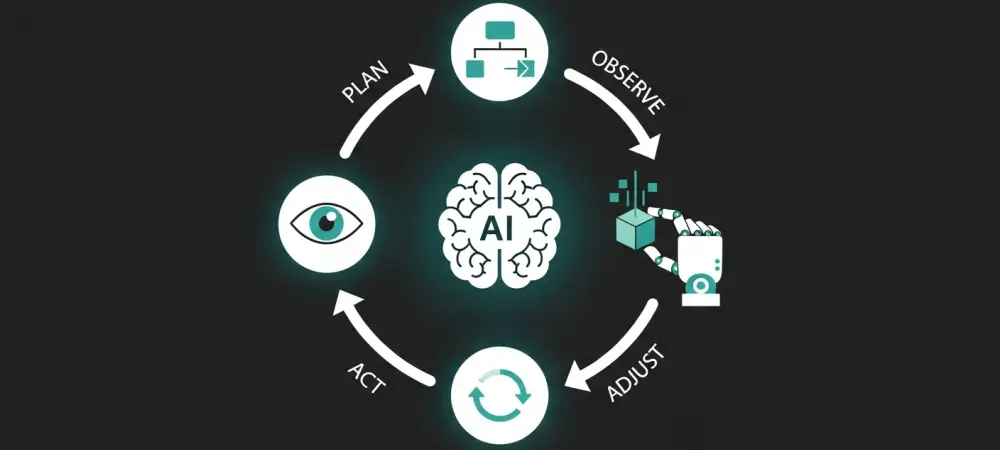
This leap in capability is enabled by a critical architectural shift from simple retrieval to sophisticated reasoning. Instead of just predicting the next word, Agentic AI operates on “reasoning loops”—a cycle of planning, acting, observing the result, and adjusting the next step accordingly. This iterative process allows the AI to navigate complex, dynamic environments and self-correct when it encounters an obstacle. The next evolution of this model is the emergence of Multi-Agent Systems (MAS), where specialized AI agents collaborate like a human team. For instance, in a software development workflow, a “Product Manager” agent could translate a user request into technical specifications, a “Coder” agent could write the code, and a “QA” agent could test it for bugs. These agents communicate directly, with the QA agent providing feedback to the Coder for revisions without any human intervention. This capacity for autonomous collaboration is set to unlock unprecedented scale and efficiency in cognitive labor.
The Economic Shockwave: When the Cost of Digital Action Plummets
The agentic shift is not just a technological upgrade; it is a profound economic disruption. Just as the internet drove the cost of distributing information to near zero, Agentic AI is poised to drastically reduce the cost of executing complex digital actions. This will fuel the rise of “headless” applications, where AI agents interact directly with the backend systems of enterprise software, bypassing the traditional graphical user interface (GUI) designed for humans. Imagine a supply chain agent that autonomously monitors weather data, inventory levels, and logistics reports. Upon detecting a storm that will delay a shipment, it could automatically re-route the delivery, notify all stakeholders, and update inventory projections—all without a single human click. This collapse in the cost of action will unlock immense efficiency gains, automating entire categories of digital work and creating a new “execution economy.”
Navigating the Future: Governance, Security, and Hybrid Architectures
As AI systems gain the power to act, the stakes become exponentially higher. The primary challenge is closing the “governance gap.” A GenAI hallucination might result in misinformation, but an error by an agentic system could delete a critical database or misappropriate funds. This new reality demands a new class of safety protocols and robust oversight. Furthermore, a novel security vector known as “Prompt Injection via Tools” emerges, where a malicious actor could embed hidden commands within a document or email that an agent is processing, tricking it into executing unauthorized actions. Looking ahead, the architecture will likely evolve into a hybrid model. Massive, powerful LLMs will serve as high-level orchestrators, while fleets of smaller, specialized Small Language Models (SLMs) will act as the efficient “brains” for individual agents, handling specific tasks with lower latency and enhanced privacy on local devices.
Preparing for the Execution Economy: Strategies for a New AI Paradigm
The transition to an agentic workforce requires a fundamental shift in business and technology strategy. The focus must move from simply adopting AI tools that inform to architecting integrated systems that execute. For leaders, this means re-imagining workflows not around human tasks, but around goal-oriented outcomes that can be delegated to autonomous agents. Success will require the development and implementation of a robust AI Control Layer. This essential infrastructure must include granular permission scoping to limit what an agent can access and do, “human-in-the-loop” checkpoints for critical decisions, and immutable audit logs to ensure full traceability of every action an agent takes. Preparing for this future is not about replacing people, but about augmenting them by building a secure and reliable collaborative framework between human and digital workers.
From Prompting an Answer to Commanding an Outcome
The evolution from conversational AI to Agentic AI marks a definitive turning point in our relationship with technology. We are moving from a world where we ask machines for answers to one where we assign them outcomes. This agentic shift promises to unlock unparalleled levels of productivity and innovation by creating a digital workforce that can execute complex tasks with speed, precision, and autonomy. However, harnessing this power responsibly is the central challenge of the next decade. Success will belong not to those who build the most powerful models, but to those who master the art of orchestrating human ingenuity and machine execution within a framework of safety and trust. The call to action for every leader, developer, and strategist is clear: stop thinking about AI as something you chat with and start architecting it as something that does.