

The global appetite for computational power has reached a point where the electricity consumed by the world’s data centers now rivals the total energy output of many medium-sized nations. As artificial intelligence models expand in complexity and edge computing pushes processing power to the very fringes of our networks, the traditional “brick and mortar” approach to IT infrastructure has become fundamentally unsustainable. This review examines the paradigm shift toward eco-efficient data center design, exploring how the industry is moving beyond simple power monitoring toward a holistic, circular economy of digital resources that integrates every device from the core server rack to the smartphone in a user’s pocket.
Evolution and Fundamentals of Green Data Centers
The transition toward green data centers was initially born out of fiscal necessity rather than environmental altruism. In the early stages of digital expansion, cooling costs often exceeded the cost of powering the actual servers, forcing engineers to rethink the basic physics of the data hall. This evolution has led to a fundamental change in how we perceive digital infrastructure, shifting from a model of “brute force” cooling and redundant power to a sophisticated, software-defined ecosystem where energy efficiency is baked into the silicon and the architecture itself. Today, the core principles of sustainable infrastructure center on high-density optimization and resource transparency. Modern facilities are no longer isolated silos; they are integrated components of the regional power grid. The context of this evolution is heavily influenced by the rise of generative AI, which requires exponentially more power per rack than traditional web hosting. Consequently, the technology has pivoted toward modularity and high-thermal-capacity designs that allow operators to scale their environmental footprint in lockstep with their computational needs, ensuring that sustainability is a persistent operational state rather than a one-time certification.
Core Components of Eco-Efficient Infrastructure
Precision Cooling and Thermal Management
At the heart of the modern sustainable data center lies a rejection of traditional air-conditioning in favor of precision cooling. While legacy systems wasted enormous amounts of energy by cooling entire rooms to sub-arctic temperatures, contemporary infrastructure utilizes rear-door heat exchangers and direct-to-chip liquid cooling. This method leverages the superior thermal conductivity of liquids—often non-conductive dielectrics or treated water—to remove heat directly from the source. By doing so, operators can maintain much higher rack densities, reaching upwards of 100 kilowatts per cabinet, without the massive energy overhead of traditional fans and chillers.
The performance of these systems is measured not just by temperature control, but by the ability to repurpose waste heat. In advanced urban implementations, the thermal energy captured by liquid cooling systems is redirected into local district heating networks, warming homes and offices. This creates a symbiotic relationship between the data center and its community, effectively turning a formerly wasted byproduct into a valuable commodity. This shift is significant because it moves the industry toward a “heat-neutral” operation, where the energy used for computing provides a secondary life-cycle benefit to society.
Advanced Power Distribution and Energy Storage
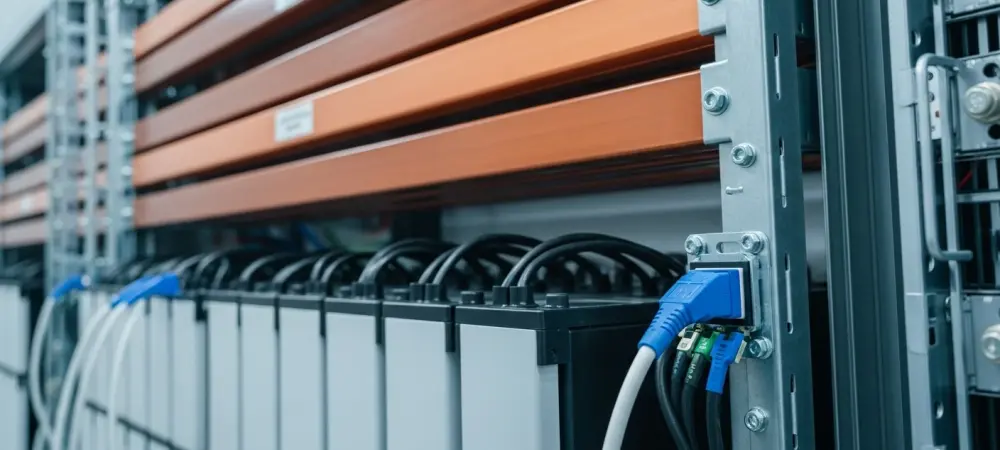
Power distribution has undergone a similar transformation, moving away from inefficient alternating current (AC) double-conversions toward high-voltage direct current (DC) architectures. By reducing the number of times electricity must be converted between the utility entrance and the server power supply, facilities can eliminate five to seven percent of total energy loss. Moreover, the integration of lithium-ion and zinc-based energy storage systems has replaced the carbon-heavy lead-acid batteries and diesel generators of the past. These modern storage solutions act as “grid balancers,” allowing data centers to store renewable energy during periods of low demand and feed it back into the facility or the grid during peak times.
The real-world usage of these technologies has enabled the rise of “carbon-intelligent” computing. In this model, the infrastructure dynamically shifts non-critical workloads to times of day when wind or solar energy is most abundant. This level of technical sophistication means the data center is no longer a passive consumer of power but an active, flexible participant in the energy market. By utilizing smart microgrids, facilities can maintain 99.999% uptime while significantly reducing their reliance on fossil fuels, proving that reliability and environmental stewardship are not mutually exclusive.
Emerging Trends in Sustainable Computing
Current shifts in industry behavior are increasingly focused on the “embodied carbon” of hardware—the emissions generated during the manufacturing and disposal of servers. This has led to a burgeoning trend of circularity, where hardware is designed for disassembly and components are refurbished rather than shredded. Furthermore, we are seeing the rise of “software-defined power,” where AI-driven algorithms predict thermal spikes before they occur, adjusting cooling levels in real-time with millisecond precision. This proactive approach eliminates the “safety margin” of over-cooling that traditionally wasted vast sums of electricity.
Another significant innovation is the move toward “waterless” cooling in regions prone to drought. As public scrutiny over the environmental impact of data centers increases, engineers are developing closed-loop systems and atmospheric water generators to decouple digital growth from local water scarcity. These trends suggest a future where the site selection for a data center is governed as much by its ability to integrate with local ecology as by its proximity to fiber-optic trunk lines.
Real-World Implementations Across Diverse Sectors
The deployment of sustainable infrastructure is manifesting uniquely across different industries. In the financial sector, where low latency is paramount, firms are deploying “green edge” nodes in urban centers. These small-footprint facilities utilize advanced immersion cooling to fit high-performance trading engines into compact, energy-efficient modules that require no external water or massive HVAC units. This allows banks to maintain high-speed operations while meeting increasingly stringent ESG (Environmental, Social, and Governance) reporting requirements.
In the public sector, several municipalities are now mandating that any new data center construction must include a plan for heat recovery. For example, some European tech hubs have successfully integrated data centers into the basement levels of residential complexes, using the server heat to provide hot water for hundreds of apartments. These use cases demonstrate that sustainable infrastructure is not a one-size-fits-all solution but a versatile toolkit that can be adapted to the specific geographic and social needs of a region.
Technical Barriers and Regulatory Challenges
Despite rapid progress, the road to total sustainability is hampered by significant technical hurdles, primarily the intermittent nature of renewable energy. While solar and wind are cleaner, they lack the “baseload” stability required for mission-critical operations, forcing many facilities to remain tethered to the traditional grid or rely on backup systems that are not yet fully carbon-neutral. Additionally, the sheer weight and complexity of liquid cooling systems present structural challenges for existing buildings, often making the retrofitting of older data centers prohibitively expensive.
Regulatory landscapes are also becoming more complex. New laws in several jurisdictions now require granular reporting on “Scope 3” emissions, which include the carbon footprint of the entire supply chain. For many operators, tracking the sustainability of every component from a global array of vendors is a logistical nightmare. These market obstacles are currently being met with a push for industry-wide standardization, but the lack of a universal metric beyond PUE (Power Usage Effectiveness) makes it difficult for consumers to compare the true environmental impact of different providers.
Future Outlook and Technological Breakthroughs
The next frontier for sustainable infrastructure lies in the development of “net-positive” data centers. These facilities will go beyond minimizing harm to actually improving their surrounding environment, perhaps through large-scale carbon capture systems integrated into their cooling towers or by acting as primary nodes for local renewable energy distribution. We are also on the cusp of breakthroughs in photonics and optical computing, which could eventually replace electricity with light for data transit, potentially reducing energy consumption by orders of magnitude.
In the long term, the impact of these technologies will likely redefine the relationship between humanity and the digital world. As the infrastructure becomes more efficient and less intrusive, we can expect a more ubiquitous distribution of computing power. This “invisible” infrastructure will support the next generation of augmented reality and autonomous systems without the heavy environmental tax that current technologies demand, essentially making digital life a sustainable part of the natural world.
Final Assessment and Strategic Impact
The transition to sustainable data center infrastructure has proved to be one of the most significant architectural shifts in the history of information technology. This review found that the integration of liquid cooling, DC power distribution, and circular hardware management has successfully decoupled the rapid growth of data processing from a proportional increase in environmental damage. While the challenges of renewable energy storage and regulatory compliance remain significant, the industry’s shift toward a holistic view of the “unified data center”—stretching from the cloud to the edge—has set a new benchmark for corporate responsibility.
Ultimately, the strategic impact of this technology goes far beyond reducing utility bills or checking a box on a sustainability report. It has created a more resilient, flexible, and socially integrated digital backbone that is capable of supporting the massive computational demands of the future. The verdict is clear: organizations that fail to adopt these eco-efficient principles will not only find themselves on the wrong side of environmental history but will also struggle to compete in an era where energy efficiency and operational survival are one and the same. Moving forward, the focus must remain on perfecting energy-independent facilities and ensuring that the digital revolution does not come at the expense of the planet’s physical health.