

Dominic Jainy has spent the better part of a decade navigating the complex intersections of high-performance computing and environmental responsibility. As an expert in machine learning and blockchain, he has witnessed firsthand the transition of generative AI from an “ethereal” innovation into a massive physical enterprise that consumes megawatts of power and cubic meters of water. In this discussion, we explore the core themes of the 2026 sustainability landscape, ranging from the death of traditional air cooling to the move toward location-based carbon accounting. We also delve into the concept of circular IT as a strategic hedge and how efficiency-per-token is becoming the ultimate competitive differentiator for modern organizations looking to survive a high-stakes auditing era.
How has the perception of artificial intelligence shifted from an abstract digital tool to a physical infrastructure challenge that demands immense natural resources?
For a long time, the corporate world viewed generative AI as a weightless innovation, almost like a ghost in the machine that lived in a vague cloud “somewhere else.” However, the arrival of May 2026 has forced us to confront a much grittier physical reality where the cost of intelligence is measured in massive energy draws and the intensive use of water to keep hardware from failing. We can no longer treat energy as a simple commodity to be offset at the end of the year; instead, we have to architect our infrastructure to treat power as a finite, high-precision resource. The bill for our digital progress is now written in the heat of high-density chips, and boards are starting to demand that we defend the physical existence of our AI roadmaps. This shift from voluntary aspirations to high-stakes auditing means that every megawatt must be accounted for with absolute transparency and technical rigor.
In a market driven by the constant need for the latest hardware, how can organizations balance the pursuit of cutting-edge AI performance with the environmental debt of premature equipment replacement?
The AI gold rush has tempted many to follow a “rip and replace” narrative, but binning functional hardware for the sake of the newest silicon creates a massive “embodied carbon” spike that most dashboards conveniently ignore. We have to realize that for these AI-heavy setups, manufacturing emissions can represent up to half of a datacentre’s total lifetime footprint. By adopting a “blended stack” strategy, we can reserve the liquid-cooled clusters for heavy training while letting legacy servers handle traditional business logic. Extending a server’s lifespan from three years to five, or even eight, is the most effective way to flatten the carbon curve and show that we value resourcefulness over just chasing the next shiny object. It is a pragmatic path that avoids the heavy carbon investment made back when that original silicon was forged in the factory.
With the arrival of stricter reporting standards like the UK Sustainability Reporting Standards, how is the traditional “shell game” of carbon credits being dismantled in favor of real-time accountability?
We are finally seeing the end of the market-based accounting shell game where companies used Renewable Energy Credits to claim neutrality while running coal-powered facilities a continent away. With the formal publication of the UK Sustainability Reporting Standards, the era of annual averages has evaporated, replaced by a demand for 24/7 Carbon-Free Energy scores. This forces us to move toward a location-based reality where auditors want to see an hourly match of energy draw with local, clean supply. For a forward-thinking CIO, this is an architectural opportunity to design “carbon-aware” workloads that shift non-urgent tasks to regions where the grid is currently at its greenest. By doing this, we ensure our AI agents don’t become a “Scope 3” liability for our customers, turning infrastructure into a dynamic compliance asset.
Why is the industry moving away from traditional air cooling, and what does the shift to liquid-cooled systems mean for operational resilience in high-density environments?
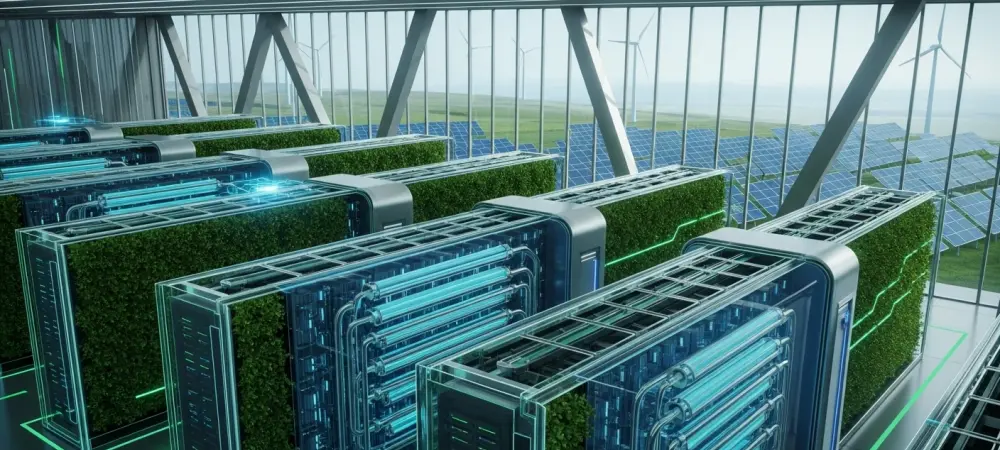
Attempting to cool a rack pulling 60kW to 100kW with traditional fans is essentially like trying to cool a blast furnace with a desk fan—it is loud, ineffective, and environmentally disastrous. The January 2026 update to ISO/IEC 30134-2 standards has effectively killed air cooling as a viable benchmark, moving us toward direct-to-chip or immersion cooling as the only defensive option. While a Power Usage Effectiveness of 1.5 was once the industry gold standard, it is now seen as a sign of legacy drag, with achievable targets now hovering around 1.1. Moving to liquid cooling isn’t just about the environment; it prevents the thermal throttling that quietly degrades AI performance during periods of intense grid stress. A 40% reduction in cooling power acts as a significant hedge against operational cost spikes in an increasingly volatile and expensive energy market.
Beyond meeting regulatory requirements, how does a focus on efficiency-per-token serve as a strategic advantage for companies looking to win over eco-conscious partners?
In today’s market, every organization is “doing AI,” so the real differentiator isn’t just the model itself, but rather the efficiency-per-token at which you can run it. As mandatory reporting begins to bite across the entire supply chain, your customers are actively seeking partners who won’t bloat their own environmental reports with unnecessary emissions. If you can prove that your infrastructure is lean, liquid-cooled, and location-aware, you stop being just another vendor and become a “low-carbon asset” in their technical stack. You essentially remove the environmental friction from their own digital transformations, making your services far more attractive than a competitor with a massive, unmanaged carbon footprint. It is a management choice to move away from the performance art of global offsets and toward the gritty reality of local grid data and hardware longevity.
What is your forecast for IT sustainability?
The industry is heading toward a period of radical transparency where “greenwashing” through distant offsets will be impossible to sustain. I predict that by the end of the decade, the most successful organizations will be those that have integrated thermal management and grid-aware computing directly into their software development lifecycles. We will see a shift where “compute-per-watt” becomes as vital a metric as “return on investment,” and the physical constraints of the local environment will dictate where and when we process our most complex models. Ultimately, the winners will be those who view sustainability not as a compliance hurdle, but as a core architectural principle that provides a permanent hedge against rising energy costs and regulatory scrutiny. Success will belong to those who stop marking their own homework and start building infrastructure that can truly stand up to the light of day.