

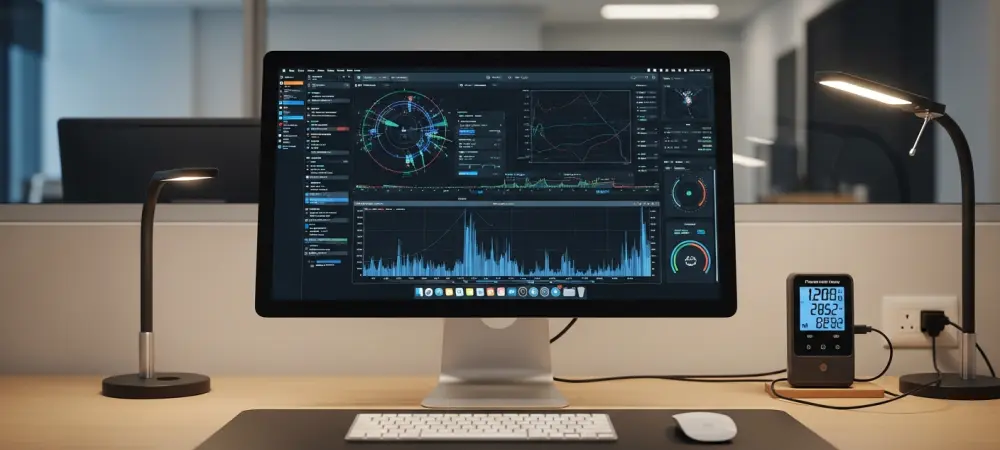
The perception that running advanced artificial intelligence models on consumer-grade hardware is effectively free once the initial purchase is made has been challenged by recent data regarding energy consumption on Apple Silicon devices. While users certainly bypass the per-token subscription fees or API costs associated with commercial cloud providers, every inference request triggers a measurable draw of electricity from the wall outlet. A comprehensive investigation conducted on high-end hardware, specifically the M3 Ultra Mac Studio, has provided a granular look at whether these energy costs are significant enough to alter the economic calculus of local AI hosting. The findings suggest that while the cost per token is remarkably low, the relationship between model size, architecture, and power consumption is far more complex than many enthusiasts initially assumed. By examining the marginal energy required to generate a million tokens, this research provides a roadmap for users seeking to optimize their local setups for both performance and fiscal efficiency.
Measuring Energy and Efficiency
The Methodology: Tracking Marginal Power Usage
To arrive at a precise understanding of what it costs to run a large language model, researchers had to look far beyond simple battery monitoring or standard system utility reports. The study utilized a specialized tool known as TokenWatt, which functions as a high-precision proxy to monitor energy consumption directly at the chip level. This software taps into the internal power counters of the Apple Silicon architecture, allowing for a real-time view of how the system on a chip (SoC) distributes energy between the central processing unit, the graphics processing unit, and the neural engine during active inference tasks. By isolating these specific metrics, the researchers were able to quantify the exact energy spike associated with token generation, providing a level of detail that general-purpose power meters often fail to capture due to their broader sampling intervals and lack of architectural integration.
One of the most critical aspects of this methodology involved the rigorous isolation of what is known as “vampire power,” which represents the baseline electricity a Mac Studio consumes simply by being powered on and idling. To determine the true cost of an inference task, it was necessary to subtract this idle energy draw from the total power consumed during the model’s operation. This focus on marginal energy ensures that the resulting data reflects only the work being performed by the large language model rather than the overhead of the operating system or peripheral components. Furthermore, the software-based readings from TokenWatt were calibrated against physical smart plugs at the wall outlet to ensure absolute accuracy. This double-check process corrected for any potential internal sensor drift and confirmed that the software measurements remained reliable within a very tight margin of error, establishing a solid foundation for comparing various model architectures.
Data Validation: Software and Hardware Calibration
The process of ensuring data integrity required running models in sustained loops, which allowed the hardware to reach a thermal and electrical steady state. This approach prevented misleading results that might occur during short bursts of activity where power management algorithms are still ramping up. By maintaining a continuous workload across different model sizes, the study established a best-case scenario for throughput and energy consumption. The researchers found that the energy used during the “prefill” phase—where the model processes the initial prompt—differed significantly from the energy used during the “decode” phase, where the model generates new text one token at a time.
Software-level reporting can sometimes be overly optimistic or ignore the efficiency losses inherent in power delivery systems, which is why the physical smart plug comparison was so vital. By measuring the power draw at the wall, the researchers could account for the efficiency of the Mac Studio’s internal power supply unit. This holistic view confirmed that while Apple Silicon is incredibly efficient, there is a tangible difference between the energy reported by the chip and the energy actually billed by a utility company. This calibration phase proved that software tools, when properly tuned, provide an excellent proxy for real-world costs, enabling developers and hobbyists to make informed decisions about their local AI infrastructure without needing professional-grade lab equipment.
Architecture and Operating Costs
Architectural Divergence: Dense Models Versus Mixture-of-Experts
The investigation highlighted a stark contrast in performance and efficiency between traditional “dense” models and the increasingly popular “Mixture-of-Experts” (MoE) architectures. In a dense model, such as the 27-billion parameter Gemma 2, every single parameter within the network is activated for every single word the model generates. This creates a massive burden on the system’s memory bandwidth, as the hardware must move an enormous amount of data from the RAM to the processor for every token. Because the energy cost of moving data often exceeds the energy cost of the actual computation, these dense models tend to have a much higher power draw relative to their output speed. This architectural bottleneck results in a higher cost per token, making dense models some of the most expensive options to run on a per-inference basis despite their relatively modest parameter counts.
In contrast, the study found that MoE models, like those with 120 billion parameters, operate on an entirely different economic principle. Although these models are physically larger and require more system memory to load, they only activate a small fraction of their total parameters—often just two “experts” out of many—for any given task. This sparse activation means the hardware only needs to move a small amount of data to the processor to generate a response. Consequently, the machine can operate at much higher speeds while drawing less power over the duration of the task. The data revealed a counterintuitive reality: a massive 120-billion parameter MoE model can actually be significantly cheaper to operate than a dense model that is less than a quarter of its size. This discovery shifts the primary concern of local AI hosting away from simple parameter counts and toward the underlying structural efficiency of the model being used.
Economic Impact: Throughput and Efficiency Gains
The data provided by the TokenWatt tool demonstrated that the primary driver of energy cost is not the peak power draw, but rather the total time the system remains in an active state. Because MoE models achieve much higher throughput—measured in tokens per second—they finish their assigned tasks and return the system to an idle state much faster than their dense counterparts. A dense 27-billion parameter model might be nearly five times more expensive to operate than a more capable 120-billion parameter MoE model simply because it takes so much longer to produce the same amount of text. This efficiency makes modern expert-based architectures the clear winner for users who are concerned about the long-term operational overhead of their local AI workstations. The faster the model can complete its work, the less electricity it consumes, regardless of how much power it draws in a single millisecond of operation.
This relationship between speed and cost suggests that for those hosting AI locally, the initial investment in higher-bandwidth hardware often pays for itself through reduced operational time. On the M3 Ultra Mac Studio, which features a massive memory bandwidth, the benefits of MoE architectures were even more pronounced. The study showed that even when accounting for the energy needed to keep a large model loaded in the system’s memory, the marginal cost per million tokens was negligible compared to the prices charged by major cloud providers. By prioritizing models that deliver high throughput, users can effectively minimize their energy bills while enjoying the benefits of larger, more intelligent systems. This analysis proved that the “real cost” of local AI is heavily dependent on choosing the right model for the right hardware, rather than just looking at the total number of parameters.
Financial Realities of Local Inference
Comparative Analysis: Local Hosting Versus Cloud Subscriptions
When evaluating the financial viability of local AI, it is essential to compare the marginal electricity costs to the subscription or per-token fees of cloud-based services like OpenAI or Google. The study found that even with the most power-hungry models, the savings associated with local hosting are substantial. Cloud providers frequently charge between ten and fifty times more per million tokens than the actual cost of the electricity used by a Mac Studio to generate that same volume of text. For high-volume users or developers running constant tests, these savings can add up to hundreds or even thousands of dollars over the course of a year. However, it is important to acknowledge that these savings must be weighed against the significant upfront capital required to purchase high-end Apple Silicon hardware, which often carries a premium price tag compared to standard computing equipment.
In a practical, real-world setting, the total cost of ownership involves more than just the energy used during active inference. Most users do not run their machines at full capacity around the clock, which introduces certain inefficiencies into the per-token cost calculation. Factors such as the “standing power” required to keep a large model loaded in the unified memory and the energy consumed during the initial processing of long prompts can effectively double the price of a local session. The study made it clear that while local AI is not “free” in a literal sense, the operational costs are low enough that they should not be a deterrent for anyone who has already invested in the necessary hardware.
Strategic Planning: Future Considerations for AI Enthusiasts
The study concluded that throughput served as the most vital metric for anyone attempting to manage the costs of a local AI environment. The research indicated that users benefited most when they prioritized models that delivered high speeds on their specific hardware configurations, as faster generation times translated directly into lower cumulative energy consumption. It was observed that the industry’s shift toward sparse architectures and Mixture-of-Experts models provided a significant advantage for home and office users. By identifying the ideal balance between model quality and generation speed, Mac owners were able to maintain high-performance AI workflows with ongoing costs that were essentially negligible. This suggested that the future of local AI would be defined by optimization rather than just raw power, encouraging a more thoughtful approach to model selection.
Furthermore, the investigation established that the environmental and financial impact of local inference was significantly lower than many critics had previously claimed. Developers who transitioned their testing and development cycles to local Apple Silicon machines found that they were able to iterate much faster without the constant pressure of API costs or usage limits. The data showed that the unified memory architecture of the Mac Studio was particularly well-suited for these tasks, as it minimized the energy-intensive data transfers found in traditional PC setups. As the technology continued to mature, the focus of the community moved toward creating even more efficient quantization methods to further reduce memory requirements. These advancements collectively ensured that local AI remained a sustainable and cost-effective alternative for the foreseeable future, providing users with both privacy and economic freedom.