

In the rapidly shifting landscape of industrial connectivity, the transition from standard wireless setups to robust Private 5G networks represents a fundamental change in how enterprises manage their digital backbone. Dominic Jainy, a seasoned expert in wireless telecommunications and enterprise networking, has spent years navigating the complexities of high-density industrial environments where signal bars alone don’t tell the whole story. From the metal-heavy floors of massive manufacturing plants to the data-hungry requirements of real-time AI automation, Jainy’s approach transcends traditional coverage models. By championing a “use-case first” philosophy and the integration of sophisticated digital twins, he provides a strategic roadmap for building resilient infrastructures that can handle the massive uplink and latency demands of today’s automated world. This conversation delves into the nitty-gritty of network coexistence, the evolution of data capture through AI, and why the physical reality of a building must match its digital representation to ensure peak performance.
While signal strength is often the primary focus, how do you shift the planning process to prioritize specific enterprise use cases over mere coverage?
The biggest trap people fall into is thinking that a “full bars” icon on a device screen means the job is done, but in a Private 5G context, that is just the starting line. When we sit down to plan, we have to look at the end-to-end lifecycle of the network and ask what the machines are actually doing; for instance, a fleet of autonomous mobile robots requires ultra-low latency that a standard coverage-only plan might ignore. We prioritize the specific “flavor” of the data, focusing heavily on capacity and uplink requirements which are often the bottleneck in industrial settings where sensors are pushing data out rather than just pulling it in. It is about ensuring that the end goal is looked at in the proper frame of context, meaning we might even decide that 5G isn’t the right fit for every single corner of the plant, perhaps opting for wired or fixed technologies where they make more sense. This transition from a coverage-centric mindset to a performance-centric one is what prevents a multi-million dollar investment from becoming a series of frustrating dead zones once the actual production starts.
Industrial facilities are notoriously difficult for radio waves due to heavy machinery and metal structures. What strategies do you use to ensure reliable connectivity in these harsh environments?
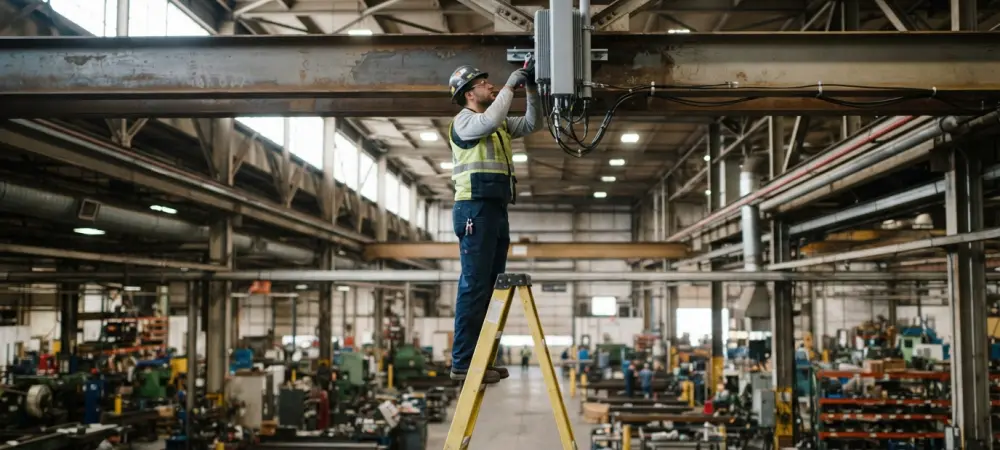
Walking into a modern manufacturing plant is like walking into a maze of radio frequency obstacles, with towering metal racks and heavy equipment that act as literal shields for wireless signals. To tackle this, we move away from guesswork and rely on high-fidelity modeling that accounts for the specific building materials and the dense layout of the machinery. We have to be incredibly surgical about antenna placement and power levels to ensure that we aren’t just blasting signal, but actually providing the necessary uplink and latency performance required for the facility’s specific tasks. It is a constant battle against attenuation and interference, so we look at the full environment, including how signals bounce off reflective surfaces or get absorbed by thick concrete walls. By treating the physical structure as a dynamic participant in the network design, we can predict performance issues before a single cable is laid, ensuring that the final deployment can handle the messy, metallic reality of the shop floor.
With the rapid rise of AI applications in the industrial sector, how have you seen data demands evolve, and what does this mean for legacy hardware?
Over the past 12 months, we have seen a massive surge in data capture requirements, largely driven by the need to feed hungry AI algorithms with high-resolution video and sensor telemetry. If you take a standard camera-based application, it’s no longer just about seeing a live feed; it’s about transporting massive amounts of raw data to an AI engine for real-time analysis, which puts an unprecedented strain on the network’s uplink. This shift is exposing the limitations of legacy systems that were designed for much lighter loads, forcing many enterprises to undergo a complete transition to newer, high-capacity systems designed specifically for AI data transport. We are seeing this trend not just in brand-new “greenfield” sites, but also in existing installations that are being expanded to keep up with the competitive need for automated insights. It is a high-stakes environment where the hardware must be as intelligent as the software, and the network is the critical bridge that allows that AI to actually function.
Digital twins are often discussed as static models, but you advocate for them as evolving tools. How does maintaining a living digital representation change the way a venue manages its wireless infrastructure?
A digital twin should never be a “one and done” project that sits on a shelf after the initial design phase; instead, it needs to be a living, breathing representation of the venue that evolves as the technology does. When a facility starts with Wi-Fi and eventually decides to layer in LTE or Private 5G, the digital twin allows us to visualize how these different technologies will coexist and where the new coverage overlaps or interferes with the old. By comparing actual field measurements against the twin’s predictions, we can pinpoint specific hardware failures, like an antenna that isn’t transmitting at the right power level, with incredible precision. This approach transforms troubleshooting from a needle-in-a-haystack search into a data-driven exercise where we can see exactly where performance diverges from expectations. Maintaining these historical snapshots over time also provides a treasure trove of data that AI can use to optimize future designs, making the network smarter with every upgrade.
How do you address the interplay between outdoor macro networks and indoor private systems to prevent interference from degrading performance?
One of the most overlooked aspects of wireless planning is the fact that a building does not exist in a vacuum; the outdoor macro environment is constantly leaking into the indoor space. We have seen cases where a carrier deploys a new outdoor site nearby, and suddenly an perfectly tuned indoor network starts experiencing mystery interference that kills performance. Our strategy is to treat the indoor and outdoor environments as a single, integrated ecosystem rather than isolated silos, ensuring that we account for those external signals during the design phase. This holistic view is crucial for troubleshooting as well, because it allows us to distinguish between an internal equipment failure and an external signal bleed that is hijacking the frequency. In an industrial facility where every millisecond of latency matters, understanding these external influences is the only way to guarantee the level of reliability that enterprise applications demand.
What is your forecast for the future of industrial wireless networks?
My forecast for the next phase of growth, from 2026 to 2028, is that we will see a total convergence of historical deployment data and predictive AI to create “self-healing” network designs. We are moving toward a reality where the data we’ve collected from thousands of similar buildings—their dimensions, materials, and capacity needs—will allow us to generate near-perfect network blueprints almost instantaneously. This will significantly lower the barrier to entry for smaller enterprises that need Private 5G but lack the massive engineering budgets of the world’s largest manufacturers. As we refine how we use digital twins and real-time field measurements, the gap between “planned performance” and “actual performance” will virtually disappear. Ultimately, the network will stop being a utility that people have to manage and start being an invisible, intelligent fabric that simply anticipates and adapts to the data needs of the machines it supports.