

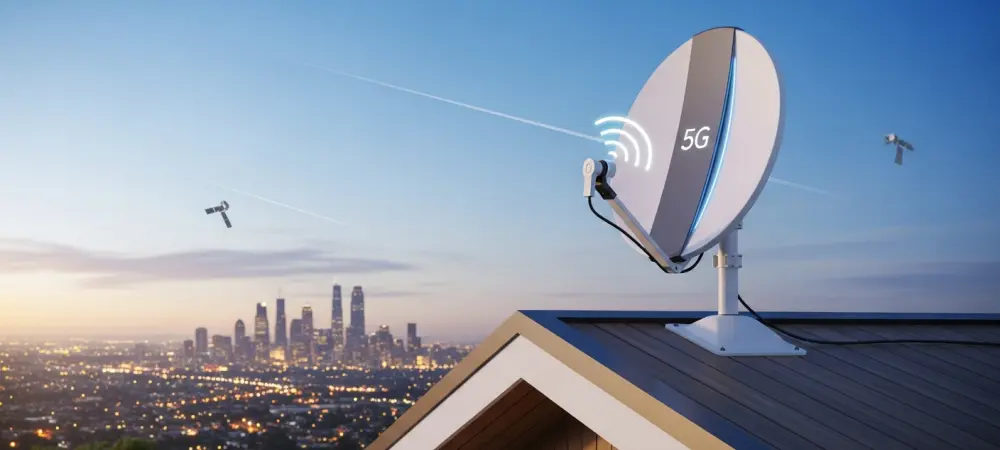
The traditional boundaries separating the silent vacuum of low Earth orbit and the bustling radio waves of city streets are rapidly dissolving as SpaceX attempts to turn millions of residential satellite dishes into a cohesive 5G cellular network. While the company has already upended the global launch market, the current focus has shifted significantly toward capturing a dominant share of the $250 billion U.S. mobile industry. This vision involves a radical engineering pivot that would see consumer Starlink hardware functioning as a massive, decentralized terrestrial network, which leadership claims will eventually outperform existing providers by a factor of one hundred.
This strategy represents a departure from the traditional satellite internet model that focused primarily on connecting remote or rural regions. By transforming the existing ground-based infrastructure into a web of mini cell towers, the company aims to disrupt the long-standing dominance of established telecom giants. The goal is to move beyond the niche market of off-grid connectivity and become the primary service provider for everyday smartphone users in dense urban and suburban environments. This high-stakes gamble requires not just technical innovation but a complete restructuring of how consumers interact with satellite-linked hardware on a daily basis.
The High-Stakes Gamble to Put a Satellite Network in Every Pocket
Elon Musk is targeting the massive U.S. mobile sector with the same aggressive disruption that characterized his entry into the automotive and aerospace industries. The current plan involves turning millions of Starlink dishes into 5G femtocells, effectively creating a terrestrial network that utilizes existing consumer footprints to bypass the need for traditional cell towers. This approach aims to create a “cell tower in every home,” promising a level of coverage density that traditional carriers struggle to match in residential areas.
The overarching objective is to provide a service that is significantly faster and more reliable than the current offerings from established giants. By integrating satellite backhaul with local ground-based delivery, SpaceX hopes to eliminate the common latency and dead-zone issues associated with legacy cellular technology. This move is seen as a direct challenge to the status quo, attempting to render the massive investments made by traditional carriers in macro-tower infrastructure obsolete through decentralized technology.
Why SpaceX’s Future Growth Depends on Conquering Terrestrial Mobile
Financial necessity serves as the primary driver behind this move toward the mobile sector as the satellite broadband market begins to reach a state of saturation. For SpaceX to sustain its massive investments in artificial intelligence and deep-space exploration, it requires access to high-margin revenue streams that only the mass-market mobile industry can provide. Industry analysts have noted that the mobile sector is currently the only adjacent market large enough to generate the billions in capital required to fund Musk’s broader technological ambitions.
The deployment of advanced “V3” satellites is a critical component of this expansion, designed to facilitate seamless data transfer between space and the palm of a user’s hand. By leveraging its existing network of ground stations and integrating them with next-generation orbital hardware, the company intends to capture a significant portion of global internet traffic. This transition is not merely a technical upgrade but a strategic survival tactic to ensure long-term growth as traditional revenue from rocket launches and rural internet service plateaus.
The Massive Infrastructure and Spectrum Barriers Thwarting Starlink’s Ambitions
However, the path to mobile dominance is blocked by the three traditional pillars of telecommunications: spectrum, physical sites, and immense capital. Currently, the company lacks the specific frequency rights required to operate a high-capacity national network that could truly compete with established carriers. While some spectrum has been acquired through recent deals, the most valuable opportunities for additional capacity are locked away until the next major C-band auctions scheduled for 2027.
Furthermore, the physical requirements for a terrestrial network are staggering, demanding a density of infrastructure that far exceeds the company’s current footprint. Analysts estimate that matching the coverage quality of the nation’s largest carriers would require the deployment of between 70,000 and 120,000 ground sites. Building such a network from the ground up would likely cost upwards of $100 billion, a price tag that presents a significant challenge even for a corporation with access to substantial private funding and a history of high-cost engineering projects.
Professional Skepticism: Why Analysts View Musk’s Strategy as More Talk Than Tech
Professional industry analysts remain deeply skeptical of the technical feasibility of building a reliable network through fragmented small cells attached to consumer dishes. Experts from firms like ABI Research have pointed out that relying on a decentralized patchwork of home-based hardware would inevitably lead to significant “dead zones” and inconsistent service. They argue that the physics of mobile connectivity require a much more uniform and robust infrastructure than what a collection of consumer broadband terminals can offer in a moving environment.
There is a growing sentiment that these aggressive public claims may actually be a tactical maneuver designed to create market “overhang” and pressure competitors. By projecting an image of inevitable disruption, the company might be attempting to force major carriers into offering a more favorable wholesale agreement. Such a play would allow SpaceX to operate as a Mobile Virtual Network Operator (MVNO), leasing existing infrastructure while maintaining its reputation as a market innovator without the burden of building a proprietary and expensive physical network.
Strategic Alternatives: Identifying the M&A and Partnership Routes to Success
The most pragmatic way forward involved a shift toward aggressive mergers or unconventional partnerships to bypass the massive costs of organic growth. Acquisition targets such as T-Mobile or Verizon were frequently identified as the only realistic routes for gaining immediate access to the necessary spectrum and tower infrastructure. Alternatively, a joint venture with a company like Charter Communications offered a solution to the persistent problem of signal penetration by utilizing millions of existing Wi-Fi hotspots to supplement satellite signals. This partnership model allowed for a hybrid approach that combined orbital reach with local density.
In the absence of a high-level merger, the company was forced to pivot toward an MVNO framework to maintain its market position while waiting for the regulatory landscape to shift. This tactical retreat into leasing network capacity provided the necessary breathing room to prepare for the upcoming 2027 spectrum auctions without exhausting capital reserves. Ultimately, the transition into the mobile space was defined by a realization that even the most innovative orbital technology had to eventually conform to the rigid economic and physical laws of terrestrial telecommunications. Future efforts remained focused on deep-integration software that allowed devices to switch seamlessly between satellite and ground-based signals as the regulatory environment evolved.