

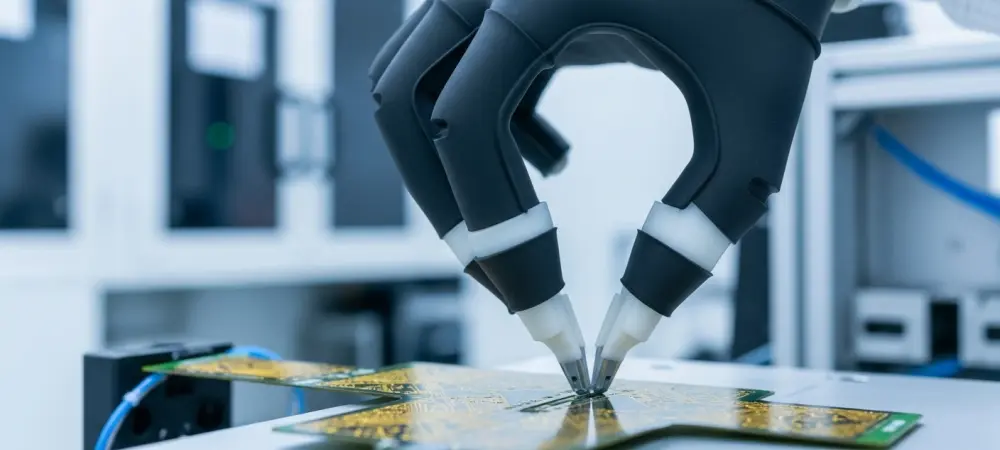
The precise moment a mechanical arm attempts to lift a delicate marshmallow only to crush it into a sticky pulp illustrates the historic divide between industrial power and organic grace. For decades, the factory floor was a kingdom of cold, unyielding steel, where robots excelled at repetitive, heavy-duty tasks but failed miserably when faced with the soft, the squishy, or the irregularly shaped. This limitation effectively locked automation out of some of the world’s largest industries, leaving food processing, delicate electronics assembly, and complex logistics to the slower pace of human hands. However, the emergence of soft robotic grippers has finally bridged this gap, allowing machines to interact with the world through a touch that is as sensitive as it is secure.
This transition from rigid to soft mechanics marks a fundamental shift in the philosophy of machine design. By utilizing advanced elastomers and bio-inspired architectures, engineers have created end-effectors that do not just grab an object, but instead adapt to its unique geometry. This flexibility is no longer a luxury; it is the cornerstone of a modern manufacturing strategy that prioritizes high-speed output without sacrificing the structural integrity of the product. As supply chains demand more variety and faster turnaround times, the ability of a single robotic arm to handle a diverse range of items—from a bruised-prone peach to a jagged circuit board—has become the new gold standard for industrial efficiency.
Beyond the Iron Grip: Why the Future of Manufacturing Is Soft
The traditional industrial robot was a masterpiece of geometry and physics, designed to move between fixed points with sub-millimeter precision. Yet, this very precision became a liability when the robot encountered a world that was not standardized. Soft robotics has inverted this logic by embracing non-linearity. Instead of forcing an object to fit a mechanical mold, soft grippers use compliant materials that deform around the target, distributing force evenly across its entire surface.
This shift toward soft systems is fundamentally an imitation of biology. Human fingers are not hard blocks of wood; they are a complex arrangement of soft tissue, bone, and nerves that can adjust to a silk thread or a heavy stone with equal ease. By mimicking this evolutionary advantage, manufacturers have unlocked a level of versatility that was previously unthinkable. These soft systems are capable of handling high-mix production lines where the product changes every hour, ensuring that the automation remains as dynamic as the market it serves.
The High Cost of Rigidity in a Fragile World
In the high-stakes world of modern production, the “crunch” of a damaged product is more than just a waste of material; it is a symptom of an inflexible system. Traditional automation setups often required a custom-designed gripper for every specific part, leading to staggering costs in both hardware and downtime. Every time a new product was introduced, the line had to be halted, the end-effector swapped, and the software meticulously recalibrated. For industries like e-commerce, where a single warehouse might process a million different SKUs in a day, this rigid approach was a physical and financial impossibility.
Moreover, the environmental and economic impact of product waste due to mechanical bruising or breakage has historically been a hidden tax on the consumer. In the food and beverage sector, even minor surface damage can lead to rapid spoilage and a total loss of retail value. By moving away from high-pressure contact points, soft robotic technology preserves the aesthetic and structural quality of perishables. The reduction in scrap rates and the elimination of frequent hardware retooling provide a clear path to a higher return on investment, making the transition to soft grippers a strategic financial decision rather than a mere equipment upgrade.
Versatility, Precision, and the End of Hardware Bottlenecks
The primary advantage of soft robotic technology lies in its inherent adaptability, often referred to as “morphological intelligence.” Because the fingers of a soft gripper are naturally compliant, they do not require complex sensors and real-time processing to figure out how to hold an avocado versus a soda can. The material itself does the work of adapting to the shape. This “wrap-around” approach allows a single robotic cell to maintain a high throughput even when the input is unpredictable. It effectively removes the hardware bottleneck that once forced companies to choose between speed and product variety.
Furthermore, these systems utilize pneumatic air pressure to modulate their strength, providing a range of motion that spans from feather-light touches to heavy-duty lifts. This precision is particularly critical in the pharmaceutical and electronics sectors, where components are often porous, textured, or incredibly fragile. By utilizing a controlled vacuum or low-pressure inflation, these grippers can secure an item without leaving a mark or discharging static electricity. This level of control ensures that even the most sensitive assembly processes can be fully automated, reducing human error while maintaining a standard of quality that rigid systems simply cannot match.
The Cobot Revolution and Enhanced Operational Safety
Safety has historically been the primary barrier preventing robots from moving out of their cages and onto the main floor. Traditional rigid robots move with such force that any accidental collision with a human worker could be catastrophic, requiring expensive light curtains and physical barriers that segment the workspace. Soft robotic grippers, however, are a fundamental pillar of the “cobot” (collaborative robot) movement. Their lightweight, flexible construction means that the kinetic energy involved in their movement is naturally dampened by the material itself.
This inherent safety fosters a more integrated and fluid operational environment where humans and machines work side-by-side in shared tasks. In a cobot setup, a human might perform the complex quality inspection while the soft robotic arm handles the delicate picking and packing. This partnership maximizes the strengths of both parties: human intuition and machine endurance. By removing the literal and metaphorical walls between workers and automation, companies can create more compact, efficient floor plans that are safer for the workforce and more responsive to real-time production changes.
Insights From the Field: Transforming Food and Electronics
Expert analysis suggests that the most dramatic transformations are occurring in sectors defined by “organic variability.” In the food and beverage industry, companies like Soft Robotics Inc. and SRT have deployed pneumatic solutions that can pick freshly baked muffins or ripe strawberries at speeds exceeding 100 cycles per minute without a single bruise. These systems solve a challenge that has plagued the industry for a century: how to handle a product that is soft, wet, and inconsistently shaped. The result is a more hygienic, faster supply chain that delivers higher quality goods to the consumer.
In the electronics sector, the challenge is different but equally demanding. As components shrink to microscopic scales, the margin for error disappears. Soft robotic fingers provide the tactile sensitivity required to seat a delicate ribbon cable or place a tiny capacitor without the risk of crushing the component or causing an electrostatic discharge. These manufacturers have become essential solution architects, providing the software and sensory integration needed to turn a simple grip into an intelligent, data-driven process. The ability to record the “feel” of a successful grip allows these systems to continuously improve their performance through machine learning.
A Framework for Integrating Soft Robotics Into Existing Workflows
Successfully implementing soft robotic technology requires a strategic roadmap focused on high-impact areas. Organizations should first identify “high-touch” stages of production where manual labor costs are prohibitive or product damage is frequent. From there, the choice between sub-technologies becomes critical. For instance, soft pneumatic grippers are the preferred choice for high-speed food lines, whereas advanced suction systems are more effective for handling the textured or porous surfaces found in logistics and warehousing. Starting with a modular approach allows companies to test the technology in a controlled environment before scaling up.
The final strategy for modern integration involves the move toward “Intelligent Soft Robotics,” where sensors and AI collaborate to adjust gripping pressure in real-time. By partnering with suppliers who offer AI-compatible software, businesses ensured that their robotic systems evolved alongside market demands. These systems eventually incorporated machine learning to “feel” and adjust to object weight and texture instantly. This proactive stance toward technology adoption did more than just fix current problems; it prepared global manufacturers for a future where the line between mechanical precision and human-like dexterity is permanently erased.