

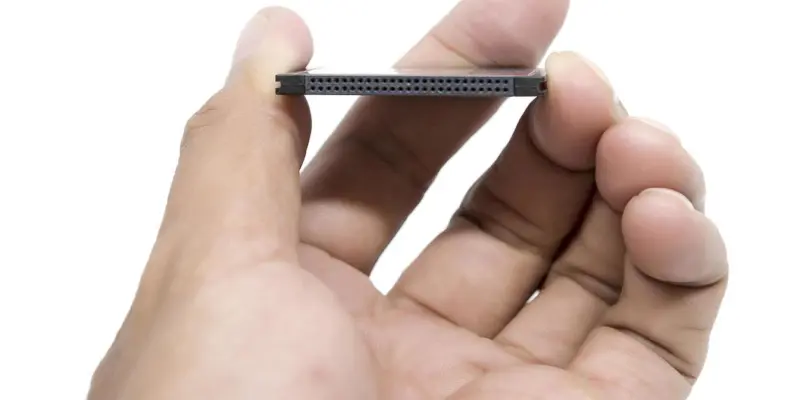
The Seagate Ultra Compact SSD is a groundbreaking piece of hardware that effectively bridges the gap between traditional USB thumb drives and conventional external SSDs. This innovative device is available at a starting price of $99.99 for the 1TB model and $179.99 for the higher capacity 2TB version tested. Designed to combine the speed and capacity of USB 3.2 Gen 2 SSDs with the convenience of USB thumb drives, the Seagate Ultra Compact SSD stands out in the market for its compact size, robust build quality, and handy features, making it a top choice for portable storage solutions.
Design and Build
The Seagate Ultra Compact SSD’s design sports the look and feel akin to a USB thumb drive. Measuring 0.3 by 2.7 by 0.7 inches and weighing just under an ounce, it promotes exceptional portability. The exterior flaunts a silver-gray casing with a removable black rubber sheath, which enhances the drive’s durability. The device includes a small unattached rubber cap covering the USB connector and a nylon or synthetic strap attached to the sheath for convenient hooking to keychains or carabiners.
The thoughtful design extends to its build quality, which complements its aesthetic appeal with practicality. The black rubber sheath not only adds durability but also provides additional grip for handling. Users must be cautious with the unattached rubber cap, though, as it can be easily misplaced. The inclusion of the strap ensures the drive can be securely attached to personal belongings, reducing the likelihood of loss. With these features, the Seagate Ultra Compact SSD illustrates a blend of sleek design and rugged practicality, ideal for users who prioritize both form and function.
Connectivity and Compatibility
Equipped with a male USB-C connector, the Seagate Ultra Compact SSD allows direct connections to USB-C ports without the need for a cable. This feature sets it apart from cheaper USB thumb drives with older USB Type-A connectors. Supporting USB 3.2 Gen 2, the interface enables a maximum throughput speed of about 1,000MBps, which can be crucial for data transfers and backups. Compatible with a wide range of devices, including Windows PCs, Macs, Android and iOS devices, and gaming consoles, this SSD ensures seamless integration across platforms. This broad compatibility is particularly beneficial for users who frequently switch between different types of devices. The need to remove phone cases to ensure a snug fit is a minor inconvenience when weighed against the benefits of high-speed data transfer and easy connectivity. The small status light on the device provides a helpful indication of activity, offering users reassurance that their data transfers are in progress. Overall, the Seagate Ultra Compact SSD impresses with its versatile connectivity, supporting a broad array of devices and ensuring high-speed performance without the hassle of extra cables.
Software and Security
Bundled with Seagate Toolkit software, the Seagate Ultra Compact SSD facilitates backups, data synchronization, and encryption. With AES 256-bit encryption, users can securely protect their sensitive data. The device also offers six free months of the Dropbox backup plan for additional security, along with a three-year subscription to Rescue Data Recovery Services and a three-year warranty, reinforcing Seagate’s commitment to data protection. The Seagate Toolkit software ensures that users have a seamless experience in managing their data. Its intuitive interface makes it simple to set up automatic backups, synchronize files across devices, and protect data with encryption. The inclusion of AES 256-bit encryption is particularly noteworthy, as it provides a high level of security for sensitive information. The added benefit of six months of Dropbox backup offers another layer of protection, ensuring that users’ data is secure even in the event of hardware loss. Furthermore, the three-year subscription to Rescue Data Recovery Services offers peace of mind, knowing expert assistance is available if data recovery is ever needed.
Performance Testing
The Seagate Ultra Compact SSD underwent various benchmarks using PC Labs’ Windows 10 storage testbed, featuring high-end hardware. Tests included Crystal DiskMark 6.0 throughput tests, PCMark 10 data drive benchmark, 3DMark Storage gaming test, Blackmagic’s Disk Speed Test, and a custom folder transfer test. Results indicated performance on par with other USB 3.2 Gen 2 drives in Windows testing but displayed lower write speeds in Blackmagic tests on MacBook Pro. Despite this, the drive performed well in the folder copy test, making it a competitive storage option. In-depth performance analysis revealed that while the Seagate Ultra Compact SSD matches its peers in the majority of testing scenarios, certain conditions may demonstrate slight variations. The drive’s impressive sequential write score in Crystal DiskMark tests highlights its capability for handling substantial data transfers efficiently. Though its performance in Blackmagic’s Disk Speed Test exhibited lower write speeds on a MacBook Pro compared to other drives, it still maintained competitive and reliable results in Windows-based environments. The drive’s ability to achieve excellent scores in the folder copy test reinforces its practicality as a robust storage solution for a wide range of computing needs.
Ruggedness and Durability
The Seagate Ultra Compact SSD boasts impressive ruggedness alongside its compact and lightweight design. Seagate claims nearly 10 feet of drop protection and an IP54 ingress protection rating, which guards against sand, dirt, and splashing water, although it is not submersion-proof. These features make it a reliable choice for users seeking a durable on-the-go storage solution. Durability is a critical factor for portable drives, and the Seagate Ultra Compact SSD delivers in this aspect. The drop protection ensures that accidental falls do not compromise data integrity, while the IP54 rating provides resistance against environmental elements, enhancing its suitability for outdoor and travel use. Though it is not submersion-proof, the drive’s resistance to dust and water splashes adds a layer of security for data under various conditions. This robustness, combined with the SSD’s convenient features, makes it an ideal option for users who need dependable storage in unpredictable environments.
Market Comparison and Pricing
The Seagate Ultra Compact SSD is a cutting-edge piece of hardware that brilliantly merges the functionality of traditional USB thumb drives with the performance of conventional external SSDs. This advanced device starts at a price of $99.99 for the 1TB model and goes up to $179.99 for the 2TB version tested. What makes the Seagate Ultra Compact SSD particularly stand out in the competitive market of portable storage solutions is its amalgamation of speed and storage capacity typical of USB 3.2 Gen 2 SSDs, alongside the sheer convenience of USB thumb drives.
One of the most notable aspects of this device is its remarkably compact size, which makes it highly portable without sacrificing performance. The robust build quality ensures durability, making it a reliable option for users who need dependable on-the-go storage. Additionally, the Seagate Ultra Compact SSD features handy functions designed to enhance user experience, including fast data transfer rates and ample storage space for high-capacity needs.
The device’s sleek design not only contributes to its aesthetics but also ensures it can easily fit into a pocket or bag, making it an ideal companion for professionals and casual users alike. Whether you’re transferring large files, backing up important data, or simply in need of extra storage, the Seagate Ultra Compact SSD provides an excellent balance of speed, capacity, and portability, cementing its position as a top choice in the realm of portable storage solutions.