

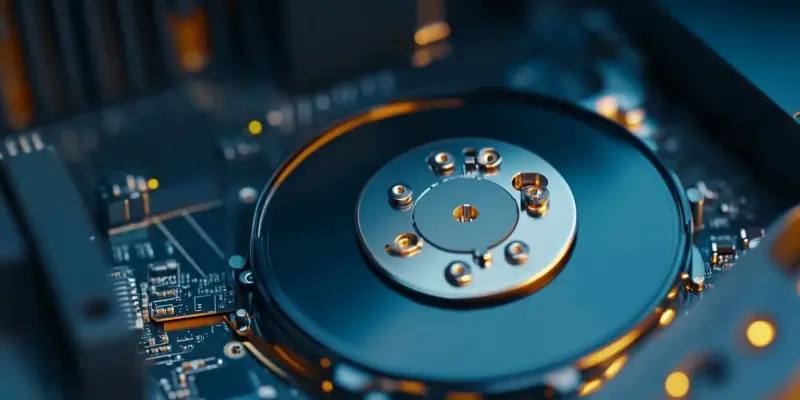
In an era where hard drives have become synonymous with massive storage and blistering speeds, the Seagate Cheetah X15 remains a quintessential symbol of innovation and technical prowess. With its introduction in 2000, the Cheetah X15 defied the conventional boundaries of hard drive technology, setting an unparalleled benchmark that still resonates within the industry today. Featuring a turn speed of 15,000 revolutions per minute (rpm), it was not just a mere advancement but a leap in performance that has yet to be surpassed.
Unprecedented Speed and Capacity
Key Features and Specifications
The Seagate Cheetah X15 heralded a new age of hard drive efficiency and effectiveness, boasting unmatched speed and solid performance parameters. Released at the turn of the millennium, the Cheetah X15 was notably the fastest commercial hard drive with a rotational speed of 15,000 rpm, a feat unprecedented at the time. This breathtaking RPM figure enabled the hard drive to achieve an access time of 3.2 milliseconds and a reading speed of 40 megabytes per second (MB/s). These attributes placed the Cheetah X15 squarely at the forefront of HDD technology, making it approximately 25% faster than its peers.
The hard drive was built with five platters, each possessing a storage capacity of 3.7 gigabytes (GB), leading to an overall capacity of 18.4 GB. The device also included 4 MB of cache memory, which further contributed to its high-speed data retrieval capabilities. Even with its staggering speed, the Cheetah X15 remained relatively energy-efficient by consuming only 12.5 watts of power. Furthermore, its noise production, a common concern among high-speed drives of that era, was remarkably lower, offering a quieter yet superior performance.
Designed for Server Excellence
Notably, the Seagate Cheetah X15 wasn’t just a powerhouse in theory; it was meticulously designed to meet the demanding conditions of server environments. Its Ultra160 Small Computer System Interface (SCSI) connector enabled seamless integration into server architectures, ensuring rapid and reliable data transfer. Servers, the unsung heroes of the digital age, require dependable components due to their continuous operation and immense workload. Seagate’s engineers designed the Cheetah X15 to excel in such circumstances.
The blend of speedy access times and high-temperature tolerances meant that servers could handle extensive data requests while reducing latency—a crucial factor for businesses relying on their data centers’ unhindered performance. This focus on creating a robust server-specific hard drive paid dividends by setting a standard that influenced subsequent generations of storage solutions.
Challenges and Evolution
Technical Limits and Thermal Dynamics
The notion of producing hard drives with speeds exceeding 15,000 rpm brings forth considerable technical, thermal, and economic challenges. Achieving higher speeds necessitates dealing with additional heat generation due to increased rotational inertia. This demand places significant constraints on the components, requiring higher precision, reliability, and consequently, escalating the costs. Cooling systems need to be more advanced to offset the extra heat, which drives both the technical complexity and operational expenses.
On this note, Thibodeau’s insights provide perspective. Rudy Thibodeau, previously a Marketing Executive Director at Seagate, elucidated that the incremental benefit of pushing beyond 15,000 rpm diminishes rapidly. Indeed, reducing access time to 1 millisecond would require boosting the speed to an impractical 30,000 rpm. Such escalations highlight the diminishing returns versus increasing complexities and constraints, making it a herculean task, if not outright improbable, from an engineering standpoint.
Pioneers Giving Way to New Technologies
Instead of chasing higher rotational speeds, the technology gradually started shifting to alternative access paradigms, spearheaded by the advent of Solid State Drives (SSDs). SSDs offer exceptional speed improvements by eliminating moving parts, thereby removing the mechanical constraints HDDs face. This shift rearranged the goalposts for storage technology, leading to the adoption of significantly quicker access technologies and advanced cache memory designs.
While the market has seen a distinguished move away from focusing solely on rotational speed, technological advancements have continued evolving. Storage solutions began emphasizing improved access times, reliability, and larger cache memories—optimizations that provide better efficiency without revisiting the RPM race. As such, the Seagate Cheetah X15’s accomplishment lives on as a benchmark and as a point of reference in the archival records of storage technology.
Legacy of the Seagate Cheetah X15
Indelible Technological Milestone
In reflecting upon the Seagate Cheetah X15’s 25th anniversary, it is clear that this hard drive made an indelible mark on the trajectory of storage technology. Its 15,000 rpm landmark has remained a feat not because it could not be surpassed but because the evolution of storage technologies steered the industry in different, more efficient directions. The Cheetah X15’s innovations in speed, capacity, and server-specific design left a blueprint that later technologies built upon, highlighting Seagate’s role in pushing the boundaries of what hard drives could achieve.
The influence of the Seagate Cheetah X15 extends beyond its technical specifications. By addressing the needs of high-demand server environments, it showcased the importance of combining speed with reliability and noise reduction. The result was a hard drive that not only met the immediate needs of its time but also anticipated future market requirements.
Paving the Way for Future Storage Solutions
In today’s world, where hard drives are known for their massive storage capacities and incredible speeds, the Seagate Cheetah X15 stands out as a landmark achievement in technological innovation. Launched in 2000, the Cheetah X15 didn’t just push the boundaries of what was thought possible for hard drive technology; it completely redefined them, establishing a new standard that continues to influence the industry. Featuring an astonishing rotational speed of 15,000 revolutions per minute (rpm), the Cheetah X15 represented not just an incremental improvement, but a significant leap forward in performance that remains unmatched. This speed set it apart, making it a symbol of cutting-edge engineering and a benchmark for future advancements in hard drive technology. Even after years, the legacy of the Cheetah X15 endures, a testament to Seagate’s relentless pursuit of pushing the envelope and achieving new heights in data storage and access speeds. It’s a milestone in the tech world that still holds relevance today.