

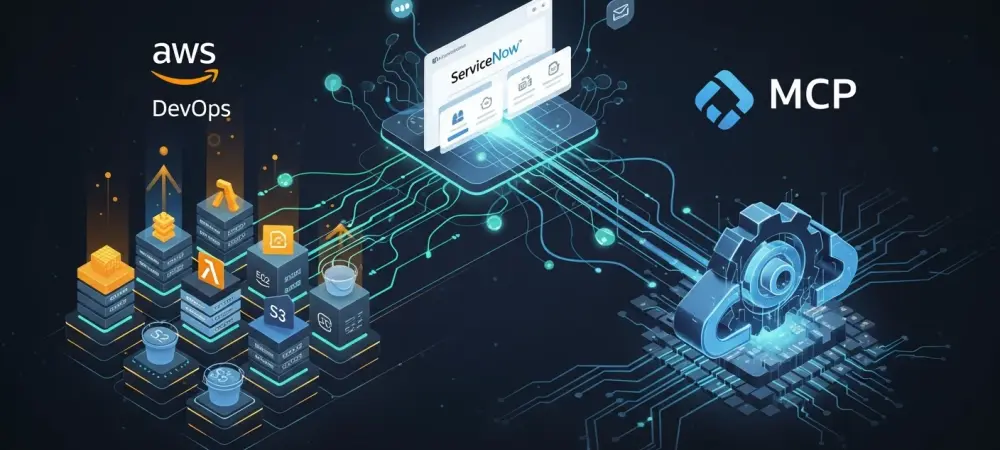
High-performance engineering teams frequently encounter a productivity bottleneck where the constant migration between cloud consoles and service management platforms fragments cognitive focus and delays critical incident responses. In the current landscape of hyper-scale cloud environments, the manual labor involved in correlating disparate data points is no longer a viable strategy for maintaining system uptime. Enterprise teams managing complex applications on Amazon Web Services often rely on ServiceNow as their primary IT service management anchor for incident tracking, change management, and configuration governance. However, the traditional workflow requires engineers to pivot constantly between AWS resources, third-party observability tools, and the ServiceNow interface, manually stitching together context before an incident record is even updated. This fragmented approach not only delays resolution but also increases the mean time to resolution while introducing a significant risk of missing subtle signals that could prevent a total system failure.
The High Cost: Context Switching in Modern Cloud Operations
Modern cloud operations suffer from a hidden tax imposed by the architectural gap between infrastructure monitoring and service management. When an automated alert triggers an incident, the initial minutes are often wasted as developers and site reliability engineers gather logs from one window while checking deployment history in another. This manual data aggregation is more than just a nuisance; it represents a fundamental inefficiency that prevents organizations from scaling their operational capacity at the same rate as their infrastructure. The mental load required to keep track of shifting cloud states while adhering to the rigorous documentation requirements of an enterprise-grade service management platform leads to burnout and operational silos that slow down the entire software delivery lifecycle.
Furthermore, the lack of real-time synchronization between the technical state of an AWS environment and the administrative state within ServiceNow creates a “visibility vacuum.” Decisions are frequently made based on outdated information, or worse, critical changes are implemented in the cloud without being properly recorded in the configuration management database. This discrepancy results in a loss of institutional knowledge, as the “why” behind a fix is often buried in a chat thread or an engineer’s memory rather than being institutionalized within the system of record. As environments grow more ephemeral and complex, the cost of these manual interventions scales non-linearly, eventually reaching a point where the operational overhead consumes the majority of the team’s engineering budget.
The arrival of frontier agents designed to handle these repetitive investigative tasks offers a way out of this cycle of manual labor. By automating the correlation of telemetry, such as logs from Amazon CloudWatch, with the operational context found in incident records, teams can finally move toward a model of proactive reliability. The objective is to eliminate the friction that exists between the moment an anomaly is detected and the moment a resolution is documented. Achieving this requires a sophisticated layer of interoperability that can bridge the divide between a cloud provider’s API and the structured workflows of a mature service management platform, ensuring that every action taken is both informed and recorded.
Bridging the Gap: AWS Infrastructure and ServiceNow ITSM
Establishing a seamless connection between AWS infrastructure and ServiceNow requires a robust framework that respects the governance needs of the enterprise while providing the agility needed for modern cloud management. The AWS DevOps Agent serves as this intelligent bridge, acting as a frontier agent that not only resolves incidents but also proactively identifies patterns to prevent future outages. This agent is designed to live within the AWS environment, gaining deep access to telemetry and resource configurations, but its true power is unlocked when it is integrated with the organizational logic housed in ServiceNow. This integration allows the agent to move beyond simple automation and into the realm of autonomous operations that are fully aligned with the organization’s existing service management policies.
The Model Context Protocol (MCP) has emerged as the critical open standard that facilitates this agent-to-tool communication. By utilizing MCP, the AWS DevOps Agent can act as a client that dynamically discovers the various tools and capabilities exposed by ServiceNow. This protocol removes the need for brittle, hard-coded integrations, allowing the agent to understand the schema and requirements of the service management platform in real time. For example, when an incident occurs, the agent can use MCP to query the configuration management database for related assets or check the recent change history to see if a specific deployment coincides with the performance degradation, effectively acting as an automated investigator. ServiceNow contributes to this bridge through the Action Fabric, a governed layer that controls and executes the actions authorized for the agent. This ensures that while the AWS DevOps Agent has the intelligence to suggest a fix, it must still operate within the boundaries defined by the ServiceNow administrators. The Action Fabric provides the necessary guardrails, ensuring that any modification to the application environment is preceded by a proper change request or authorized by a specific role. This synergy creates a closed-loop system where the agility of the cloud is matched by the rigor of enterprise service management, providing a unified platform for scaling autonomous operations without sacrificing control.
The Mechanics: Autonomous Incident Investigation via MCP
The technical interaction between the AWS DevOps Agent and the ServiceNow MCP Server is a study in dynamic discovery and secure communication. Once the agent is triggered by an anomaly or a new incident ticket, it initiates a discovery phase where it scans the MCP Server to identify the available tools. Because this discovery happens at runtime, any new capabilities added to the ServiceNow instance via the MCP Server Console are immediately available to the agent, ensuring the system evolves alongside the business without requiring constant re-configuration of the agent itself.
During the investigation phase, the agent acts as a sophisticated data orchestrator, pulling telemetry from Amazon CloudWatch and deployment data from AWS resources while simultaneously pulling context from ServiceNow. It correlates these data streams to build a comprehensive picture of the incident, looking for the specific moment when a code change or resource exhaustion occurred. The agent does not merely present a list of symptoms; it uses the tools provided through the MCP server to cross-reference these symptoms with existing known issues or previous incidents stored in ServiceNow. This level of correlation allows the agent to produce a high-fidelity root cause analysis that includes the specific affected resources and a proposed mitigation plan.
Execution and recording represent the final stages of the autonomous workflow, where the agent’s findings are pushed back into the ServiceNow incident record. The agent uses the MCP-discovered tools to write detailed findings directly into the ticket, ensuring that human operators have a complete narrative of the event as soon as they open the incident. If the agent is authorized to do so through the ServiceNow Action Fabric, it may also execute a resolution, such as rolling back a deployment or scaling a resource group. Every step of this process is recorded, creating an auditable trail that shows exactly what data was analyzed and what actions were taken, effectively automating the administrative burden that typically bogs down the incident response process.
Governance and Security: The Age of Agentic AI
Operating autonomous agents within a mission-critical enterprise environment necessitates a “security-first” architecture that goes beyond simple password protection. The integration between AWS and ServiceNow utilizes OAuth 2.0 authentication to establish a secure, scoped connection that defines exactly what the agent can and cannot do. By using client credentials and scoped permissions, organizations ensure that the AWS DevOps Agent only interacts with the specific modules of ServiceNow that are relevant to its operational mission. This minimizes the attack surface and prevents the agent from accessing sensitive data that is not required for incident resolution or infrastructure management.
Beyond authentication, the ServiceNow MCP Server Console provides a granular level of governance through tool-level scoping and role masking. Administrators can define precise Access Control Lists that determine which agent spaces have permission to use certain tools, such as the ability to create a change request or update a configuration item. This role masking ensures that even if an agent is performing high-level analysis, it does so using the identity and permissions of a restricted service account. This layer of abstraction is vital for maintaining compliance in regulated industries, as it provides a clear separation of concerns between the agent’s intelligence and its authority to affect the production environment. Accountability is maintained through the ServiceNow AI Control Tower, which provides a centralized view of all agentic activities. Every time the AWS DevOps Agent invokes a tool through the MCP server, the action is logged and monitored, allowing for real-time observation of the agent’s behavior. This auditability is not just for compliance; it is a critical component of building trust in autonomous systems. By being able to review the exact chain of thought and the specific tool calls made by the agent, engineering leaders can verify that the system is operating within the expected parameters. This transparent governance framework allows organizations to confidently scale their agentic operations, knowing that every action is authenticated, authorized, and fully observable.
Strategic Roadmap: Deploying Integrated Autonomous Workflows
The journey toward a fully integrated autonomous operation began with the careful configuration of the ServiceNow MCP Server to expose the necessary capabilities. Organizations first identified the high-frequency tasks that consumed the most engineering time, such as status updates and initial data gathering, and mapped these to specific tools within the MCP Server Console. By defining these tools early on, administrators established the boundaries of the agent’s workspace, ensuring that the initial deployment focused on high-value, low-risk activities. This phased approach allowed teams to familiarize themselves with the MCP communication patterns before moving toward more complex remediation tasks.
As the second step in the implementation, engineers created dedicated AWS DevOps Agent Spaces that were tailored to specific application environments. These spaces defined the scope of the AWS resources the agent would monitor, providing it with the necessary IAM roles to access telemetry and configuration data. The registration of the ServiceNow MCP Server within these spaces acted as the final handshake, enabling the agent to discover the ServiceNow tools and begin its role as an automated investigator. This alignment of AWS resource scopes with ServiceNow governance scopes ensured that the agent operated as a cohesive part of the existing IT organization rather than a disconnected silo of automation.
The validation phase involved testing the connection through end-to-end scenarios where synthetic incidents were used to trigger the agent’s response. Teams monitored as the agent successfully queried ServiceNow for historical context and posted its findings back into the incident record without any human intervention. This successful demonstration of the “investigate and record” workflow proved that the latency between an error and its analysis could be reduced to seconds. The transition to this model allowed the SRE teams to pivot their focus from firefighting toward long-term architectural improvements, as the burden of routine operational maintenance was successfully offloaded to the autonomous system. This evolution represented a shift in how cloud stability was maintained, moving from a reactive, manual posture toward a proactive, agent-led strategy that scaled effortlessly with the growth of the enterprise.