

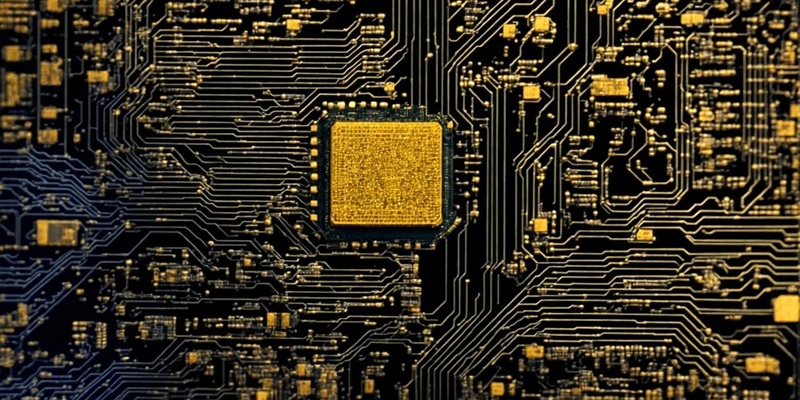
At the Mobile World Congress in Barcelona, Samsung introduced a groundbreaking innovation in memory technology crucial for an AI-centric future, the first-ever 36GB HBM3E DRAM chip. This advanced memory module is specially engineered to cater to the intensive demands of artificial intelligence workloads and the burgeoning next-gen cellular networks. The 36GB HBM3E is expected to play a pivotal role in enabling faster and more efficient data processing, critical for the seamless operation of AI systems and high-speed communications. Samsung’s unveiling of this memory chip marks a significant stride toward supporting the infrastructure needed for a more interconnected and intelligent world. Companies at the forefront of technology are thus preparing the foundations for a radical shift in how devices and services will operate in the near future, emphasizing the importance of high-performance memory in an increasingly data-driven society.
Unleashing AI Potential with Cutting-Edge Memory Solutions
The Drive for Speed and Capacity
Samsung’s 36GB HBM3E DRAM chip breaks new ground in the realm of technology with unparalleled capacity and bandwidth, overshadowing previous models by 50%. Engineered to enhance AI applications, the chip’s 1,280GB/s support paves the way for advancements in areas like mixed reality and autonomous vehicles, where data-intensive tasks have long sought such memory capabilities.
The boost in memory performance brings high-stack, high-speed solutions to the forefront, meeting the demands for swift data access within AI computation. As AI evolves with more complex algorithms and larger datasets, Samsung’s innovative DRAM fills the gap, ensuring that real-time services and high-level cognitive functions aren’t hampered by memory bottlenecks. This leap in technology is set to transform AI’s potential, enabling more seamless and sophisticated user experiences.
Fostering Advancements Across Industries
With the rise of mixed reality, users can immerse themselves in a world where digital and physical realms converge. This seamless blend is augmented by Samsung’s new DRAM chip, which ensures that the required memory capabilities are not a bottleneck in this evolving sector. Likewise, in robotics, the chip facilitates machine learning processes that require fast, intensive data handling for robots to act autonomously and make decisions in real-time.
In the realm of autonomous vehicles, the sheer amount of data generated by sensors and cameras is gargantuan. Processing this data to make split-second decisions is vital for safety and efficiency. Samsung’s 36GB HBM3E DRAM chip steps in as the memory solution with the muscle to handle such high-throughput demands, ensuring that as technologies evolve, memory won’t be the limiting factor for innovation and application development.
The Evolution of Connectivity with 6G
Shaping a Seamless Network of Interactions
A broader industry trend is emerging, prefacing a future where 6G will blend communication and computing into a seamless tether of digital and physical interactions. Samsung is at the vanguard of this revolution, joining forces with powerhouses like Arm, Ericsson, and Microsoft in the AI-RAN Alliance. This initiative underscores the significance of combining AI with wireless communication to pioneer new service models and optimize user experiences in the years to come.
The evolution of connectivity calls for a radical shift in how digital infrastructure is built and utilized. Samsung’s participation in the AI-RAN Alliance is a testament to its commitment to driving innovation where AI not only enhances wireless communication but reshapes it. The promise of 6G lies in its potential to integrate smart internet of things (IoT) systems more effectively, knit together by the advanced memory technologies spearheaded by Samsung.
Envisioning the Future of AI Services
The consensus in the tech industry is that AI is the linchpin in transforming human interactions with technology. According to tech visionaries such as Qin Fei from Vivo, the ushering in of the 6G era will reveal applications once relegated to science fiction, holographic communication, three-dimensional digital humans, and more. Samsung’s 36GB HBM3E DRAM chip is pivotal in realizing these visions, offering the memory capabilities essential for sophisticated, AI-driven services.
Synthesizing the complexities of AI services demands not just advanced algorithms but also robust, reliable hardware backing them. Samsung’s innovation in DRAM chip technology demonstrates that the future will not just be defined by the software that drives AI but equally by the hardware that sustains it. When holograms and digital humans become part of the everyday user experience, it will be memory solutions like Samsung’s that will have laid the foundation for this AI-enhanced, 6G-fueled world.