

Dominic Jainy is a seasoned IT professional whose finger is always on the pulse of emerging mobile technologies. With years of experience tracking the evolution of artificial intelligence and hardware design, he offers a unique perspective on how manufacturing shifts signal broader consumer trends. As Samsung prepares for its massive July 22 event in London, Dominic joins us to break down the strategic pivot toward the wide-format Galaxy Z Fold 8 and what these specific production volumes reveal about the future of the foldable category. We discuss the transition from the traditional book-style design to a more ergonomic passport-style frame, the internal hardware trade-offs between the new models, and the overall market expectations for this next generation of devices.
The latest production reports show a massive lean toward the new passport-style Galaxy Z Fold 8, with 2.8 million units planned. What does this shift tell you about how Samsung is rethinking the ergonomics of its flagship foldables?
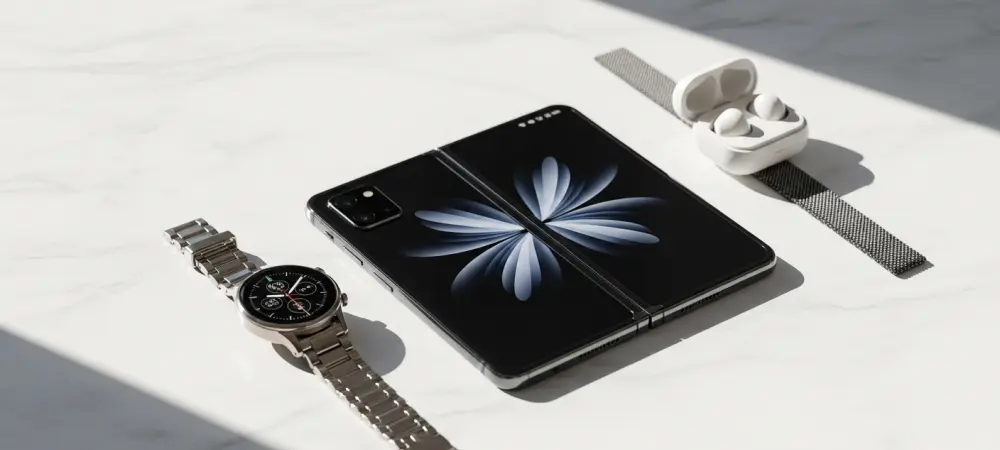
This shift is a clear signal that the company is listening to users who felt the previous “book-style” designs were a bit too narrow for comfortable daily use. By aiming for 2.8 million units of the wide-style Fold 8, they are significantly outstripping the 2 million units allocated for the Ultra and the 1.5 million for the Flip 8. This “passport” design feels much more substantial and balanced in your hand, moving away from that remote-control aesthetic that many found polarizing. It is a bold move to prioritize a new form factor so heavily, but it shows a deep commitment to making the cover screen as functional as a standard smartphone. When you hold a device with these proportions, it feels more like a productivity tool and less like a delicate experiment.
Looking at the rumored hardware specs, how do the 16:10 cover screen and the 4:3 inner display on the Fold 8 change the day-to-day experience compared to the more traditional Fold 8 Ultra?
The change in aspect ratios is going to be the first thing users notice when they pick up the device, as that 5.5-inch cover screen with a 16:10 ratio makes typing and scrolling feel much more natural. Once you open it up to the 7.6-inch AMOLED inner screen, the 4:3 ratio provides a canvas that is perfect for multitasking or immersive reading, especially with that buttery smooth 120Hz refresh rate. Interestingly, to keep this model more affordable and hit those high production targets, they have opted for a dual-camera setup on the rear rather than the triple-camera array found on the Ultra. It is a calculated trade-off where you lose a bit of photographic versatility but gain a device that is easier to handle and easier on the wallet. Seeing those vibrant pixels flow at 120Hz on a wider display really changes the sensory experience of mobile computing.
Samsung seems to be targeting between 5.5 and 6 million total units for this generation, which is a slight adjustment from previous years. How do you interpret this approach given the success of the Galaxy Z Fold 7?
Last year was a high-water mark for the series, with shipments crossing the 6 million unit threshold thanks to the strong momentum of the Fold 7. Aiming for 5.5 to 6 million units this year suggests a focused consolidation rather than an aggressive, unchecked expansion. They are essentially overhauling the entire lineup, and by placing the Fold 8 at the center with nearly 3 million units, they are betting that the “wide” design is the key to mainstream adoption. It is a fascinating strategy to watch because it moves the Fold away from being a niche luxury item and positions it as a practical replacement for a standard flagship. They are being realistic about the market while simultaneously pushing the boundaries of what a primary phone can look like.
With the London Unpacked event set for July 22, how do the secondary devices like the Galaxy Watch 9 and Watch Ultra 2 round out this new foldable-centric ecosystem?
The event on July 22 at 2pm BST is shaping up to be one of the most comprehensive showcases we have seen in years. Beyond the three main foldable phones, the introduction of the Galaxy Watch 9 and the Watch Ultra 2 suggests that Samsung wants a cohesive, high-performance ecosystem to support these new screen formats. For a user carrying a passport-style foldable, having a robust wearable is essential for those moments when you don’t want to unfold a large display just to check a notification. The integration between the new 120Hz screens and the updated watch series should feel seamless and highly responsive. It is about creating a tactile, interconnected world where the hardware disappears and only the utility remains.
What is your forecast for the foldable market?
I believe we are entering an era of “specialized diversification” where the one-size-fits-all approach to foldables is finally dying out. Within the next two years, we will see the “wide” or passport-style design become the industry standard for productivity, while the “Ultra” models will push into extreme photography and high-end materials. As production yields continue to stabilize around that 6 million unit mark, the prices will drop, and the dual-camera configurations will become the entry point for millions of new users. Eventually, the distinction between a “foldable” and a “regular” phone will blur so much that the hinge will be seen as just another standard feature rather than a futuristic luxury.