

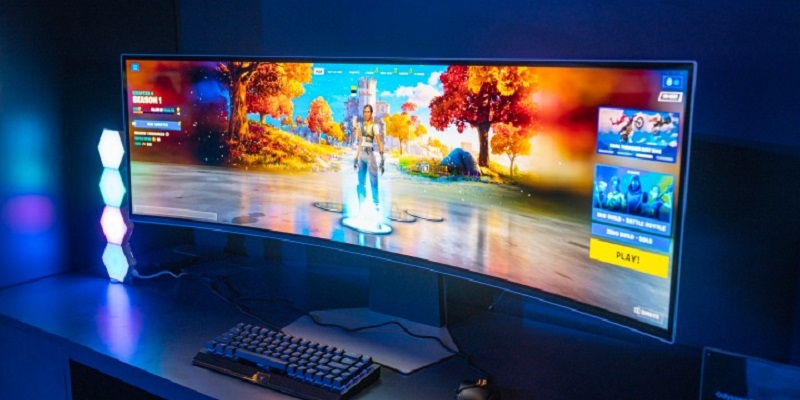
After being unveiled at CES 2021 six months ago, Samsung has finally announced the global release of its highly anticipated gaming monitor, the Odyssey OLED G9. This gaming monitor is unlike any other on the market, featuring a 49-inch Dual QHD display with a maximum resolution of 5,120 x 1,440. It comes with a curved panel at 1800R curvature and an ultrawide 32:9 aspect ratio that enhances the viewing experience dramatically.
The OLED G9’s 49-inch Dual QHD display is what sets it apart from its competitors. With a maximum resolution of 5,120 x 1,440, images and videos are crisp and vibrant, making the gaming experience all the more enjoyable. With Dual QHD resolution, users can simultaneously play games, talk on video calls or watch movies, all on the same screen. The monitor is perfect for those who want a more immersive gaming experience.
The curved panel, with its 1800R curvature, allows users to have a more natural viewing experience, resulting in less eye strain. The ultrawide 32:9 aspect ratio is another remarkable feature of the OLED G9. This aspect ratio makes playing games much more immersive. For instance, Fortnite gamers can now see the full action of the game instead of having only a small section of the screen to work with.
With a 240Hz refresh rate and a 0.03ms response time, Samsung’s OLED G9 is well ahead of its competitors. This superior feature makes it possible for gamers to say goodbye to motion blurriness and ghost-imaging, providing users with smoother graphics and a better gaming experience. The 240Hz refresh rate allows for smoother image transitions, while the 0.03ms response time enables faster transitions between scenes without any lag.
Samsung’s newly introduced Gaming Hub offers users complete access to cloud gaming. Users can now have instant access to the latest games without having to wait for downloads or installations. With the introduction of the Gaming Hub, users can subscribe to a list of top-rated online games that are either free or offered at discounted prices. This means that users can enjoy the latest games without breaking the bank.
Neo Quantum Processor Pro Chip
The OLED G9 comes with Samsung’s latest Neo Quantum Processor Pro chip, which enhances the monitor’s performance. The chip is optimized for gaming and provides the best possible graphics. The processor provides users with faster computing power, sharper image rendering, better contrast, and more accurate colors. The chip offers gamers a seamless experience that cannot be beaten.
Pricing
Samsung has not yet released the pricing for the OLED G9 in the United States. However, it is likely to be one of the most expensive gaming monitors due to its superior specifications. The OLED G9 is targeted towards serious gamers who are looking to enhance their gaming experience.
The OLED G9 is expected to come in two variants: the G95SC model and the G93SC. The G95SC model is the high-end version and will offer the latest features, including Samsung Gaming Hub and Neo Quantum Processor Pro Chip. The G93SC variant is a mid-range option that is also expected to provide superior graphics (but not the latest ones) at a cheaper price point.
Availability
The Odyssey OLED G9 (G95SC) will be available globally by June 12th. Gamers are eagerly waiting to get their hands on this gaming monitor, owing to its unmatched specifications and features. The G93SC variant is expected to retail by Q3 2023.
In conclusion, the OLED G9 is a highly anticipated gaming monitor that has finally made its way to the market. Once released, it has the potential to revolutionize the gaming experience. With its Dual QHD display, curved panel, ultrawide 32:9 aspect ratio, 240Hz refresh rate, and 0.03ms response time, the OLED G9 offers an unmatched gaming experience that will take gaming to the next level. The introduction of Samsung Gaming Hub and Neo Quantum Processor Pro Chip means that gamers can enjoy the latest games almost instantly and at optimal performance levels. Therefore, if you are a serious gamer searching for the next big thing in gaming, look no further than Samsung’s Odyssey OLED G9.