

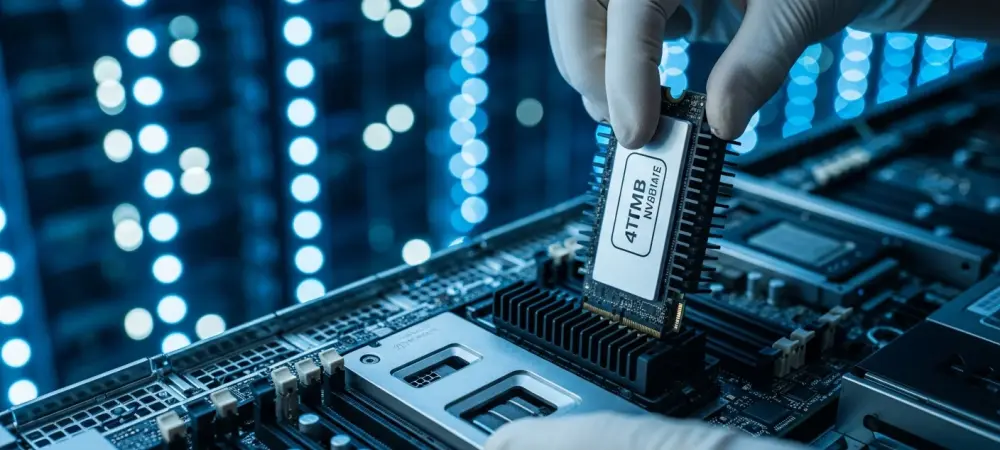
For consumers closely watching the volatile market for PC components, the sudden appearance of an incredible deal can feel like finding an oasis in a desert, but that relief can turn to frustration just as quickly when it disappears without a trace. This exact scenario unfolded recently when a high-capacity, high-performance solid-state drive from Samsung saw a significant, albeit temporary, price reduction. The fleeting nature of this discount serves as a stark reminder of the broader pressures affecting the industry, where a widespread memory crisis continues to drive hardware costs upward. For many enthusiasts and professionals, securing top-tier components at a reasonable price has become a game of speed and luck, and this recent event underscored just how quickly the window of opportunity can close in the current economic climate, leaving many to wonder if they missed their last best chance for an affordable upgrade.
A Glimpse of Affordability in a Volatile Market
The brief opportunity presented itself as a remarkable discount on Samsung’s 4TB 990 PRO PCIe NVMe Gen 4 SSD. For a short time, the version without a heatsink was available for $329.99, a full 21% off its usual list price. The model equipped with a heatsink, ideal for PlayStation 5 installations or desktops with limited airflow, was also on sale for a marginal increase at $339.99. In a market where storage costs have been on a steady upward trajectory, this price point for a 4TB drive from a leading manufacturer was an exceptional value. It represented a rare chance for users to acquire a substantial amount of high-speed storage without breaking the bank. This deal was particularly notable given the ongoing DRAM and memory shortage, a global issue that has been exerting consistent upward pressure on the prices of consumer electronics, making such significant markdowns an increasingly rare occurrence for prospective buyers.
The Samsung 990 PRO is widely regarded as a top-tier performer in the PCIe Gen 4 category, making the temporary deal even more compelling. The drive boasts staggering sequential read and write speeds of up to 7,450MB/s and 6,900MB/s, respectively, which translates to near-instantaneous load times in games and rapid file transfers for creative professionals. Its performance in random operations is equally impressive, with IOPS (Input/Output Operations Per Second) reaching 1.4 million for reads and 1.55 million for writes, ensuring a snappy and responsive system experience. To maintain this level of performance under load, Samsung incorporates a sophisticated thermal solution, including a nickel-coated, in-house controller and an LPDDR4 cache. However, the drive’s high performance generates considerable heat, and users must ensure their system provides adequate cooling to prevent thermal throttling, a factor that makes the discounted heatsink version an attractive proposition for many.
The Shifting Sands of Component Pricing
The optimism sparked by the discount was short-lived, as the price for the 4TB 990 PRO abruptly reverted, soaring to $419.99. This rapid fluctuation is a direct reflection of the instability plaguing the consumer electronics supply chain. The underlying memory shortage has created a market where prices are not only rising but are also subject to sudden and dramatic shifts. For consumers, this environment makes purchasing decisions incredibly challenging. Hesitation can mean missing out entirely, as a deal that is available one moment can be gone the next. This incident serves as a microcosm of the larger trend: fleeting discounts are becoming the norm, forcing buyers to either make snap decisions or risk paying a significant premium later. The predictable seasonal sales and gradual price drops of the past have given way to a far more unpredictable and often frustrating landscape for anyone looking to build or upgrade a system.
In the wake of the price correction, the value proposition of the 990 PRO shifted dramatically. At its new price of $419.99, a different strategic consideration emerged for savvy consumers. For an additional investment of just $50, buyers could instead acquire the next-generation 4TB 9100 PRO PCIe Gen 5 SSD, which was priced at $469.99. This alternative offered a substantial leap in performance, leveraging the newer interface for even faster speeds. The diminished value of the 990 PRO deal forced a re-evaluation; the choice was no longer about securing a great discount but about whether to invest a little more for a technologically superior and more future-proof component. This situation illustrated a critical lesson for navigating the current market: when a deal evaporates, the best course of action involved looking beyond the missed opportunity and reassessing the entire competitive landscape to find the most logical investment.