

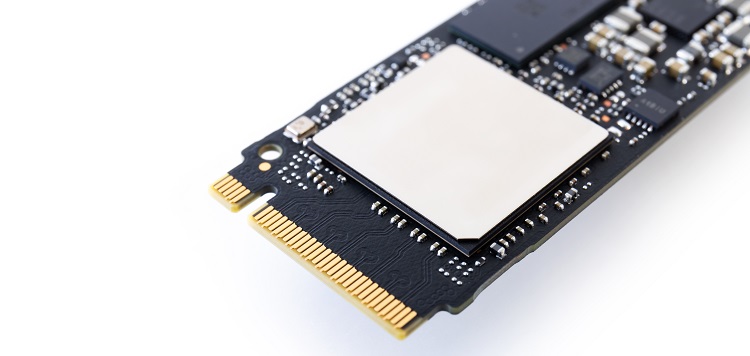
Solid State Drives (SSDs) have been the storage medium of choice for many consumers due to their reliability, speed, and affordability. However, the Sabrent Rocket 4 Plus has taken the speed factor to the next level by breaking all previous speed records in the world of SSDs. This article will delve into the Sabrent Rocket 4 Plus and its impressive performance attributes that make it a great option for gamers, content creators, and professionals.
The Sabrent Rocket 4 Plus and Its Impressive Speed
The Sabrent Rocket 4 Plus happens to be the fastest storage device on the market, with record-breaking sequential read and write speeds of 7,000 MBps and 6,850 MBps, respectively. As a result, it is one of the few storage devices that can achieve high-speed data transfer capabilities.
The Rocket 4 Plus utilizes Phison’s PS5018-E18 controller, which uses PCIe 4.0 x4 and NVMe 1.4 protocols to enable up to 32 GT/s of bandwidth. The SSD’s interface supports transmission rates twice as fast as those of PCIe 3.0. Its low-latency architecture makes the Sabrent Rocket 4 Plus the perfect choice for gamers, power users, and content creators.
Capacities and Usage
The Sabrent Rocket 4 Plus comes in four different storage capacities: 500GB, 1TB, 2TB, and 4TB, which makes it suitable for users with different storage needs. This SSD is a good alternative for gamers who require faster load times and more responsive games. Game developers would also benefit from using the Sabrent Rocket 4 Plus, as it reduces loading times for game assets, review processes, and testing.
Performance tests
Aside from its record-breaking speed in sporting, the Sabrent Rocket 4 Plus also performs well in various performance benchmarks. One of its noteworthy achievements is its performance in the PCMark 10 benchmark, which measures a device’s capacity to handle everyday tasks, like booting up and launching applications.
Experts rank the Rocket 4 Plus highly in such tests, indicating that it is among the top performers in the market. The Sabrent Rocket 4 Plus is also reliable, boasting an MTTF rating of 1.7 million hours and a five-year warranty.
Heat dissipation and backward compatibility
During substantial workloads, the Sabrent Rocket 4 Plus can become hot. Sabrent includes a heat sink with the SSD to help dissipate the heat, a measure that improves the device’s overall lifespan.
The SSD is also backward compatible with PCIe 3.0 technology, which means that you can use it with PCIe 3.0 devices. Though it won’t achieve outstanding speeds when paired with PCIe 3.0 technology, it’s still an excellent SSD that would improve the speed of PCIe 3.0 compatible devices.
Cost
The pricing for the Sabrent Rocket 4 Plus varies based on its storage capacity. The 500GB model is priced at $149.99, while the 1TB, 2TB, and 4TB models offer better value at $249.99, $499.99, and $999.99, respectively.
In conclusion, the Sabrent Rocket 4 Plus SSD is a revolutionary device perfect for content creators, professionals, gamers, power users, and anyone who values speed and reliability in their storage devices. Although the 500GB model is expensive compared to other high-end SSDs, the larger capacities offer great value for money. The Sabrent Rocket 4 Plus remains the SSD to beat because of its record-breaking speeds, high reliability, excellent heat dissipation capacity, and backward compatibility.