

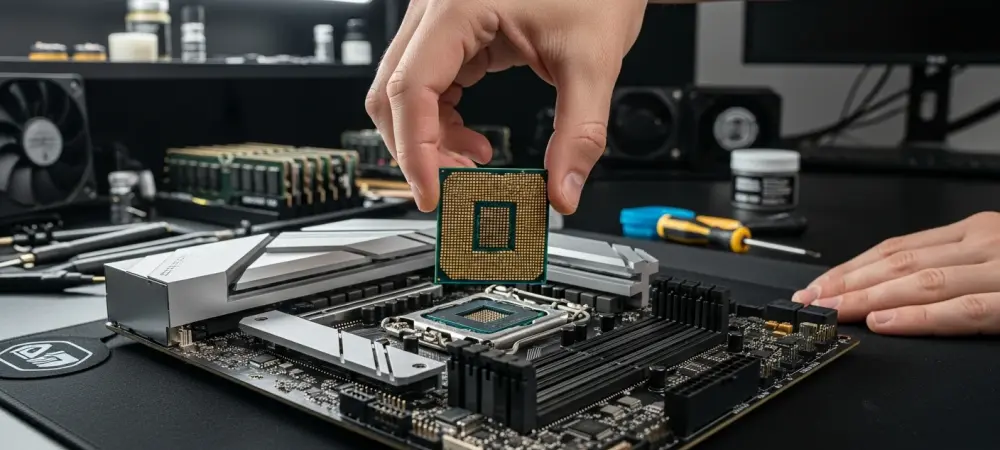
The relentless pursuit of peak computing performance has shifted its battleground from raw core counts to the intricate art of memory overclocking, where every megatransfer per second can unlock unprecedented system responsiveness. With the arrival of AMD’s Ryzen 9000 series processors, the mature AM5 platform is now at the forefront of this evolution in the PC enthusiast sector. This review explores the platform’s enhanced DDR5 overclocking capabilities, examining the key features of the new X870E chipset and the performance metrics demonstrated on cutting-edge hardware. The goal is to provide a thorough understanding of the platform’s current overclocking potential and its compelling future trajectory.
The Maturation of the AM5 Platform
AMD’s Ryzen 9000 series represents a significant refinement of the AM5 platform, with a notably improved memory controller at its core. This enhancement is pivotal, as DDR5 overclocking has become a critical factor in extracting maximum CPU performance. The platform has evolved past its initial launch phase into a stable and potent ecosystem, setting the stage for enthusiasts to push memory speeds to new heights.
This newfound stability has spurred the development of advanced motherboards designed to exploit the full potential of the new processors. Hardware like MSI’s MEG X870E GODLIKE has emerged specifically to cater to this demand, providing the robust foundation necessary to support memory speeds that were once purely theoretical. The synergy between the refined CPU and purpose-built motherboards marks a new chapter for memory performance on the AM5 platform.
Deep Dive into Overclocking Hardware and Results
The MSI MEG X870E GODLIKE X Edition Testbed
The MSI MEG X870E GODLIKE X Edition, a premium, limited-edition motherboard, serves as the ideal testbed for extreme overclocking. Its design philosophy is centered around providing an uncompromising power delivery system, an advanced BIOS with granular controls, and high-quality components engineered for thermal stability. These features are not just for marketing; they are essential for sustaining the advertised DDR5 speeds that exceed 9000 MT/s.
Priced at the top of the market, this motherboard justifies its positioning by delivering on its promises. It is engineered as a specialized tool for enthusiasts chasing record-breaking performance, providing the stability and headroom required to push both the CPU and memory to their absolute limits. The board’s robust construction is a direct enabler of the overclocking achievements seen with the Ryzen 9000 series.
Pushing the Limits with the Ryzen 7 9700X
The overclocking prowess of the platform becomes evident when paired with the Ryzen 7 9700X. In testing, this combination successfully achieved a boot at a remarkable DDR5-9100, showcasing the raw frequency potential of the new memory controller. While a bootable speed indicates the hardware’s ceiling, stable operation is the true measure of performance. Further results demonstrated stable operation at DDR5-9000 with CL40 timings. This achievement transforms a peak boot speed into a tangible, albeit extreme, performance metric. It confirms that the architectural improvements in Zen 5 have yielded a significant leap in memory frequency handling, moving well beyond the capabilities of the previous generation.
Low-Latency Gaming Performance with the Ryzen 7 9800X3D
For gaming, low latency is often more critical than raw frequency. The Ryzen 7 9800X3D, with its 3D V-Cache, pushes this paradigm further. Testing revealed a stable DDR5-8900 overclock with tight CL36 timings, balancing high frequency with quick response times for a superior gaming experience.
An even more compelling result for gamers was a stable run at DDR5-6600 with incredibly aggressive CL24 timings. This configuration surpasses the previously established DDR5-6400 “sweet spot” for optimal gaming performance on Ryzen CPUs. Achieving such low latency at a substantial frequency suggests a new benchmark for tuning gaming-focused systems, promising smoother and more responsive gameplay.
Emerging Trends in Memory Technology and Platform Support
The continued enhancement of the AM5 ecosystem relies heavily on ongoing software development. Crucial AGESA (AMD Generic Encapsulated Software Architecture) updates serve as the backbone for memory stability and overclocking headroom. These firmware releases are a key trend, progressively unlocking more potential from the existing hardware and refining compatibility with a wider range of memory kits.
This software evolution is part of a larger, collaborative trend within the industry. Motherboard manufacturers and memory vendors are working closely with AMD to ensure the platform’s trajectory continues upward. This coordinated effort ensures that as new, faster memory modules become available, the AM5 platform will be ready to support them, further solidifying its position as a leading enthusiast platform.
Real-World Impact for Gamers and Power Users
These overclocking achievements are not merely for bragging rights; they translate into tangible, real-world benefits. For gamers, surpassing 9000 MT/s or achieving ultra-low latencies can result in higher and more consistent frame rates, particularly in CPU-bound titles where memory bandwidth is a limiting factor. This can provide a noticeable competitive edge and a more immersive gaming experience.
For power users such as content creators and engineers, the impact is equally significant. The increased memory bandwidth accelerates workflows in professional applications, from video rendering and 3D modeling to complex scientific computations. This improved responsiveness allows professionals to complete tasks faster, directly boosting productivity.
Overcoming Overclocking Hurdles and Limitations
Despite these impressive results, extreme DDR5 overclocking is not without its challenges. The “silicon lottery” remains a significant factor, as the maximum achievable frequency varies between individual CPUs and memory kits. Furthermore, maintaining stability at such high speeds often requires advanced cooling solutions for both the processor and the RAM modules to prevent thermal throttling.
Market accessibility presents another hurdle. The high cost of entry for premium motherboards and top-tier, high-frequency memory kits places this level of performance out of reach for many users. This economic barrier may temper widespread adoption of these extreme overclocking practices, confining them to a dedicated niche of enthusiasts for the time being.
The Future of DDR5 on the AM5 Platform
The outlook for DDR5 on the AM5 platform remains bright. Future AGESA releases are expected to bring further breakthroughs, potentially enabling even higher stable frequencies or tighter timings as the platform continues to mature. The current performance ceiling is impressive, but there is still untapped potential waiting to be unlocked through continued software refinement.
Looking further ahead, the platform’s design demonstrates long-term vision. AMD is already preparing it for the next generation of CUDIMM DDR5 modules, which are anticipated to launch alongside future Zen 6-based processors. This forward-looking approach ensures the longevity of the AM5 socket, giving enthusiasts confidence that their investment in the ecosystem will remain viable for years to come.
Conclusion: A New Era for Memory Performance
The analysis of the Ryzen 9000 series confirmed its exceptional DDR5 overclocking capabilities. When paired with high-end X870E hardware, the platform successfully demonstrated both outstanding raw frequency potential reaching beyond 9000 MT/s and impressive low-latency configurations that set a new standard for gaming performance.
Ultimately, these results showed that the AM5 platform has matured into a powerful and versatile ecosystem. It has successfully established a new benchmark for memory performance, providing a robust and future-proof foundation for enthusiasts seeking to extract every ounce of performance from their systems. The advancements seen here have ushered in a new and exciting era for PC memory.