

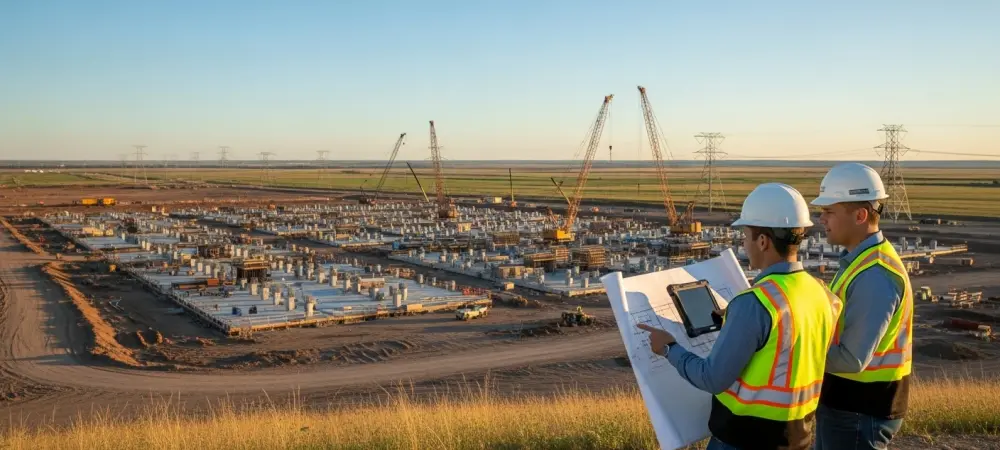
With the digital world’s insatiable demand for processing power, particularly fueled by the rise of artificial intelligence, the landscape of data infrastructure is rapidly evolving. We’re joined by Dominic Jainy, a veteran IT professional whose work at the intersection of AI, machine learning, and blockchain gives him a unique perspective on these seismic shifts. Today, we’ll explore the strategy behind massive new data center developments, focusing on Rowan Digital Infrastructure’s ambitious new campus in Temple, Texas. Our conversation will touch on the critical decisions driving a $700 million investment, the technical ingenuity of leveraging existing power grids, how these facilities are being purpose-built for AI, and what the emergence of new tech hubs like Temple signals for the future of the industry.
Rowan is launching a massive $700 million, 300MW project in Temple. Could you walk us through the strategic calculations behind such a significant investment in this specific location and outline the key milestones planned to reach the 2027 operational target?
When you see a number like $700 million for a 300-megawatt campus, you’re looking at a chess move, not just a simple construction project. The strategy here is about securing a massive foothold for the future of AI. The calculation is simple: AI requires immense power, and the first to secure that power at scale wins. By acquiring a 700-acre plot, Rowan isn’t just building a data center; they’re building a long-term resource. The key milestone is hitting that 2027 operational date, which is incredibly ambitious. The critical piece enabling this timeline is their established power partnership with Oncor. Without that power secured upfront, a project of this magnitude could be stuck in development for a decade.
The new campus leverages power infrastructure from the former Moriah Data Center. Can you elaborate on the specific technical and financial advantages of this approach and how the partnership with Oncor helps you become operational much faster than a typical greenfield project?
This is the secret sauce to their speed and a brilliant strategic advantage. Building on a true greenfield site means you’re starting from scratch, which involves years of navigating permits and construction for new high-voltage transmission lines and substations. It’s a logistical and financial nightmare. By siting the new campus adjacent to their existing Moriah facility, Rowan gets to plug into an already-built, robust power infrastructure. This means no new transmission or substation construction is needed. Financially, this saves tens, if not hundreds, of millions of dollars. More importantly, it shaves years off the project timeline, allowing them to meet the urgent demands of the AI market and start generating revenue far sooner than competitors building from the ground up.
CEO Charley Daitch stated this campus enables breakthroughs in medicine and climate solutions through AI. Beyond providing space and power, what specific design features are being built into this facility to cater directly to the unique, high-density demands of modern AI workloads?
While the public statements focus on the noble outcomes, the engineering that enables them is what’s truly fascinating. When a facility is planned for 300 megawatts, its entire design philosophy is centered on high-density computing. You’re not building for traditional servers; you’re building for racks of GPUs that consume enormous amounts of power and generate incredible heat. This means from day one, the blueprints must incorporate advanced cooling systems, whether it’s liquid cooling or highly sophisticated air handling. The power distribution within the facility has to be exceptionally robust to handle the intense, fluctuating loads of AI training models. So, even without seeing the blueprints, the scale itself tells you this isn’t just about providing empty space; it’s about creating a specialized environment engineered specifically for the intense demands of the AI revolution.
With Meta also building nearby, Temple is becoming a data center hub. What specific competitive advantages did Temple offer over other Texas locations, such as San Antonio where you also operate, regarding land availability, utility cooperation, and the unanimous support from the City Council?
The emergence of Temple as a hub is a classic case of having all the right ingredients at the right time. First, land. You can’t build a 700-acre campus in a dense, primary market without astronomical costs, if at all. Temple offered the available space. Second, and most critically, is the utility partnership. A willing and capable power partner like Oncor is non-negotiable. But the human element is just as important. The article notes that Rowan received unanimous final approval from the Temple City Council. That kind of unequivocal political and community support is invaluable. It signals a smooth, cooperative path forward, which is a massive de-risking factor compared to locations where projects can get bogged down in regulatory battles for years. Meta’s presence simply validates the choice, creating a positive feedback loop that attracts more talent and investment.
What is your forecast for the growth of large-scale data center campuses in secondary markets like Temple, Texas, especially as AI continues to drive unprecedented power demands?
My forecast is that what we’re seeing in Temple is the blueprint for the next decade of digital infrastructure development. The relentless demand for power driven by AI is fundamentally reshaping the map. Primary data center markets are becoming saturated—they’re running out of affordable land and, more importantly, available power. This is forcing a migration to secondary markets like Temple that possess the holy trinity for data center development: vast tracts of land, cooperative utility partners with available capacity, and supportive local governments. We are going to see a surge in these multi-hundred-megawatt campuses popping up in unexpected places across the country, turning small towns into the new, critical hubs of the global digital economy.