

Dominic Jainy stands at the forefront of the digital revolution in heavy industry, bringing a sophisticated understanding of how artificial intelligence and robotics intersect with the grit of traditional manufacturing. With an extensive background in machine learning and blockchain, Jainy has dedicated his career to transforming high-stakes environments where human safety and operational efficiency were once at odds. His perspective on the aluminum sector is particularly timely, as he explores how the industry can navigate a perfect storm of rising energy costs and volatile global trade routes. In this discussion, we examine the systemic shift toward automated smelting and the technological innovations required to survive in one of the most punishing industrial settings on Earth.
The following conversation explores the strategic pivot toward industrial resilience, emphasizing how robotic precision mitigates the dangers of extreme heat and toxic emissions. We delve into the staggering energy requirements of modern smelting, the engineering necessary to protect sensitive electronics from electromagnetic interference, and the role of automated systems in stabilizing global supply chains.
Global aluminum supply faces significant pressure due to disruptions in strategic routes like the Strait of Hormuz. How does automation specifically help producers buffer against these external geopolitical shocks, and what internal operational shifts are required to successfully transition toward this higher level of industrial resilience?
The fragility of the global supply chain has never been more apparent than it is today, especially with the Persian Gulf region accounting for roughly 9% of world production. When strategic bottlenecks like the Strait of Hormuz are threatened, producers must find ways to maintain operational continuity despite the surrounding uncertainty. Automation acts as a critical buffer by allowing plants to maintain a consistent output with fewer manual interventions, effectively decoupling production rates from the availability of local labor or the immediate arrival of specialized personnel. To truly transition toward this resilience, a facility must shift its internal culture from reactive maintenance to a data-driven, predictive model. This involves integrating systems that can simulate various supply scenarios and adjust smelting parameters automatically to preserve resources during periods of high market volatility.
Smelting processes involving the Hall-Héroult method reach temperatures near 950°C and create high-risk environments. When deploying robots for tasks like anode changing or furnace cleaning in these extremes, what are the primary engineering hurdles, and how do these automated systems maintain precision while operating ten times faster than humans?
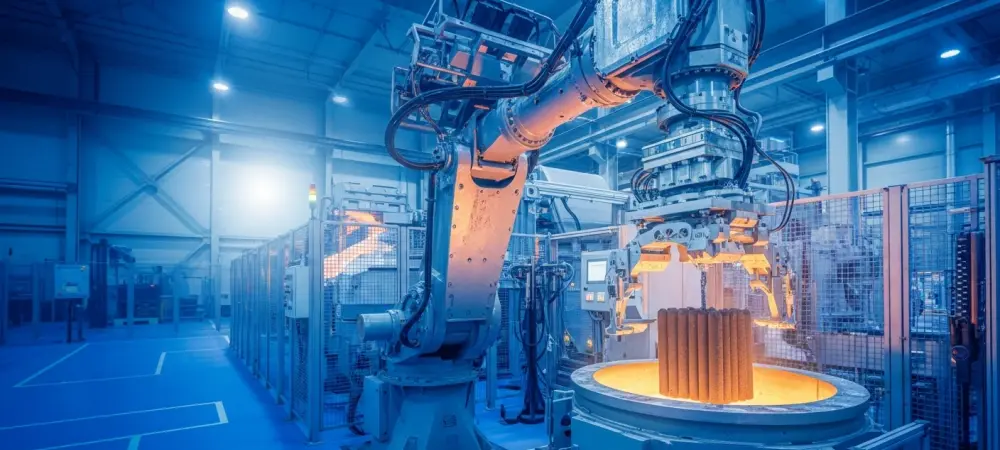
Operating in an environment that hovers around 950°C is an incredible feat of engineering because most standard industrial components would fail within minutes under such intense thermal stress. The primary hurdle is designing specialized cooling jackets and heat-resistant alloys that protect the robot’s joints and internal sensors without sacrificing their range of motion. We see these systems performing tasks like anode changing and furnace cleaning with a level of repeatability that human workers simply cannot sustain over a long shift. Because the robots are built with high-torque actuators and advanced spatial mapping, they can move with a swift, calculated grace that is ten times faster than a manual crew. This speed isn’t just about output; it’s about minimizing the time the furnace doors are open, which helps keep the internal temperatures stable and reduces the overall strain on the equipment.
High-risk zones like electrolysis rooms expose workers to thermal stress, toxic emissions, and electrical accidents. Can you detail the safety protocols involved when removing human presence from these critical areas, and what specific metrics or improvements in accident rates are typically observed after implementing automated handling solutions?
In the electrolysis room, the air is thick with heat and the ever-present threat of toxic emissions, making it one of the most hazardous workplaces in the world. When we implement automated handling solutions, the first safety protocol is the establishment of “exclusion zones” where high-voltage equipment and molten metal are handled exclusively by machinery. Companies like Rio Tinto have seen significant improvements in their safety metrics by using robots for dangerous welding and component handling, which fundamentally removes the human variable from the most accident-prone zones. We typically observe a sharp decline in incidents related to thermal exhaustion and respiratory issues once the “boots on the ground” are replaced by remote monitoring stations. This shift doesn’t just save lives; it transforms the workplace into a controlled environment where the heavy lifting is done by steel and silicon rather than human muscle.
Producing a single ton of aluminum can consume approximately 14 MWh of energy. How does the precision of robotic automation minimize waste to stabilize energy usage, and what does the long-term profitability look like when balancing the high initial investment against the reduction in operating errors?
The energy intensity of this industry is staggering, with 14 MWh of power required for every single ton of aluminum that leaves the plant. Robotic automation addresses this by bringing a level of precision to the smelting process that human operators find difficult to maintain, such as the exact positioning of anodes to optimize the electrical current flow. By reducing the frequency of operating errors, such as over-feeding or improper furnace cleaning, we see a much more stable energy profile that prevents costly spikes in consumption. While the initial capital expenditure for these robotic cells is high, the long-term profitability is driven by the reduction in raw material waste and the elimination of downtime caused by human error. Over time, the consistency of a robotized line ensures that the cost per ton drops significantly, allowing the facility to remain competitive even when global energy prices are fluctuating wildly.
Industrial environments often contain abrasive dust and intense electromagnetic fields that can interfere with sensitive electronics. What specialized technical adaptations are necessary to protect robotic components in a foundry, and how must artificial intelligence evolve to manage the real-time process variability inherent in smelting?
A foundry is a nightmare for traditional electronics because the abrasive dust acts like sandpaper on moving parts, and the massive electromagnetic fields can scramble unshielded circuits. To counter this, we utilize specialized Faraday cage enclosures for the control units and use fiber-optic communication lines that are immune to electrical interference. The next step in this evolution is the implementation of artificial intelligence that can “feel” the variability of the smelting process in real time, adjusting for tiny changes in the chemical bath or the temperature of the pot. We need AI models that are robust enough to handle the chaotic nature of molten metal, moving beyond simple programmed loops to a more cognitive approach that anticipates problems before they lead to a system failure. This level of technical adaptation is what will ultimately lead us to the “lights-out” foundry, where the machines are self-correcting and shielded against the harsh reality of their surroundings.
What is your forecast for aluminum foundry automation?
I believe we are entering an era where the “autonomous foundry” will transition from a futuristic concept to a global standard for any producer wishing to stay relevant. Over the next decade, the focus will shift from automating isolated tasks—like anode changing—to the complete orchestration of the smelting process by advanced artificial intelligence. In regions like North America and Europe, where labor costs and environmental regulations are high, this transformation will happen even faster as companies seek to protect their margins. We will see a specialized marketplace emerge for highly resilient robotics that can survive the 950°C heat for years, not just months. Ultimately, the industry will move away from being a labor-intensive, high-risk sector and toward a high-tech, precision-driven manufacturing model that is far more resilient to the geopolitical and economic shocks we see today.