

Centrostyle, an Italian manufacturer of eyeglass cleaning cloths, faced significant challenges in the post-print handling of their products, driven by the inefficiency and health risks posed by traditional methods. The conventional process involved heavy reels, which required labor-intensive manual handling to detach and package the cloths, resulting in inefficiencies and potential workplace hazards. To overcome these obstacles, Centrostyle embarked on a transformative journey to modernize their operations, seeking an innovative solution that would not only streamline processes but also enhance worker safety and productivity. This quest for improvement led them to partner with Roboprint, an Italian startup specializing in robotic automation.
Collaborative Innovation
Roboprint, a forward-thinking startup, was entrusted with the task of developing an automated system that could efficiently handle the detachment and packaging of eyeglass cleaning cloths. Recognizing the complexity of the task, Roboprint sought collaboration with BBS ROBOT, a seasoned robotics and automation consultant and distributor. Through this partnership and utilizing robots from Shibaura Machine, Roboprint engineered a groundbreaking solution, revolutionizing Centrostyle’s operations by transitioning from manual labor to robotic efficiency.
The resulting solution, known as the “Splitter,” successfully automated the detachment process. The Splitter utilized an innovative system that pulls and folds the paper roll at an acute angle, causing the cloth patches to be slightly detached. A second conveyor belt then completely separated these patches, preparing them for subsequent processing stages. This automated approach significantly reduced the need for manual intervention, thereby mitigating the risks and inefficiencies associated with traditional methods.
Advanced Robotic Integration
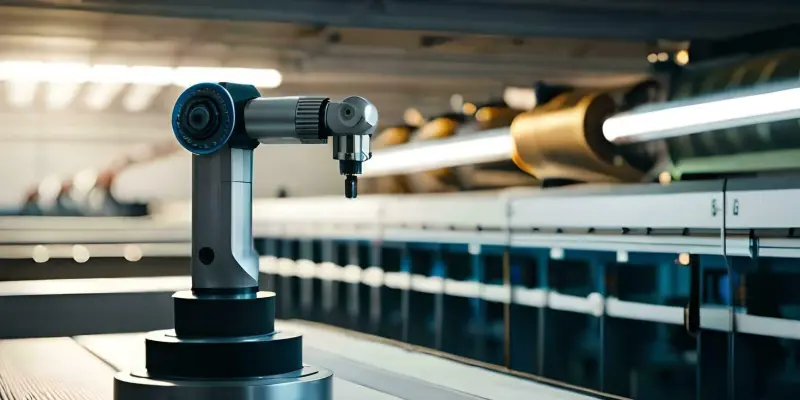
Central to the success of the Splitter system was the integration of two Shibaura Machine THE600 SCARA robots. These advanced robots played a crucial role in the automated handling of the detached cloth patches. Equipped with precision suction channels, the THE600 SCARA robots were able to grab and stack the patches according to their sizes, addressing the diverse size requirements of Centrostyle’s products and ensuring uniformity in the stacking process. The THE600 SCARA robots offered a perfect balance of speed, precision, and payload capacity, making them ideal for the demanding tasks of the Splitter system. Their compact design and superior performance, especially in handling high payloads without compromising accuracy, provided the necessary reliability and efficiency for the automated process. This seamless integration of robotic technology not only enhanced productivity but also maintained the high-quality standards expected by Centrostyle.
Efficiency and Safety
The implementation of the SCARA robots brought about a drastic reduction in manual handling steps, significantly minimizing workplace hazards and enhancing overall safety for Centrostyle’s workers. The use of two conveyor belts automatically handled the stacked patches, efficiently preparing them for safe boxing by operators. This automated process eliminated the need for workers to manually lift and move heavy reels, reducing the risk of injuries and fostering a safer work environment. Synchronization between the SCARA robots was a critical factor in ensuring the seamless operation of the Splitter system. The robots maintained constant communication with each other, preventing collisions and enhancing safety throughout the process. From detachment to packaging, the synchronized operation of the robots ensured a smooth and uninterrupted workflow, further contributing to the overall efficiency and safety of Centrostyle’s manufacturing environment.
Technological Reliability
A cornerstone of the system’s reliability was Shibaura Machine’s TS5000 robot controller. This advanced controller combined edge computing protocols with vibration analytic tools to generate predictive maintenance profiles, significantly reducing downtime and ensuring smooth and continuous operation. The ability to anticipate and address potential maintenance issues before they escalated was pivotal in maintaining the Splitter system’s high performance and reliability.
In addition to the hardware, the use of intuitive programming software like the TSAssist industrial robot programming tool was vital. With its user-friendly features, including PLC communication adaptation and 3D simulation capabilities, TSAssist facilitated the seamless integration and operation of the robots within Centrostyle’s manufacturing environment. This software tool allowed for easy programming and troubleshooting, ensuring that the robotic system could be quickly adapted to meet the specific needs of Centrostyle’s production processes.
Industry Implications
The implementation of the automated Splitter system had a profound impact on Centrostyle’s operations, resulting in significant operational cost savings and remarkable productivity gains. By reducing their reliance on manual labor, Centrostyle was able to save over €300,000 annually, while simultaneously enhancing the safety and well-being of their workforce. This case serves as a powerful demonstration of the broader potential that robotic automation holds for the textile and printing sectors, highlighting the tangible benefits that can be achieved through technological innovation.
The success of this project underscores several critical benefits, such as cost and efficiency gains, enhanced safety, and technological advancements. It also highlights the scalability of such solutions, prompting the potential for further adoption in other areas of textile processing. The versatility and adaptability of robotic automation make it an appealing option for businesses seeking to improve operational efficiency and competitiveness in an increasingly automated industrial landscape.
Exploring New Automation Frontiers
Contrary to sectors like automotive and logistics where robots are more commonly employed, this project showcases innovative applications of robotics in the textile industry—a field traditionally reliant on manual labor. This pioneering approach marks new territory in the automation landscape, demonstrating the potential for similar technological advancements in other industries. By integrating robotic solutions into their operations, companies can unlock new levels of efficiency, safety, and productivity, setting new benchmarks for industry standards and performance.
As more companies recognize and implement robotic solutions, driven by proven success stories like that of Centrostyle and Roboprint, the trend towards automation is likely to accelerate. This will spur significant technological advancements and operational efficiency across various industries, fostering a new era of innovation and growth. The successful deployment of the Splitter system serves as a testament to the transformative power of robotic automation, offering valuable insights and inspiration for future projects in the textile industry and beyond.
Conclusion
Centrostyle, an Italian company known for manufacturing eyeglass cleaning cloths, encountered significant challenges with their post-print handling procedures. The conventional methods they employed were not only inefficient but also posed health risks to their workers. The traditional process involved using heavy reels, necessitating strenuous manual labor to detach and package the cloths. This labor-intensive approach led to inefficiencies and increased the likelihood of workplace injuries.
To address these issues, Centrostyle decided to modernize their operations and improve both efficiency and worker safety. Their quest for a more innovative solution led them to collaborate with Roboprint, an Italian startup specializing in robotic automation. By partnering with Roboprint, Centrostyle aimed to streamline their processes and create a safer, more productive work environment.
This strategic partnership allowed Centrostyle to leverage advanced robotic technology, which not only automated the handling and packaging of the cleaning cloths but also significantly reduced the physical strain on their workers. As a result, the company saw marked improvements in operational efficiency and a substantial decrease in workplace hazards. This transformative journey underscored the importance of embracing technological innovation to overcome traditional manufacturing challenges.