

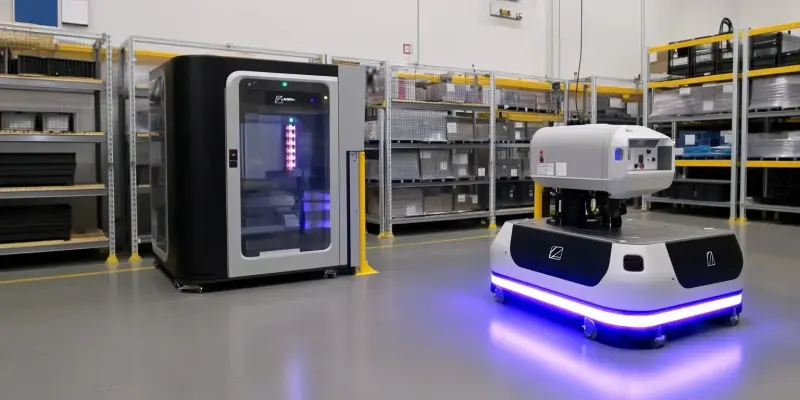
In an era where technological advancements are reshaping industries at an unprecedented pace, the transformation witnessed in warehouse management and supply chains stands out remarkably. Advanced robotic technology has become a linchpin in this ongoing revolution, reengineering the processes that drive efficiency, accuracy, and competitiveness in warehouses worldwide. As we delve into the nuances of this transformation, it becomes crucial to understand its historical context by tracing the evolution of industrial revolutions and the unique attributes defining the current phase.
The journey begins with the first industrial revolution, marked by the utilization of steam power to mechanize production processes. This era laid the foundational blueprint for modern manufacturing by enabling mass production and significantly boosting efficiency. The second industrial revolution further advanced these capabilities through the widespread adoption of electricity, culminating in factory efficiencies and the advent of assembly lines, which revolutionized various industries, particularly automotive manufacturing. The third industrial revolution, which commenced in the 1960s, integrated digital technology into production processes, giving rise to automation, enhanced data management, and more sophisticated manufacturing techniques.
The Evolution of Industrial Revolutions
The first industrial revolution represented a seismic shift from manual labor to mechanized production, leveraging steam power to drive machinery and improve operational efficiency. This transition paved the way for the modern manufacturing blueprint, enabling mass production and establishing a foundation for subsequent advancements.
The second industrial revolution witnessed the rise of electricity as a pivotal force in enhancing production capabilities. Factories became increasingly efficient, with the introduction of the assembly line radically transforming industries such as automotive manufacturing. This era saw a significant boost in productivity, as the streamlined processes facilitated quicker assembly times and higher output levels.
Entering the 1960s, the third industrial revolution marked a paradigm shift with the integration of digital technology into manufacturing processes. Computers and information technology became integral components, enabling greater automation, improved data management, and the development of more sophisticated manufacturing techniques. This transition laid the groundwork for the current advancements driving the fourth industrial revolution.
The Fourth Industrial Revolution: A New Era of Robotics
The fourth industrial revolution, distinguished by the convergence of the physical and digital domains, brings forth unprecedented innovations such as artificial intelligence (AI), the Internet of Things (IoT), robotic process automation, autonomous vehicles, 3D printing, and cyber-physical systems. These technologies are integral in enhancing manufacturing processes by seamlessly integrating virtual and physical production environments.
Manufacturers have been quick to leverage these advancements, significantly boosting efficiency, accuracy, and quality in production lines. Industrial robots have become indispensable, transforming assembly lines by undertaking tasks such as welding, assembling, heavy lifting, and auto body painting. Notably, the automotive industry has been at the forefront of this revolution for several years, utilizing these robots to expedite processes, enhance safety, and reduce costs.
Expanding beyond automotive industries, sectors such as e-commerce, fast-moving consumer goods (FMCG), retail, and pharmaceuticals are increasingly adopting robotic technology. The proliferation of industrial robots is most prominent in countries like the USA, China, and Japan, although adoption in regions like India remains sporadic despite its potential. In India, robots are widely used in manufacturing and assembly but less so in the supply chain segment, where storage and inventory management account for a substantial portion of the chain’s capacity, suggesting immense potential for transformation.
Expanding Robotic Technology Beyond Automotive Industries
While the automotive industry remains a pioneer in adopting robotic technology, other sectors such as e-commerce, FMCG, retail, and pharmaceuticals are rapidly catching up. This diversification is leading to significant transformations across the global supply chain. Countries like the USA, China, and Japan are leading in the number of industrial robots deployed. In contrast, India’s adoption has been uneven, with widespread use in manufacturing and assembly sectors but lagging in supply chain applications.
In India, a significant portion of the supply chain remains technologically underserved, especially in warehousing and inventory management, which constitutes 60% of the entire supply chain process. The potential for transforming these sectors using robotics is immense, offering numerous benefits such as real-time inventory auditing, error elimination, and reduced pilferage. The expansion of robotic technology into non-automotive industries is accelerating, driven by the need for efficiency and accuracy in inventory management.
One stark example of how e-commerce and logistics industries are leading this charge is evident in companies like Flipkart. Over the last five years, these industries have aggressively adopted advanced robotic technologies to create high-productivity warehouses and optimize their supply chains. The exponential growth of e-commerce presents unique challenges, such as handling high volumes of diverse orders, managing multiple delivery locations, and ensuring rapid delivery services, often within a day. These challenges are further exacerbated during seasonal peaks, necessitating sophisticated solutions.
E-commerce and Logistics: Leading the Charge
The e-commerce and logistics sectors have spearheaded the rapid adoption of advanced robotic technology over the last five years, driven by the need to manage high-volume single-item and multiple-item orders across numerous locations. This trend is particularly noticeable in India, where e-commerce giants like Flipkart are leveraging robotics to enhance productivity and optimize supply chains.
The rapid growth of e-commerce has introduced unique challenges, such as managing varied order volumes, shipping to multiple destinations, and providing expedited delivery services like same-day and next-day delivery. Seasonal peaks further heighten these challenges, demanding advanced solutions to maintain efficiency. Robotic technology offers a robust answer, automating inventory management and sortation processes, and improving efficiency and accuracy in warehouses, fulfillment, and distribution centers.
The implementation of robotics has proven beneficial for Flipkart, significantly reducing fulfillment time, enhancing order profiling and sortation processes, and improving the accuracy of dimensioning and weighing. This improvement has not only increased throughput to 48,000 items per hour but also reduced operational expenses by half and boosted revenue recognition by over 10%. These advances point to the profound impact of robotics in streamlining operations and enhancing overall efficiency.
Robotic Solutions for Warehousing Challenges
Robotic technology presents effective solutions to the challenges in warehousing, fulfillment, and distribution. By automating inventory management and sortation processes, companies can efficiently handle high order volumes, ensure accurate picking and packing, and conduct real-time inventory auditing. The example of Flipkart illustrates the transformative potential of advanced robotics, from streamlining order profiling to improving the precision of dimensioning and weighing processes.
The benefits realized from these technologies are substantial. Throughput rates, like those at Flipkart, increase significantly, operational expenses are halved, and revenue recognition improves by over 10%. This case underlines the significant efficiencies gained from robotic automation. The industry is rapidly moving towards integrating these technologies, driven by the need to address unique distribution challenges and improve productivity.
A case in point is Hong Kong’s Kerry Logistics, which has revolutionized its operations using goods-to-person robots. As one of the first third-party logistics providers in Asia to adopt this technology, Kerry Logistics has significantly enhanced order accuracy and fulfillment speeds. The arrival of real-time sales orders triggers robots to deliver goods to operators at pick-put stations, utilizing pick-put-to-light technology to denote which items should be picked. This innovation has improved picking accuracy to over 99% while increasing the pick rate by six times.
The Future of Warehousing and Supply Chains
In an era of rapid technological advancements, the transformation within warehouse management and supply chains is particularly noteworthy. Advanced robotic technology is at the heart of this revolution, reengineering processes to enhance efficiency, accuracy, and competitiveness globally. To fully appreciate the current phase, it’s essential to explore its historical context by examining the evolution of industrial revolutions.
The journey started with the first industrial revolution, which utilized steam power to mechanize production. This period laid the groundwork for modern manufacturing, enabling mass production and significantly enhancing efficiency. The second industrial revolution, driven by electricity, introduced factory efficiencies and assembly lines, revolutionizing industries like automotive manufacturing.
The third industrial revolution began in the 1960s, integrating digital technology into production. This era saw the rise of automation, improved data management, and more sophisticated manufacturing techniques. Today, we stand at the forefront of a new phase, where advanced robotics and AI continuously redefine operations in warehouses and supply chains, pushing the boundaries of what is possible.