

Introducing a Game-Changer in Compact Computing
Imagine a world where a device no bigger than a small book can outperform a full-sized desktop tower, handling everything from intensive gaming to complex AI model processing with ease. This is the reality brought to life by a remarkable mini PC that has captured the attention of tech enthusiasts and professionals alike. The purpose of this review is to dissect the capabilities of this compact powerhouse, evaluating whether it truly delivers on its promise of high performance in a portable form factor. Designed for those who demand workstation-level power without sacrificing desk space, this device aims to redefine expectations in the mini PC market.
The growing demand for compact yet powerful systems has spurred innovation, with manufacturers racing to pack cutting-edge technology into smaller footprints. This review will explore how this particular mini PC stands out in a crowded field, offering a detailed look at its hardware, design, and real-world applications. By focusing on its suitability for diverse users—ranging from gamers to content creators—the analysis aims to provide clarity for potential buyers navigating their options in an increasingly competitive landscape.
Unveiling the Hardware and Design
At the heart of this mini PC lies the AMD Ryzen AI Max+ 395 processor, a beast with 16 cores and 32 threads, capable of reaching turbo speeds up to 5.1GHz. Paired with the Radeon 8060S GPU built on RDNA 3.5 architecture, it offers graphical performance rivaling mobile discrete GPUs like the Nvidia RTX 4060. Support for up to 128GB of LPDDR5X RAM at 8000MHz and a pre-installed 2TB PCIe 4.0 SSD further solidify its position as a no-compromise solution for demanding workloads.
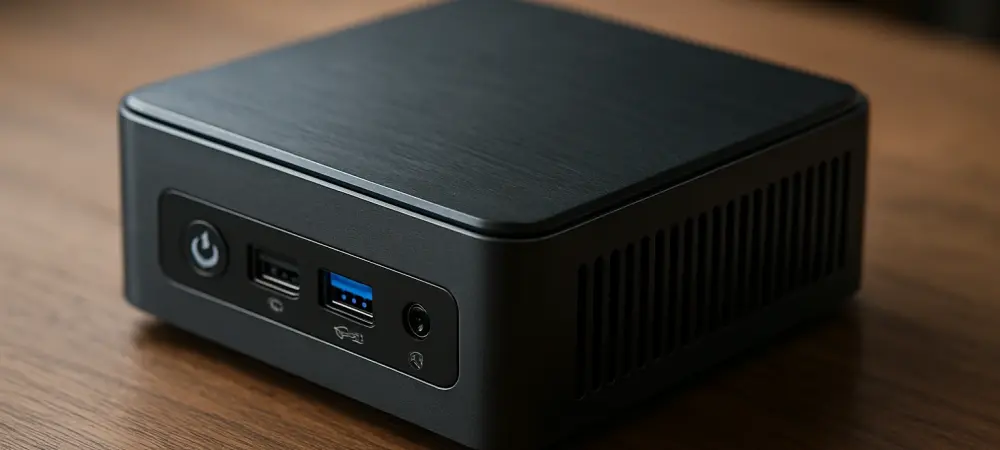
Beyond raw specs, the design strikes a balance between aesthetics and functionality, measuring a compact 200mm x 200mm x 60mm. The aluminum chassis, with its sleek silver and black finish, features angled corners for a modern, console-like appearance. Practical elements, such as a performance mode button to toggle between silent, balanced, and high-performance settings, and an easy-access panel for storage upgrades, enhance usability, though the absence of VESA mounting options limits placement flexibility.
Connectivity sets this device apart with forward-thinking options, including two USB4 Type-C ports, three USB 3.2 Gen 2 ports, HDMI 2.1, DisplayPort 1.4, Wi-Fi 7, and Bluetooth 5.2. Capable of driving up to four displays simultaneously, it caters to professionals requiring multi-monitor setups. These features ensure the system remains relevant for years to come, aligning with emerging tech standards and high-speed peripheral needs.
Performance Under the Microscope
Benchmark results reveal the exceptional prowess of this mini PC, with a 3DMark Steel Nomad Lite score of 11,201, surpassing even some desktop systems equipped with dedicated GPUs like the AMD Radeon RX 6600 XT. In CineBenc##4 tests, it consistently outperforms Intel-based competitors, showcasing its strength in multi-threaded tasks. Such metrics highlight its ability to handle intensive applications without breaking a sweat.
Real-world testing further confirms its versatility across various scenarios, from gaming at high settings to rendering 4K video edits and processing CAD designs. The integrated GPU delivers smooth frame rates in next-gen titles, while the processor manages complex AI workloads with efficiency. Power consumption ranges from 86W in silent mode to 175W in performance mode, a reasonable trade-off for the output provided in such a small package.
Multitasking efficiency stands out as a key strength, with the high-speed RAM ensuring seamless operation even when juggling multiple resource-heavy programs. Compared to other mini PCs in its class, this device offers a significant edge, often tripling graphical performance scores of Intel Arc-equipped systems. This makes it an ideal choice for users who prioritize speed and reliability in their daily tasks.
Weighing the Strengths and Limitations
Among the standout advantages of this mini PC is its unmatched performance within a compact form factor, making it a viable desktop replacement for power users. The future-proof connectivity options, such as USB4 and Wi-Fi 7, add to its appeal, ensuring compatibility with the latest peripherals and networks. Its versatility also shines through, catering to both professional applications like video editing and recreational uses like gaming.
However, certain drawbacks temper the enthusiasm, notably the premium pricing starting at $1,489.14 for the base configuration. This cost may deter budget-conscious buyers seeking more affordable alternatives. Additionally, the lack of VESA mounting support and absence of OCulink for external GPU integration could frustrate users with specific setup requirements or those needing even more graphical power.
Suitability varies across user groups based on these factors, with high-end users and professionals likely to find the investment worthwhile due to productivity gains. Conversely, casual users or those with lighter computing needs might struggle to justify the price tag, especially when more economical options exist in the market. This balance of pros and cons shapes the decision-making process for potential buyers.
Final Thoughts and Recommendation
Reflecting on the evaluation, the assessment revealed that this mini PC excelled in delivering top-tier performance, innovative design, and cutting-edge connectivity, despite a few minor design limitations and a steep price point. The hardware capabilities proved transformative for demanding workloads, while the compact form factor opened up new possibilities for space-constrained environments. It was a standout option in a field often dominated by larger systems. For those considering the next steps, exploring this device as a primary computing solution was highly recommended, particularly for professionals and gamers needing robust power without bulk. Comparing it against alternatives in the same price range was advised to ensure alignment with specific needs, such as multi-display support or storage expansion. Delving into user forums for real-world feedback could also provide valuable insights before making a final purchase decision.