

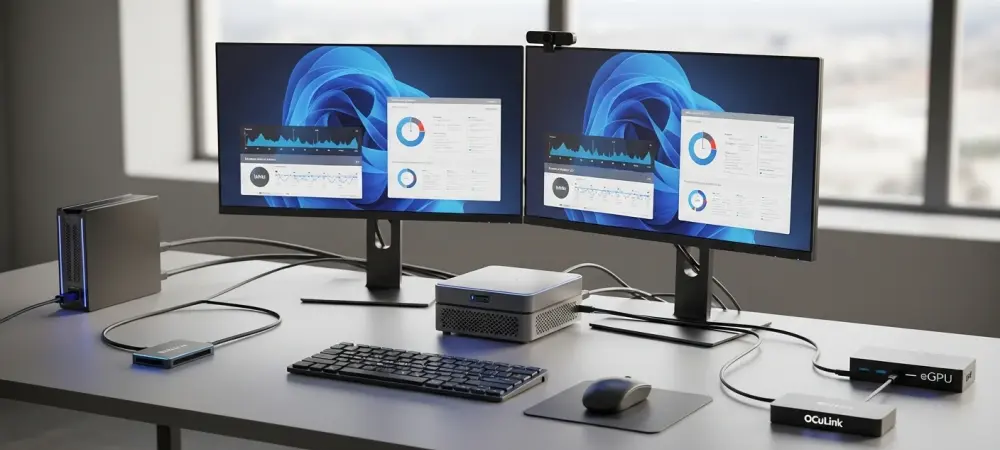
Power users chasing local AI, credible 1080p gaming, and a tangle‑free desk now eye a palm‑size box promising desktop punch without the tower clutter, and the ACEMAGIC F5A wagers it can be that do‑it‑all machine. This review examines whether ACEMAGIC’s Ryzen AI 9 HX 470 platform actually delivers value beyond hype, with a focus on real productivity, on‑device inference, and living‑room‑friendly acoustics.
At stake is more than raw speed: a compact form factor must balance thermals, I/O breadth, and upgrade paths. If the F5A threads that needle, it becomes a rare small desktop that scales from coding and content work to modern gaming—with room to evolve through eGPU support.
What This Review Seeks to Answer
Three questions guide the assessment: does the F5A’s silicon and cooling translate into consistent results, who benefits most from its feature mix, and where do memory choices or pricing undercut the appeal?
Answers hinge on how the 12‑core Zen 5 CPU, 55‑TOPS NPU, and Radeon 890M iGPU interact in mixed workloads, and whether the chassis and BIOS keep performance steady without roaring fans.
Product Overview and Standout Features
The platform centers on AMD’s Ryzen AI 9 HX 470, pairing 12 Zen 5 cores (up to 5.2 GHz) with a 55‑TOPS NPU and an RDNA 3.5 Radeon 890M iGPU (16 CUs, up to 3.1 GHz). Frame generation via FSR and Fluid Motion Frames signals serious 1080p intent.
Supporting hardware lands above class norms: dual USB4, OCuLink for eGPU, dual 2.5 GbE, Wi‑Fi 7, and two PCIe Gen4 M.2 slots. Cooling uses two centrifugal fans and an aluminum SSD spreader to tame cramped‑case thermals.
Performance Evaluation in Real‑World Scenarios
In productivity, the Zen 5 cores feel snappy, knocking out compiles, compressions, and scripting with short bursts that remain sustained under heavier batches. Responsiveness in daily multitasking stays crisp.
Local AI is the headline: the NPU accelerates vision and voice pipelines while offloading Studio Effects. Mixed CPU–GPU–NPU agents show low latency and strong efficiency, shrinking power draw versus GPU‑only runs.
Gaming aligns with expectations: esports titles hit high frame rates at 1080p, while AAA needs FSR and Frame‑Gen for smooth play. Media creators gain from fast encodes and responsive timeline scrubbing.
USB4 carries high‑speed storage and multiple displays without choking bandwidth, and OCuLink unlocks straightforward eGPU scaling to modern discrete cards. Networking proves quick and consistent on Wi‑Fi 7 and dual 2.5 GbE.
Advantages and Drawbacks
Strengths are clear: meaningful on‑chip AI, a competitive iGPU, and I/O rarely found in this size. Dual NVMe slots suit OS‑plus‑projects layouts, and OCuLink extends longevity with dGPU muscle.
Trade‑offs warrant attention. Potential soldered LPDDR5X in prebuilts limits RAM upgrades, and the iGPU still leans on upscaling in demanding games. Under sustained AI or gaming, fan noise rises, and the prebuilt price premium stings.
Summary Judgment and Clear Recommendation
Value landed well for anyone using USB4, OCuLink, and the dual NVMe bays; the F5A read as balanced, AI‑ready, and genuinely capable at 1080p with the right settings. It also held an edge over prior mini PCs lacking NPUs and modern RDNA graphics.
Recommended paths split neatly: the $759 DIY barebone suited tinkerers who want DDR5 SODIMMs and custom Gen4 storage, while the $1,299 prebuilt only made sense with ample RAM and fast drives at a fair, transparent premium.
Who Should Buy It and Purchase Considerations
Ideal buyers include local‑agent builders, coders, and data tinkerers who benefit from on‑device inference, along with students and professionals who need compact productivity and light creative headroom. Gamers content with optimized 1080p will be satisfied.
Configuration tips are straightforward: aim for 32–64 GB in dual channel, split projects across two NVMe drives, and consider an OCuLink eGPU for heavy creation or higher‑end gaming. Verify memory type before purchase, plan for acoustics in tight desks, and confirm app driver support.
In closing, the F5A proved a small desktop that rewarded informed buyers: choose the DIY barebone for flexibility and price‑to‑performance, and opt for the prebuilt only when memory and storage meet needs without a steep markup, while keeping the eGPU path in mind for long‑term growth.