

Today we’re speaking with Dominic Jainy, an IT professional whose work at the intersection of AI, machine learning, and now, micro-robotics, is pushing the boundaries of what we thought was possible. His team’s latest creation, a swarm of programmable robots smaller than a grain of salt, is poised to revolutionize fields from medicine to manufacturing. We’ll be exploring the incredible innovations behind these penny-sized bots, from their unique propulsion system and bee-inspired communication to the challenges of integrating a full computer onto a microscopic chassis, and what this all means for the future.
Your team created programmable robots smaller than a grain of salt that cost just a penny each. Could you walk us through the key manufacturing innovations that allow for this incredible miniaturization and cost-effectiveness, perhaps sharing an anecdote from the development process?
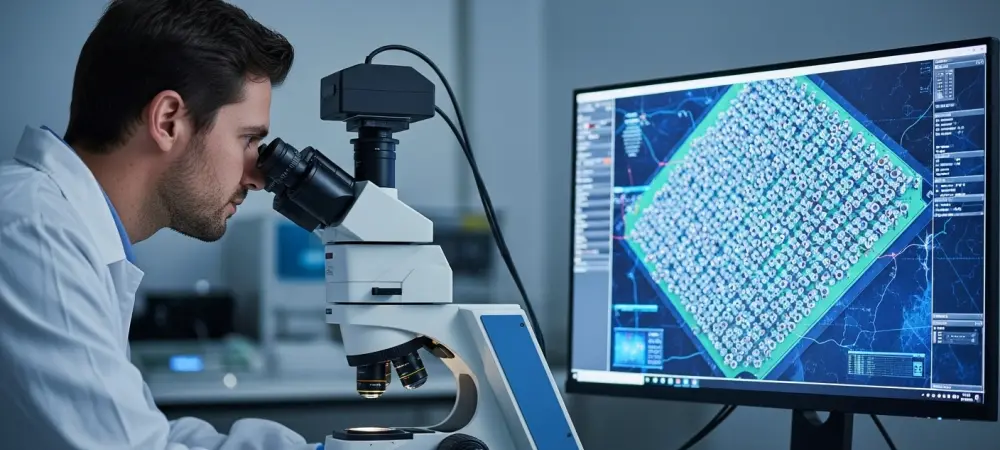
It’s a scale that’s still hard to wrap your head around, even for us. We’ve effectively made autonomous robots 10,000 times smaller than what came before, and that leap required a complete paradigm shift. The key was moving away from traditional, bespoke assembly and leveraging techniques from semiconductor manufacturing. By fabricating them on a silicon wafer, much like computer chips, we can produce thousands at once. This massively parallel process is what drives the cost down to a mere penny per unit. I remember the first time we successfully etched a full batch. Looking at that wafer under the microscope, seeing thousands of complete, functional robots where there was once just a blank slate… it was a profound moment. We realized we hadn’t just built a tiny robot; we had created a pathway to produce them in populations.
The article mentions a unique propulsion system that moves surrounding water with an electrical field. Can you explain the step-by-step physics of this process and how you fine-tune the field to coordinate group movements, similar to a school of fish?
Absolutely. Operating in water at this scale is a massive challenge because of viscosity; it’s like trying to swim through honey. Instead of fighting that resistance with a tiny propeller, we decided to work with the environment itself. The robot generates a very precise electrical field around its body. This field interacts with ions in the liquid, gently nudging them. These energized ions, in turn, push the nearby water molecules, creating a subtle but powerful current that propels the robot forward. The real magic happens when you start adjusting that field. By modulating its shape and intensity, we can steer, reverse, and even perform complex maneuvers, reaching speeds of up to one body length per second. For group coordination, we use this same principle on a larger scale, creating fields that influence the whole swarm, allowing them to move in beautiful, coordinated patterns, just like a school of fish turning in unison.
These robots can detect temperature changes within a third of a degree and communicate this via a “waggle dance.” Could you elaborate on how the onboard processor translates sensor data into this movement and give a specific example of how this could monitor cellular health?
The sensitivity is truly remarkable, isn’t it? Being able to detect temperature shifts within a third of a degree Celsius opens up a whole new world of diagnostics at the micro-level. The onboard processor is the brain that makes this possible. When the integrated sensor picks up a temperature fluctuation, the processor converts that raw data into a specific motor command. This command initiates a pre-programmed movement pattern—the “waggle dance” we borrowed from honeybees. The intensity or frequency of the waggle directly corresponds to the data, creating a simple, visible language. Imagine deploying a swarm of these into a tissue sample. If a single cell becomes cancerous, its metabolic rate often increases, generating a tiny amount of extra heat. One of our robots could drift by, detect that minuscule temperature spike, and begin its waggle dance, instantly signaling the location of the anomaly to an external observer or other robots in the swarm.
This is the first sub-millimeter robot with a complete computing system powered by light pulses. What was the single greatest challenge in integrating a processor, memory, and sensors onto such a tiny chassis, and how does that system enable dividing tasks among a group?
The greatest challenge was definitely the integration. It’s one thing to miniaturize a sensor or a memory cell, but it’s an entirely different beast to get a processor, memory, and sensors all working together on a chassis measuring just 200 by 300 micrometers. The power and communication were a huge hurdle. We solved this by using light pulses, which serve a dual purpose: they provide the energy to power the onboard electronics and simultaneously transmit programming instructions. This was the breakthrough that allowed us to create the first sub-millimeter robot with a complete computing system. This system is also what enables collaboration. Each robot is fabricated with a unique identifier. When we send out light-based commands, we can address them individually, telling one robot to act as a temperature sensor, another to move toward a specific location, and a third to simply hold its position as a beacon. This allows a swarm to divide and conquer complex tasks in a way a single unit never could.
What is your forecast for micro-robotics? Considering future versions will store more complex programs and integrate new sensors, what specific medical or industrial breakthroughs do you realistically envision these robots enabling in the next decade?
I truly believe we are just at the beginning; this is the first chapter of an entirely new book for robotics. In the next decade, as we enhance their capabilities with more complex programs and a wider array of sensors—perhaps for chemical or pressure detection—the applications will be transformative. In medicine, I envision swarms of these robots being used for in-body diagnostics at the cellular level, identifying diseases long before they are detectable by current methods. They could even be tasked with constructing microscale medical devices directly inside the body. In the industrial world, they could act as microscopic builders, assembling new materials atom by atom or performing quality control from within a product. We’ve established the foundation: a brain, a motor, and a sensor in a package almost too small to see that can survive for months. The door is now open to layer on incredible intelligence and functionality, creating a future where robotics operates on a scale we’ve only dreamed of.