

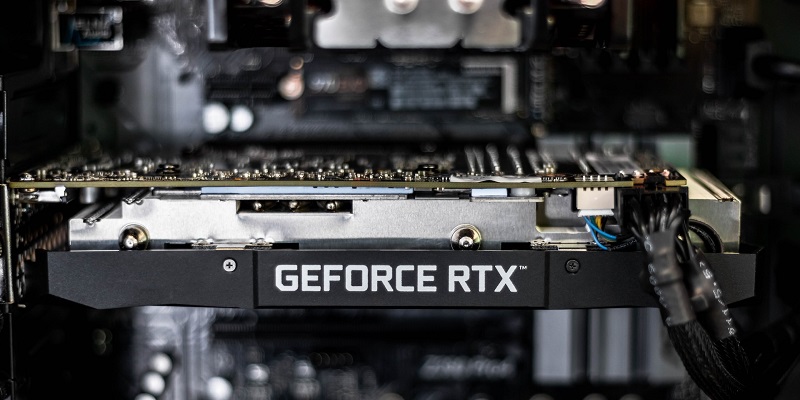
When it comes to custom PC builds, enthusiasts are always pushing the boundaries of what’s possible. One ambitious Redditor has taken things to a whole new level by creating their own Mini-ITX NVIDIA Founders Edition graphics card. By modifying a GeForce RTX 3060 GPU, this DIY project has caught the attention of the tech community.
Description of the modder’s creation
For this impressive feat, the modder chose to use a Gainward GeForce RTX 3060 Pegasus graphics card as a reference. Using their creativity and skill, they utilized a 3D printer to craft the entire heatsink and shroud. The result is a custom design that closely resembles what the team at NVIDIA might have created.
Design Similarities and Differences
Examining the custom NVIDIA Founders Edition design, it is evident that the modder paid careful attention to detail. The card boasts a solid-looking finned shroud on the front, which is typically utilized as a heat sink in the official design. However, in this modded variant, it serves as an attractive cover plate.
Another noteworthy feature of the mini-ITX design is the presence of a single 92mm fan from Noctua. This choice ensures efficient and effective cooling, while also maintaining a compact form factor suitable for smaller PC builds.
Cooling Performance
One of the crucial factors in any graphics card design is how well it handles heat dissipation. Fortunately, in testing, the Mini-ITX NVIDIA Founders Edition mod exhibited similar cooling performance to the standard shroud. This is a promising outcome, indicating that the modder’s design choices were well-considered.
Deformation Issues and Solutions
However, some challenges were encountered during the creation process. As PLA filament was used for 3D printing, deformation became noticeable once temperatures reached around 60°C. The modder observed that the fan holder started to curve and deform downwards, impacting the aesthetics and potentially the overall stability.
To address this issue, the modder plans to explore alternative materials such as ABS or PETG for future 3D printing endeavors. These materials are known for their higher temperature resistance and enhanced durability, which should help overcome the deformation problems.
Future improvements and considerations
Although the 3D-printed design currently lacks a backplate, it is possible that a more finalized version may feature one in the future. A backplate would provide structural support and offer a polished and cohesive appearance, aligning closer to the official NVIDIA Founders Edition aesthetic.
NVIDIA’s Mini-ITX Founders Edition graphics card
While this modified creation is undoubtedly impressive, it is worth noting that NVIDIA has yet to produce an official Mini-ITX Founders Edition graphics card. This highlights the ingenuity and creativity of the modding community, which constantly pushes the boundaries and fills in gaps where manufacturers may not venture.
In the world of custom PC builds, innovation knows no bounds. The Redditor’s successful endeavor to create a Mini-ITX NVIDIA Founders Edition graphics card using a GeForce RTX 3060 is a testament to the passion and skills of PC enthusiasts. Despite the challenges faced, the modder’s creation closely mimics what the green team might have accomplished, proving that with determination and creativity, anything is possible in the realm of DIY PC modifications.