

Lead: A Sharper Path Emerged
Smartphones, cars, and factories now inhale data faster than networks can exhale capacity, and that imbalance is forcing 6G timelines to bend, not break, under rising expectations. The schedule looks bold: first commercial footholds around 2029, years earlier than the usual cadence. The catalyst is unusual for telecom—an early, cross-vendor alliance that aims to trim integration drag before the first radios leave the lab. Qualcomm has pushed beyond bilateral demos to align radio-frequency behavior across gNodeB and user equipment with Ericsson, Nokia, and Samsung. The bet is simple: prove interoperability and spectrum agility now, and the market negotiates fewer surprises later.
Nut Graph: Why This Story Matters
Network demand has outgrown incremental fixes. Edge AI workloads, immersive services, and latency-sensitive apps strain today’s RAN and core, while operators face strict energy budgets and tight upgrade windows. A faster route to 6G would not just raise peak rates; it would reframe cost, efficiency, and time to revenue.
Policy and standards decide what can ship and when. By tying prototypes to 3GPP priorities and eyeing harmonized spectrum from upper 6 GHz to 8.4 GHz, the effort converts regulatory momentum into deployable features. That alignment could turn paper spectrum into living capacity.
Body: Inside the Fast-Track
The coalition’s most distinctive move is RF alignment across multiple vendors before standards freeze. “First-wave fragmentation is the real tax,” said one network architect. Early over-the-air checks of beam patterns, reference signals, and channel feedback aim to prevent that tax from compounding at launch.
AI is treated as infrastructure, not an overlay. Prototypes emphasize AI-driven scheduling, beam management, and resource allocation that learn from traffic in real time. Distributed inference at the edge positions the network to host privacy-preserving, low-latency applications without hauling every decision back to the core.
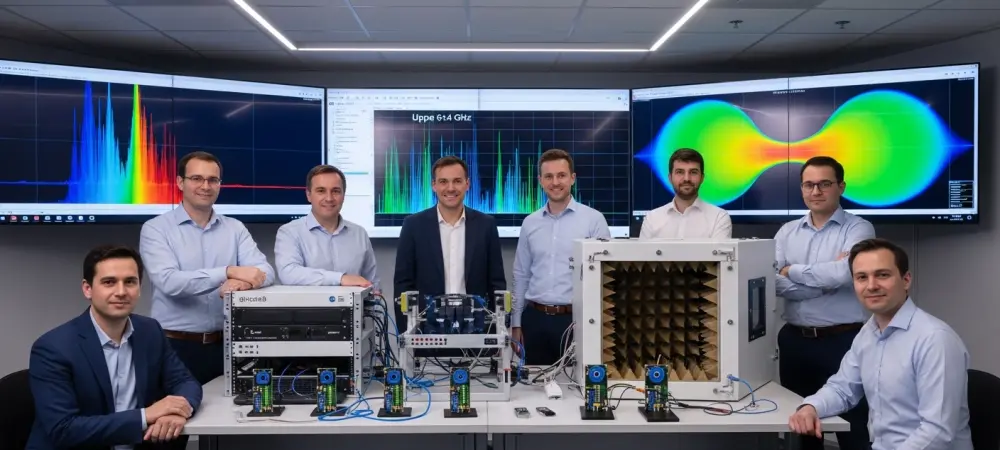
Spectrum plans anchor the technical story. Trials already exercise 400 MHz channels in the upper 6–8.4 GHz range, combining wide bandwidth with numerologies designed for shorter slots and tighter control loops. Giga-MIMO is expected to lift capacity while keeping coverage practical in those mid-to-upper bands, balancing brute-force throughput with spectral efficiency.
Power is the parallel design axis. Telco servers blend CPUs, GPUs, and accelerators mapped to RAN, core, and edge AI tasks, with co-designed software to hunt for per-feature energy wins. Radios tuned for brownfield sites respect fronthaul constraints, mast weights, and cooling envelopes; as one planner noted, “A great radio that doesn’t fit the rack is just a white paper.”
System validation ties the threads together. End-to-end trials span radios, transport, and compute to retire integration debt early. Cross-vendor testing reduces the risk of divergent implementations, setting a path where operator RFPs can mandate interoperable profiles, energy KPIs, and telemetry that feeds both performance and sustainability dashboards. Evidence already surfaced in working prototypes: wider channels cutting scheduling overhead, beam agility sustaining links in dense urban layouts, and RF alignment that held across partner equipment. Analysts have begun to frame a consensus—early ecosystem coordination and standards harmonization were no longer optional if global scale was the goal.
Conclusion: The Road Operators and Builders Took
The next steps favored pragmatism. Operators prepared pilots in upper 6–8.4 GHz, readied sites for Giga-MIMO, and put data pipelines and model governance in place for AI-native RAN functions. Vendors finalized RF co-testing across gNodeB and UE stacks, validated brownfield installs, and right-sized heterogeneous compute placements. Policymakers harmonized channelization to enable wide-band operation and backed conformance regimes that cut friction. Application teams targeted the emerging edge with latency-aware designs and APIs that read network context to adapt on the fly. If the coalition held its course, 6G arrived as a standards-based, power-aware platform that scaled on real networks, not just on slides.