

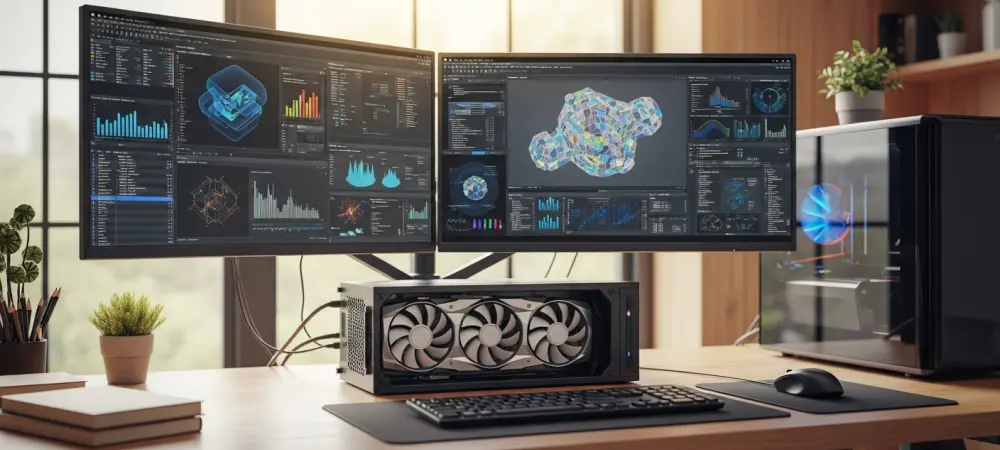
Achieving native 4K resolution at stable frame rates has finally reached a point where it is no longer an exclusive luxury for those with unlimited hardware budgets. While the industry has historically pushed flagship components toward the four-figure price bracket, the introduction of the PowerColor Reaper RX 9070 XT signifies a major pivot toward accessibility for the enthusiast community in 2026. This specific graphics card addresses a critical gap in the current market by offering robust high-resolution capabilities at a price point that directly challenges the dominance of more expensive rivals. As display technology continues to advance, the demand for hardware that can comfortably drive high pixel counts without compromising visual fidelity has grown exponentially. PowerColor has managed to capitalize on this trend by delivering a card that balances raw power with architectural efficiency, making it a standout option for builders who refuse to pay the standard premium tax often associated with top-tier performance.
Market Evolution: Breaking the Price Barrier
The financial appeal of the Reaper model is anchored by a significant price adjustment observed on major retail platforms such as Amazon, where a 14% discount has positioned the unit at an attractive $690. This valuation is particularly noteworthy when compared to the historical average price of $751, representing a rare moment of downward price pressure in a segment typically defined by rising costs. Such a reduction serves as a catalyst for users who have delayed upgrading their systems due to the prohibitive nature of high-end hardware. By lowering the entry barrier to sub-$700, this deal effectively transforms the landscape for mid-to-high-range builds, allowing for a more balanced allocation of funds toward other critical components like high-speed storage or upgraded cooling solutions. This shift indicates a broader movement toward competitive pricing strategies that prioritize market share over individual unit margins in the high-resolution gaming sector.
When evaluating the broader competitive landscape, the value proposition offered by the RX 9070 XT becomes even more pronounced when viewed alongside the offerings from rival manufacturers. Nvidia’s closest performance equivalent, the RTX 5070 Ti, frequently commands a retail price near the $1,000 threshold, creating a substantial financial gap of several hundred dollars for nearly identical frame rates. For consumers who prioritize raw rasterization performance and high-resolution output over specific proprietary software ecosystems, the Reaper model presents a clear path to high-end results without the associated financial burden. This price discrepancy highlights the increasing importance of price-to-performance metrics in an era where gamers are becoming more discerning about where their money is spent. Choosing the Reaper over a more expensive competitor allows for a significantly higher return on investment, particularly for those whose primary goal is achieving smooth 4K gameplay.
Engineering Excellence: Powering the Ultra-HD Experience
Beneath the thermal shroud, the PowerColor Reaper RX 9070 XT utilizes a sophisticated architecture designed to handle the most demanding computational workloads and high-fidelity gaming environments. The inclusion of 16GB of GDDR6 VRAM is a pivotal feature, as it provides the necessary memory buffer to manage high-resolution textures and complex shaders in modern AAA titles. This capacity is increasingly essential for both immersive gaming and intensive creative tasks such as 8K video editing or complex 3D rendering. Physically, the card is engineered with a focus on broad compatibility, measuring a manageable 289mm in length to ensure it fits within the majority of standard mid-tower chassis. To maintain peak operational stability, the hardware requires a robust 750W power supply and utilizes two 8-pin PCIe connectors. This combination of substantial memory overhead and standard physical dimensions makes it a versatile choice for a wide variety of custom computer builds. Performance benchmarks for the Reaper model reveal a capability that frequently matches or exceeds legacy flagship hardware, such as the RTX 4080, in raw frame rate production at 4K settings. Even though this specific variant is not factory-overclocked, its thermal management system allows it to maintain consistent clock speeds during extended gaming sessions without thermal throttling. This stability is crucial for players who demand a fluid experience in competitive or cinematic titles where frame drops can significantly impact the overall quality of engagement. The card’s ability to deliver native resolution performance without a heavy reliance on upscaling technologies ensures that the visual output remains crisp and true to the developers’ original intent. For users seeking a reliable workhorse that can sustain high-performance metrics across a diverse library of titles, the RX 9070 XT provides a level of power that guarantees hardware relevance for the foreseeable future.
Implementation Strategy: Optimizing Your High-Resolution Rig
The ongoing debate between choosing AMD or Nvidia hardware often centers on the balance between sheer hardware volume and specialized software features like AI-driven upscaling. The RX 9070 XT offers a distinct advantage in this regard by providing 16GB of VRAM, whereas Nvidia’s baseline RTX 5070 models often ship with only 12GB of memory. This difference is critical because higher memory capacity prevents performance bottlenecks in games that utilize large asset pools or ray-traced reflections at high resolutions. While Nvidia maintains a lead in certain proprietary frame generation technologies, the Reaper appeals to those who favor a brute force approach to gaming performance. By offering more physical resources for a lower price, the card caters to a segment of the market that values longevity and raw hardware capability over the temporary benefits of software-based enhancements. This strategic allocation of resources ensures that the card remains capable as game engines become more demanding.
Maximizing the potential of this high-performance component required a strategic approach to system integration and environmental management. Builders who successfully deployed the Reaper RX 9070 XT prioritized high-airflow case configurations and ensured that their power delivery systems met the recommended overhead requirements. This careful planning allowed for a seamless transition into 4K gaming, confirming that the card was a definitive solution for those seeking elite performance within a specific budget. The market’s shift toward this hardware validated the idea that high-capacity VRAM was the most critical factor for long-term system relevance. Furthermore, the decision to pair this GPU with a high-refresh-rate 4K monitor demonstrated the true capabilities of the RDNA architecture in a real-world setting. These steps provided a clear roadmap for achieving a premium visual experience, proving that professional-grade results were attainable without the need for excessive financial expenditure on flagship alternatives.