
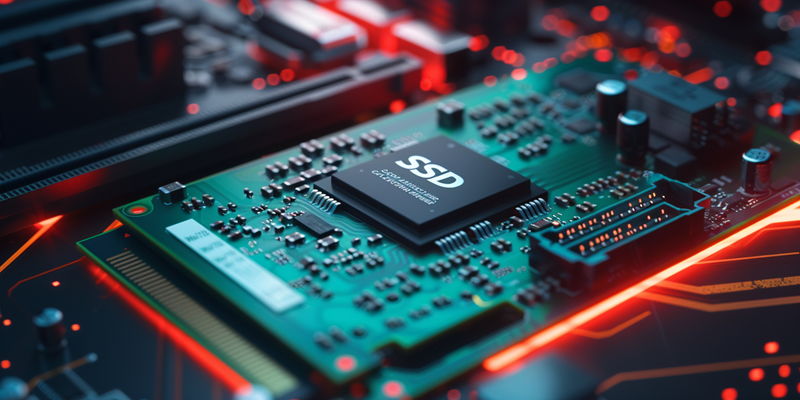
Phison E31T: Bringing Affordable PCIe Gen5 SSD Tech to Market

In an exciting development for tech enthusiasts and penny-wise consumers alike, Phison has unveiled the E31T PCIe Gen5 SSD controller. This new entry into the world of solid-state drives heralds a significant shift in the industry—imagine the blazing-fast speeds of a Gen5 SSD being accessible to the broader market. The E31T asserts itself as a cost-effective, DRAM-less solution to a segment that’s long been craving the pinnacle of performance without the pinnacle of price. The absence of DRAM in SSDs typically hints at a budget-friendly stance, and Phison is capitalizing on this to widen the PCIe 5.0 embrace.

A Leap in Performance for the Value-Conscious

The E31T isn’t just affordable; it’s a powerhouse. By drastically cutting production costs and omitting the need for expensive heatsinks, this SSD controller is set to redefine the value segment of the market. It presses forward with speeds that can reach 10 GB/s for reads and writes and an impressive 1,500K in 4K random IOPS—all achieved through the use of TSMC’s cutting-edge 7nm manufacturing process. The controller further boasts two Arm Cortex-R5 cores and a four-channel NAND interface, which collectively push the envelope in delivering high-end performance.

Moreover, Phison hasn’t compromised on reliability or durability. The integration of its seventh-generation ECC engine employs LDPC coding to enhance not just the performance but also the reliability of the SSD. Moves like these see Phison aiming high, promising not just affordability but a product that’s robust and equipped to handle the demands of modern high-speed data transfer, all without causing a dent in your finances.

A New Era of Affordable Gen5 SSDs

Tech aficionados and budget-conscious shoppers have reason to celebrate: Phison has just introduced the E31T PCIe Gen5 SSD controller, a game-changer in the realm of solid-state drives. This launch signals a transformative period in the SSD industry, making the ultra-fast speeds once reserved for high-end models now available at more affordable price points. The E31T stands out with its value and efficiency—it’s a DRAM-less controller, meaning it slashes costs while still catering to those desiring top-tier performance. With the E31T’s arrival, the promise of PCIe 5.0 technology is expanding to reach a wider audience without sacrificing speed for savings. This strategy by Phison cleverly leverages the typically lower-cost nature of DRAM-less SSDs, positioning the company to broaden the adoption of next-generation technology among consumers.

Explore more

Institutional Cryptocurrency Market Evolution – Review

The metamorphosis of the digital asset landscape from a fringe experimental playground into a cornerstone of the global financial architecture represents a monumental shift in how institutional capital perceives decentralized technology. This review explores the technological maturation and the sophisticated frameworks that now define the market, moving beyond retail speculation toward a phase of structured, multi-billion-dollar integration. By analyzing current

Are Fake Gemini and Claude Code Sites Stealing Your Data?

The meteoric rise of generative artificial intelligence platforms such as Google’s Gemini and Anthropic’s Claude Code has inadvertently paved a lucrative path for cybercriminals seeking to exploit the massive influx of developers and enterprises eager to integrate these advanced coding assistants into their daily workflows. These malicious actors deploy highly convincing replicas of official landing pages, leveraging typosquatting and deceptive

Is Kevin O’Leary’s 9GW Data Center Too Big for Utah?

Dominic Jainy is a veteran IT professional specializing in the intersection of artificial intelligence, machine learning, and massive infrastructure. He provides a critical look at how the Stratos project in Utah represents a paradigm shift in how we power and permit the digital future. This discussion covers the friction between state-led initiatives and local governance, the unprecedented power demands of

Why Are Cities Investing in Their Own Data Centers?

Modern metropolitan administrations are increasingly recognizing that total reliance on centralized commercial cloud providers poses significant risks to the continuity of essential public services and the long-term protection of sensitive citizen information during times of regional crises. This realization has sparked a significant shift toward the development of municipally owned and operated data centers designed to handle the massive influx

Can AI Cybersecurity Outpace the Human Bottleneck?

The current velocity of cyberattacks has reached a point where manual intervention is no longer a viable primary defense mechanism for modern enterprises. Digital environments have evolved into vast, hyper-connected ecosystems where millions of signals cross networks every second, creating a scale that surpasses human cognitive limits. Security Operations Centers (SOCs) now face a relentless barrage of sophisticated threats that