

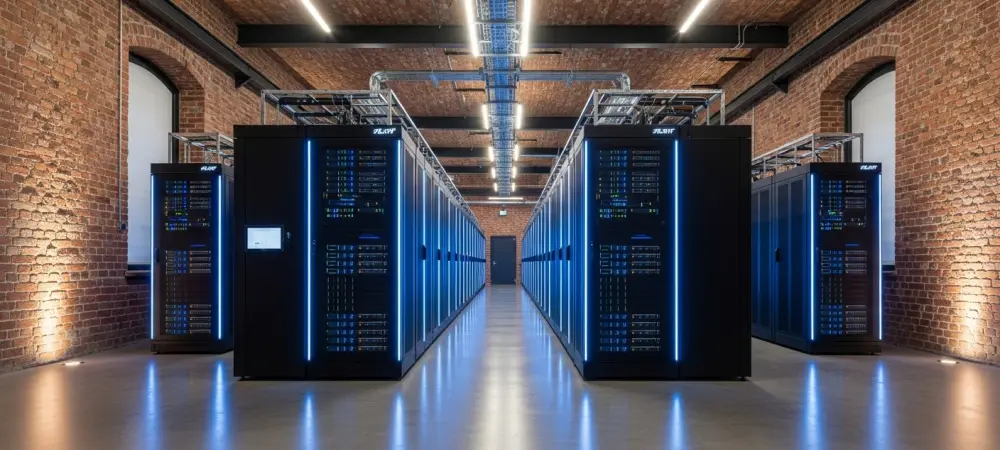
The iconic former headquarters of the Kansas City Star, once the epicenter of the city’s news cycle, is now poised to become a central node in the global flow of digital information, heralding a new technological era for the region. This transformation is being supercharged by a monumental investment secured by Patmos Hosting, an infrastructure company with a vision to redefine the urban data center. The recent acquisition of a $100 million C-Pace loan marks a critical turning point, not only for the project itself but for Kansas City’s aspirations to become a key player in the artificial intelligence landscape.
A Landmark Investment for Kansas City’s Tech Future
Patmos Hosting has officially secured a $100 million Commercial Property Assessed Clean Energy (C-Pace) loan, a significant financial milestone for its ambitious AI campus. This infusion of capital, facilitated by PACE Loan Group, is earmarked for comprehensive energy-efficient upgrades to the facility’s core systems, including advanced HVAC and plumbing infrastructure designed to handle the immense power and cooling demands of AI workloads.
This development is more than just a real estate transaction; it represents a pivotal step in positioning Kansas City as a formidable hub for data infrastructure. By attracting such a substantial investment, the city is signaling its readiness to support the next generation of technological innovation. The Patmos project serves as a powerful magnet for talent, further investment, and the kind of high-tech ecosystem that can drive regional economic growth for decades to come.
From Newsprint to Neural Networks: The Project’s Foundation
At the heart of this venture is Patmos Hosting, a Kansas City-based infrastructure company that has carved out a unique identity by focusing on the redevelopment of brownfield sites. Rather than building on undeveloped land, the company specializes in revitalizing existing urban structures, blending historical preservation with cutting-edge technological utility. This approach not only minimizes environmental impact but also integrates modern infrastructure directly into the fabric of the city.
The project’s location is a testament to this philosophy. The historic 421,000-square-foot former Kansas City Star building, a long-standing city landmark, is being meticulously repurposed. This effort breathes new commercial life into a cherished piece of local architecture, transforming a bastion of 20th-century media into a state-of-the-art facility designed to power 21st-century artificial intelligence.
The Strategic Allocation of Capital
Project Milestones and Phased Rollout
The $100 million C-Pace loan is a crucial component of the broader $1 billion, 35 MW data center project. This funding is strategically directed toward propelling the development through its second and third phases, with a clear goal of achieving full operational capacity by the end of 2026. The capital enables the implementation of critical energy-efficient systems that are essential for the campus’s long-term viability and performance.
Progress on the ground is already tangible. Since beginning construction, Patmos has successfully brought 10 MW of capacity online and has already secured two multi-year tenants, demonstrating strong market confidence in its model. The new financing acts as an accelerator, ensuring the project remains on its ambitious timeline and is equipped to meet the growing demand for specialized AI hosting solutions.
An Innovative Approach to Sustainability
The project’s commitment to environmental responsibility is woven into its financial and operational DNA. Described by company leadership as a “greener brownfield project,” its design philosophy prioritizes sustainability. The C-Pace loan is a natural fit for this vision, as this financing mechanism is specifically designed to fund improvements that enhance energy efficiency and reduce environmental impact.
A cornerstone of this sustainable approach is a pioneering closed-loop water system, developed in partnership with a local chilled water company. This collaboration will allow Patmos to offload nearly 100% of its cooling energy—a significant achievement, considering that cooling can account for up to 40% of a typical data center’s energy consumption. Consequently, this system will drastically reduce the water waste commonly associated with large-scale data facilities, setting a new industry standard.
A Niche Strategy in a Hyperscale World
While many industry titans are locked in a race to build gigawatt-scale campuses for a handful of hyperscale clients, Patmos is charting a different course. Its market strategy deliberately bypasses the hyperscale sector, instead focusing on a segment of the market that is often overlooked: mid-market and small-to-medium-sized businesses (SMBs) with power needs under 50 MW.
The company is cultivating an “AI Campus” environment designed to democratize access to high-performance computing. By offering smaller colocation footprints and more flexible terms, Patmos empowers SMBs to leverage cutting-edge AI infrastructure without the prohibitive cost of a full-scale investment. This approach fosters a more inclusive tech ecosystem where innovation is not limited to the industry’s largest players.
Current Status and National Expansion
The Kansas City campus is already a hive of activity, with 10 MW of its capacity operational and occupied by its first tenants. The new funding ensures the remaining phases of construction will proceed without delay, solidifying its role as a key infrastructure asset in the Midwest.
This project is not an isolated endeavor but a key piece of Patmos’s broader national strategy. The company is actively applying its successful brownfield redevelopment model to other markets, with similar projects already underway in Dallas and Phoenix. This strategic expansion demonstrates a scalable and repeatable formula for transforming underutilized urban properties into valuable, high-tech hubs.
Reflection and Broader Impacts
Reflection
The Patmos AI Campus stands on several pillars of strength. Its unique market positioning, which caters to the underserved SMB sector, provides a clear competitive advantage. Furthermore, its profound commitment to sustainability, evidenced by its innovative cooling system and use of C-Pace financing, aligns with modern environmental and corporate governance standards. By revitalizing an urban landmark, the project also achieves a level of community integration rarely seen in the data center industry.
However, the path forward is not without potential challenges. Competing in a market dominated by tech behemoths requires continuous innovation and agility. Scaling its SMB-focused model to other cities will test the company’s ability to replicate its success while adapting to the unique economic and regulatory landscapes of new markets.
Broader Impact
The success of the Patmos AI Campus could send ripples throughout the data center industry. It offers a compelling blueprint for how to develop sustainable, urban-centric facilities that are both technologically advanced and community-focused. This model provides an alternative to the remote, resource-intensive data centers that have become the industry norm.
For Kansas City, the economic implications are significant. The campus is poised to attract a new wave of tech companies and talent, fostering a more vibrant and competitive local economy. By creating an accessible on-ramp to AI infrastructure, Patmos is helping to level the playing field, enabling smaller businesses to innovate and compete on a larger stage.
Forging a New Blueprint for Urban AI Development
The $100 million investment in the Patmos AI Campus did more than just finance a construction project; it validated a forward-thinking vision. This venture successfully merged historical preservation with technological advancement, creating a facility that respects the past while building for the future. Its innovative sustainability features and unique mission to empower small and mid-sized businesses have set it apart in a crowded market.
Ultimately, the Patmos AI Campus in Kansas City has become more than just a data center. It represents a new, integrated model for urban development, demonstrating how technology, community, and sustainability can not only coexist but also mutually reinforce one another to create lasting value.