

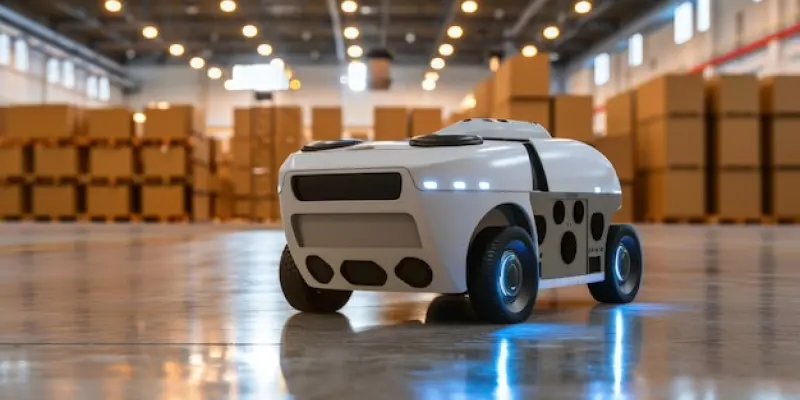
On March 24, Ocado Intelligent Automation (OIA), a division of Ocado Group, introduced the Porter AMR, an innovative autonomous mobile robot aimed at transforming warehouse logistics. This state-of-the-art robot is designed to enhance efficiency by automating the movement of pallets and streamlining essential warehouse operations such as cross-docking, bulk-item picking, putaway, and pallet relocation.
Enhancing Warehouse Efficiency
Streamlined Operations with Patented Technology
The Porter AMR operates under OIA’s patented system-directed software, which optimizes the movements of both individual robots and entire fleets. This minimizes travel times, reduces congestion, and ensures a more efficient warehouse environment. The robot’s integration with Ocado’s Fulfillment Execution System (FES) significantly improves the picking process by grouping orders, optimizing route plans, and decreasing the number of steps required between picks. Machine learning is employed within the Porter AMR to prioritize and plan pallet stacking more intelligently. This reduces the risk of product damage and further enhances warehouse efficiency. By utilizing this advanced technology, the Porter AMR not only accelerates operations but also improves overall reliability and productivity within the warehouse.
Jeff Larson, Director of Solutions Design for the Ocado Mobile Robot System at OIA, highlighted the significant value Porter brings in automating low-value, manual tasks. This allows warehouse employees to focus on higher-value activities, ultimately creating a more productive work environment. The Porter AMR’s ability to enhance case-picking rates and manage substantial inventory movements offers considerable benefits in various sectors, including third-party logistics, retail, e-commerce, distribution, and healthcare.
Precision and Flexibility
The Porter AMR distinguishes itself with its precision in autonomously picking, moving, and placing pallets, even in tightly aligned spaces. Its design also accommodates the handling of cages, providing additional operational flexibility. Key features of this robot include an onboard touchscreen with a live front-camera view for manual control when necessary and a payload capacity of 3,300 pounds. The robot can transport both pallets and roll cages with ease.
Dynamic task-switching software within Porter enables it to seamlessly transition between different tasks, such as inventory movement and case-picking, as required. This adaptability ensures that warehouse operations remain efficient and responsive to changing demands. Advanced sensors built into the Porter allow it to detect and handle various standard pallet types, including CHEP, GMA, and EPAL pallets.
Integration and Safety Measures
Seamless System Integration
The Porter AMR is designed to integrate smoothly with existing warehouse systems such as Warehouse Execution Systems (WES), Warehouse Control Systems (WCS), and Warehouse Management Systems (WMS). This integration enables the robot to prioritize tasks based on real-time data, enhancing overall productivity. The collaborative picking feature allows for efficient automated inbound and outbound movements from Automated Storage and Retrieval Systems (AS/RS), and connectivity to robotic arms for handling pallets further streamlines operations.
By integrating with these systems, the Porter AMR supports various warehouse processes, ensuring that all tasks are completed efficiently and without unnecessary delays. This connectivity also allows businesses to adapt to changes in demand quickly, making them more agile and capable of scaling operations without being as reliant on manual labor and certified drivers.
Ensuring Safety and Reliability
On March 24, Ocado Intelligent Automation (OIA), a subsidiary of Ocado Group, unveiled the Porter AMR, a cutting-edge autonomous mobile robot engineered to revolutionize warehouse logistics. This advanced robot is intended to boost efficiency by automating the transportation of pallets, thereby optimizing key warehouse operations. These operations include cross-docking, which is the direct transfer of goods from inbound to outbound transportation with minimal storage time, bulk-item picking, where large volumes of items are selected for shipment or storage, putaway, which is the process of storing goods in their designated locations, and pallet relocation, the moving of pallets to different positions within the warehouse. Through these improvements, the Porter AMR promises to streamline warehouse workflows, reduce manual labor, and enhance overall productivity, making it a significant innovation in the field of warehouse management systems.