

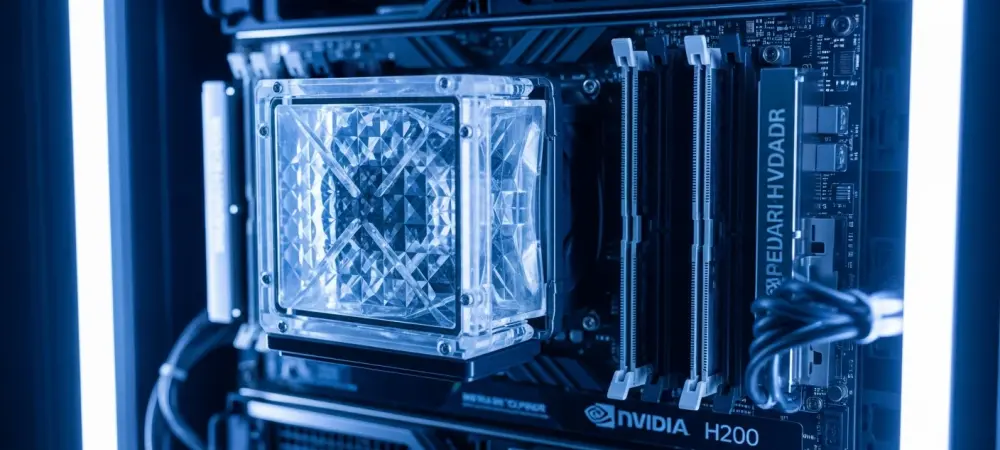
The global race for artificial intelligence supremacy has officially hit a thermal wall, forcing infrastructure providers to look beyond traditional silicon and copper to the hardest material on Earth. In a landmark shift for the high-performance computing market, Indian service provider NxtGen AI has successfully deployed the first Nvidia H100 GPU clusters cooled by synthetic diamonds. This move, executed through a $27 million partnership with Akash Systems, represents a pivotal moment where material science dictates the next phase of digital scaling. By moving away from the cooling methods that have defined the last thirty years, this deployment sets a new standard for how much power can be packed into a single server rack.
A New Era of Thermal Management in High-Performance Computing
The heat generated by modern generative AI workloads has outpaced the physical capabilities of air and liquid cooling, creating a bottleneck that threatens to stall innovation. For decades, the industry relied on the gradual refinement of heat sinks and fans, but as GPU power consumption climbs toward a kilowatt per chip, these traditional methods are proving insufficient. Data centers are increasingly facing “thermal throttling,” where expensive hardware must slow its processing speed to avoid physical meltdown. This crisis has transformed cooling from a background utility into a primary strategic concern for any organization looking to scale its compute capacity.
From Satellites to Servers: The Evolution of Thermal Control
Technological breakthroughs often originate in the most extreme environments, and the shift toward diamond-based cooling is no exception. The foundation of this new infrastructure lies in gallium nitride-on-diamond (GaN-on-diamond) substrates, a technology originally perfected for satellite communications in the vacuum of space. Transitioning this aerospace innovation to terrestrial data centers allows for a level of heat dissipation that was previously unthinkable. By leveraging the same physics that protect orbital hardware from solar radiation, providers can now manage the intense energy density required for large-scale language model training and real-time inference.
Overcoming the Thermal Bottleneck with Synthetic Diamonds
The Physics of Performance: Why Diamond Outperforms Copper
The primary reason for this technological leap is that synthetic diamond possesses a thermal conductivity five times greater than that of copper, the current industry standard. In the new NxtGen deployment, these diamond layers are integrated directly into the GPU die, allowing heat to be pulled away from the processor at an incredible rate. This process reduces localized hotspot temperatures by approximately 10°C (50°F), ensuring that Nvidia H100 processors can run at maximum clock speeds indefinitely. Consequently, this allows for a higher density of GPUs within each rack, maximizing the value of expensive data center real estate.
Energy Sustainability and the Quest for FLOPs per Watt
Beyond raw performance, the transition to diamond cooling addresses the growing pressure on the industry to improve its environmental footprint. By making the heat transfer process more efficient, Akash Systems has demonstrated that servers can achieve a 15 percent improvement in FLOPs (Floating Point Operations) per Watt. This efficiency gain is critical because it reduces the total electricity required to achieve the same computational output. Moreover, as the chips themselves handle heat more effectively, the demand for secondary, energy-intensive air conditioning systems drops, significantly improving the overall Power Usage Effectiveness of the facility.
Operational Resilience in Extreme Ambient Temperatures
One of the most disruptive market implications of this technology is the ability to operate high-end hardware in ambient temperatures reaching 50°C (122°F). Standard data centers typically require aggressive chilling to keep the air between 24°C and 29°C, which restricts their placement to cooler climates or requires massive investment in refrigeration. Diamond-cooled servers effectively “de-risk” the expansion of AI infrastructure in tropical regions and emerging markets. This capability enables a global decentralization of AI factories, allowing compute clusters to be placed closer to the users they serve, regardless of the local weather.
The Future of AI Factories and Material Science
As the industry prepares for even more power-hungry hardware, such as the upcoming Blackwell series, the focus is shifting from chip architecture to the materials that house them. We are likely to see a trend toward “inherent cooling,” where advanced materials are baked into the hardware at the foundry level rather than added as an afterthought. This shift will likely lead to a new category of “ruggedized” high-performance servers that do not require specialized, climate-controlled environments. Such an evolution could democratize access to AI, as the barrier to entry for building a tier-three data center becomes significantly lower.
Strategic Implications for the Global AI Landscape
For business leaders and developers, the arrival of diamond cooling necessitates a change in how compute costs are calculated. The focus must transition from the initial capital expenditure of the GPU to the long-term operational efficiency and token output per dollar. NxtGen’s success provides a clear roadmap for organizations looking to optimize their hardware refresh cycles by prioritizing heat-tolerant infrastructure. As these specialized materials become more common, the competitive advantage will go to those who can maintain peak performance in high-density environments while minimizing their reliance on the local power grid.
Concluding Thoughts on the Diamond-Cooled Frontier
The deployment of these advanced thermal systems represented a definitive departure from the limitations of the silicon-only era. By integrating synthetic diamonds into the heart of the data center, the partnership between NxtGen and Akash Systems proved that material science is the key to unlocking the next order of magnitude in AI compute. Looking ahead, organizations should evaluate their current cooling architectures to identify where thermal bottlenecks are costing them performance. Investing in heat-resilient hardware will be essential for staying relevant as the power demands of artificial intelligence continue their relentless climb.