

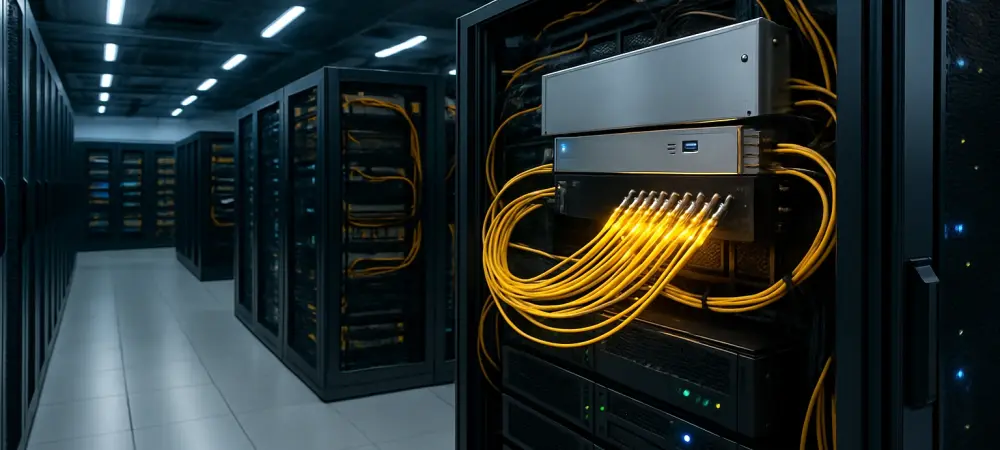
In an era where artificial intelligence is pushing the boundaries of computational demand, data centers are grappling with unprecedented challenges in efficiency and scalability, especially in AI factories that power cutting-edge innovations. The sheer volume of data processed by GPU clusters for machine learning and deep learning applications has exposed critical bottlenecks in traditional interconnect technologies. These limitations not only hinder performance but also result in staggering power consumption, with network optics alone accounting for a significant portion of an AI factory’s energy footprint. Amid this backdrop, a transformative solution has emerged, promising to redefine how data centers operate. This advancement focuses on leveraging photonics to address the inefficiencies of conventional optical interconnects, offering a pathway to unprecedented speed and energy conservation. As AI continues to evolve, the urgency for such groundbreaking technology becomes undeniable, setting the stage for a deeper exploration of this game-changing development.
Breaking New Ground with Photonics Technology
Pioneering Silicon Photonics for AI Efficiency
The shift toward silicon photonics represents a monumental leap in addressing the escalating needs of AI-driven data centers. Unlike traditional optical interconnects that struggle with high power demands, this new approach integrates co-packaged optics to deliver remarkable improvements. A standout feature is the achievement of a 3.5x increase in power efficiency, alongside a 1.3x boost in operational speed compared to older standards. This is particularly crucial in AI factories, where optics power consumption is 17 times higher than in conventional cloud environments due to the intense communication needs of GPU clusters. By reducing the number of lasers required for high-speed links and minimizing signal loss through strategic proximity to switch ASICs, the technology slashes energy overhead. Such advancements ensure that more power is allocated to computational tasks rather than network infrastructure, marking a significant stride toward sustainable high-performance computing.
Architectural Innovations Driving Performance
Beyond efficiency, the architectural design of this photonics solution introduces cutting-edge features that enhance data center capabilities. At its core lies a Silicon Photonics CPO chip boasting a 1.6T transfer rate, utilizing Micro-Ring Modulators to achieve higher bandwidth with a reduced power footprint. The implementation of 3D stacking between photonic and electronic layers further optimizes bandwidth density while simplifying complex routing challenges. This design not only boosts throughput but also enhances signal integrity, ensuring reliable communication across GPU clusters. Collaborations with leading manufacturing experts have played a vital role in refining production quality, ensuring that these innovations meet the rigorous demands of modern AI infrastructure. As a result, this technology sets a new benchmark for interconnect solutions, promising to support the relentless growth of AI compute requirements with unparalleled resilience and speed.
Scaling AI Infrastructure for the Future
Transforming Data Centers with Integrated Solutions
One of the most compelling aspects of this photonics breakthrough is its potential to transform AI factories through integrated hardware solutions. A flagship offering in this domain is a high-capacity switch that doubles throughput while achieving 63x better signal integrity and a 4x reduction in laser usage. By replacing dozens of separate transceivers with a single cohesive unit, this switch exemplifies how integrated photonics can streamline data center operations. Additionally, it provides a 1.6x increase in bandwidth density and a 13x improvement in laser reliability, addressing longstanding challenges in scalability and maintenance. These advancements are critical for environments where every watt of power and every millisecond of latency impact overall performance. As AI workloads continue to intensify, such solutions pave the way for data centers to handle larger, more complex tasks without compromising on efficiency or reliability.
Industry Trends and Strategic Vision
The broader industry trend toward silicon photonics underscores a collective recognition of its importance in scaling AI infrastructure. While other major hardware players focus on alternative interconnect approaches, the emphasis on replacing traditional optical systems entirely highlights a strategic vision centered on data center-wide efficiency. This approach prioritizes reallocating power to GPU performance, with reported gains of 3x higher output under identical power constraints. A nearly 4x reduction in total laser usage further frees up resources for computational priorities, aligning with the growing consensus that photonics will become the mainstream interconnect solution. This shift is not merely a technological upgrade but a fundamental rethinking of how data centers should operate in an AI-dominated landscape. The implications are profound, suggesting a future where energy conservation and performance go hand in hand, driven by innovative interconnect technologies.
Setting a New Standard for AI Compute
Reflecting on the strides made, it becomes evident that this photonics innovation tackles critical inefficiencies head-on, establishing a robust foundation for AI factory scalability. The integration of photon-based communication streamlines interconnect processes, delivering unmatched speed and reliability while significantly cutting power consumption. Flagship hardware like the high-capacity switch demonstrates tangible benefits, from enhanced signal integrity to accelerated interconnect speeds, positioning this technology as a leader in the field. Although widespread adoption remains a future milestone, the reported metrics paint a promising picture of what is achievable. Ultimately, this development stands as a pivotal moment in silicon photonics, offering a cohesive solution to the escalating demands of AI infrastructure. Looking ahead, the focus should shift to integrating these advancements into existing frameworks, ensuring that data centers can fully harness the potential of this transformative technology for sustained growth and efficiency.