

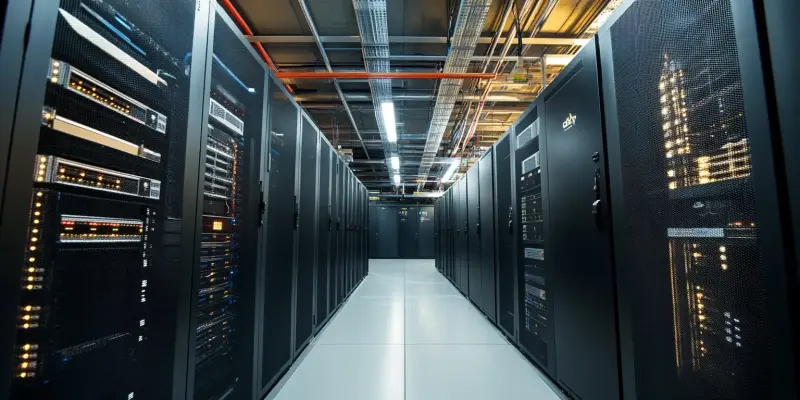
In an era where technological advancements drive the evolution of data centers, Nvidia’s innovative networking solutions have emerged as a defining force shaping the industry’s future. At the helm of this revolution, Nvidia has introduced groundbreaking technologies, particularly in the realm of co-packaged optics, pushing the limits of speed, efficiency, and performance in data center networks. The significance of this innovation is underscored by Nvidia’s recent announcements at their highly anticipated GTC events, where they unveiled the Quantum-X InfiniBand and Spectrum-X silicon photonics switches. These developments highlight the growing importance of advanced networking in seamlessly integrating processing, memory, and storage into a cohesive unit.
Defining the Technological Breakthrough
One of the most remarkable strides that Nvidia has made is the introduction of the Blackwell GB200 GPU AI accelerator coupled with the Grace CPU. This combination represents a significant leap forward for the industry, bringing unparalleled processing power to data centers. However, the NVLink switch, capable of interconnecting 72 GPUs into a unified entity, truly stands out as a game-changing scale-up solution. This innovation paves the way for a more integrated and efficient approach to handling data-intensive tasks. Coupled with co-packaged optical networking solutions, Nvidia is set to redefine the parameters of network scalability through strategic industry partnerships.
A pivotal element in this narrative is the collaborative effort between Nvidia and its partners, including key players such as Browave, Coherent, and Corning. Together, they have tackled longstanding challenges associated with co-packaged optics, such as fiber coupling and the integration of light sources. These solutions, which have been in development for nearly a quarter-century, are now ready for volume production, signifying a major milestone. Nvidia’s cutting-edge advancements have not only paved the way for achieving unprecedented efficiencies but also solidified the practical application of co-packaged optics.
Quantifying the Advancements
Nvidia’s claims regarding the superiority of the Spectrum-X switches compared to traditional optical transceivers are nothing short of impressive. The company boasts a fourfold reduction in the number of lasers needed, a 3.5-times increase in power efficiency, a staggering 63-times improvement in signal integrity, a tenfold boost in network resiliency, and a 1.3-times decrease in network deployment time. These metrics are particularly crucial in the age of AI, where the demand for robust and resilient infrastructure is paramount. Handling intensive AI workloads, particularly those associated with agentic AI, requires substantial resources and optimized networking components.
Additionally, Nvidia’s forward-looking approach includes the introduction of data center GPUs such as the Blackwell Ultra, Rubin, and Rubin Ultra, along with the DGX Spark system tailored for AI developers. The innovations continue with the Blackwell DGX SuperPOD and a suite of new models and software solutions designed to enhance and optimize the development of agentic AI. These tools exemplify Nvidia’s commitment to advancing the capabilities of data centers and ensuring they remain at the forefront of AI advancements.
Pioneering the Future of Data Centers
Nvidia’s continued focus on networking innovations, highlighted by the development of co-packaged optics and enhanced data center interconnectivity, was the centerpiece of Jensen Huang’s keynote at the recent GTC event. This milestone in technology is not only a significant achievement for Nvidia but also for the entire industry, representing a new standard for performance and efficiency. The innovations showcased promise substantial improvements in data center networking, making them more efficient and reliable. This is particularly critical as the industry moves towards more complex and resource-intensive applications, further emphasizing the need for sophisticated networking solutions.
The advancements in co-packaged optics are anticipated to play a pivotal role in internal rack networking, setting a new benchmark for the industry. Nvidia’s dedication to pushing the boundaries of what is technologically possible reflects a consensus on the importance of high-performance, low-latency networking in supporting the next generation of AI and data-intensive applications. These developments signify a transformative phase for data centers, with Nvidia leading the charge by integrating cutting-edge components and robust infrastructures.
Redefining Data Center Networking
The narrative of Nvidia’s networking revolution is not just about the technological components but also about the strategic vision that drives these developments. Through innovations like the Quantum-X InfiniBand and Spectrum-X photonics switches, Nvidia has demonstrated the pivotal role of networking in enhancing data center performance. The company’s commitment to integrating these advanced technologies creates a more cohesive and efficient system, addressing the growing demands of AI and data-driven applications.
Nvidia’s holistic approach, rooted in collaboration with industry leaders, underscores the company’s role as a catalyst for change. By tackling the intricacies of co-packaged optics and overcoming significant engineering challenges, Nvidia is setting the stage for a redefined era in data center networking. These advancements highlight the critical importance of integrating high-performance networking solutions to support the rapid evolution of AI technologies and data-intensive workloads.
Future Considerations
In an era where technological advancements are driving the evolution of data centers, Nvidia’s innovative networking solutions have become a pivotal force shaping the industry’s future. Leading this revolution, Nvidia has introduced cutting-edge technologies, particularly in the realm of co-packaged optics. These advancements are pushing the boundaries of speed, efficiency, and performance in data center networks. Nvidia’s recent announcements at their highly anticipated GTC events underscore the significance of this innovation. At these events, they unveiled the Quantum-X InfiniBand and Spectrum-X silicon photonics switches. These new technologies highlight the increasing importance of advanced networking in seamlessly integrating processing, memory, and storage into a unified system. As data centers continue to evolve, Nvidia’s pioneering efforts in networking solutions are setting new standards and paving the way for more efficient, high-performance infrastructure, making them an indispensable part of the future of data center technology.