
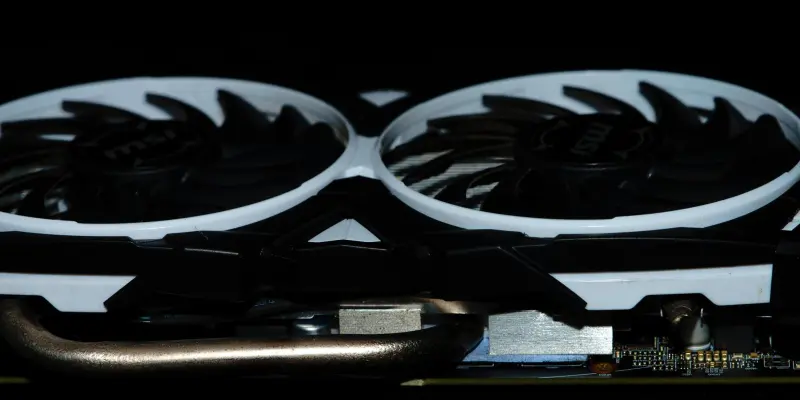
Nvidia Unveils RTX 5060 and Gaming Innovations at Computex 2025

Article Highlights
Off On

In a significant stride for graphics technology, ## Nvidia has introduced the RTX 5060 at Computex 2025, boasting both desktop and laptop configurations. This powerful GPU is priced strategically for wider accessibility, with the desktop version starting at $299 and laptop versions beginning at $1099. This release marks a leap in gaming performance, delivering the ability to play AAA titles at over 100 frames per second at maximum settings. The utilization of DLSS Quality at 1080p ensures enhanced visual output, meeting the demands of contemporary gaming environments. Central to the RTX 5060 is the integration of Blackwell SM technology, underscoring advancements in Shader Cores, Tensor Cores, and RT Cores. These improvements highlight the GPU’s capability in AI processing and real-time rendering, setting a new benchmark for immersive gaming experiences. Nvidia’s focus on pushing graphics boundaries is evident, aiming to redefine user expectations for high-fidelity gaming.

Enhanced Gaming Experience through Technology

Beyond announcing new hardware, Nvidia has revealed a software roadmap designed to transform gaming interactions. A key highlight is the upcoming Path Tracing update for DOOM: The Dark Ages, which will enhance the game’s ray interaction and boost graphical quality, aligning with Nvidia’s drive for higher graphic realism in gaming. Nvidia is also pushing DLSS 4 technology across more popular titles like Portal with RTX and Crimson Desert, marking a shift toward more sophisticated machine learning applications in rendering, promising notable improvements in quality. The introduction of RTX Remix further showcases Nvidia’s commitment, sparking over 150 mods and more than 350 projects. This tool underscores Nvidia’s support for the modding community and is bolstered by the upcoming RTX Remix Mod Contest, which offers enticing prizes to participants. Collectively, these initiatives highlight Nvidia’s strategy to maintain leadership in the graphics industry by continually innovating to serve both gamers and developers. As a result, they are poised to remain a dominant influence in this field.

Explore more

ARPA-H Invests $32M in Autonomous Robotic Stroke Treatment

Redefining the Race: The Clock in Stroke Intervention When a blood clot suddenly lodges in a cerebral artery, the human brain begins to lose roughly two million neurons every single minute that the obstruction remains in place. This reality defines the urgency behind a $32 million investment from the Advanced Research Projects Agency for Health (ARPA-H). The funding targets Magnendo,

Guide Ranks the Best Small Business Payroll Software for 2026

The moment an entrepreneur realizes that a simple decimal error in a payroll run could trigger a massive federal audit is usually the exact second they stop viewing their software as a luxury and start seeing it as an essential protective shield. In the current landscape, the margin for error has narrowed significantly, as state and federal tax authorities have

Can AI Ever Replace Human Intuition in Modern Hiring?

A seasoned hiring manager tosses a candidate’s profile aside while claiming the person simply did not have the right energy, leaving a nearby data analyst completely baffled. To an advanced artificial intelligence, this feedback is a dead end—a vague data point that offers no actionable insight for a machine-learning model. To a veteran recruiter, however, this phrase is a coded

AI Hiring Tools Are Now a Major Security Risk for CIOs

The unassuming PDF file sitting in a digital stack of applications has quietly evolved from a static career summary into a sophisticated piece of executable code capable of hijacking enterprise logic. For decades, recruitment software lived in the relative safety of the back office, primarily serving as a repository for record-keeping and workflow automation. However, the rapid integration of artificial

AI and Remote Work Fuel a Costly Crisis in Hiring Integrity

The polished professional currently answering technical questions on a high-definition video call might actually be an elaborate digital facade powered by a sophisticated network of hidden AI agents. Recruitment processes that once relied on physical cues and verified histories have been subverted by a wave of technological deception that threatens the very core of corporate integrity. As organizations expanded their