
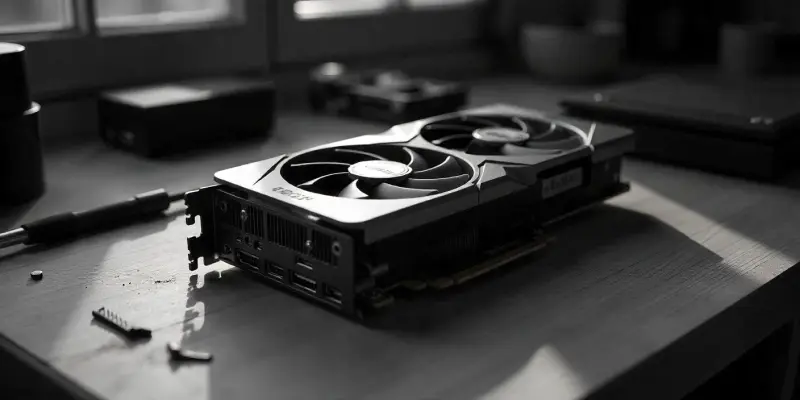
Nvidia RTX 5080 Super Leak Reveals 24 GB GDDR7 Upgrade

Article Highlights
Off On

In the ever-evolving world of graphics technology, recent leaks have directed the spotlight onto Nvidia’s forthcoming RTX 5080 Super graphics card. The major talking point from this leak is the substantial upgrade in memory capacity, presenting a significant step forward for this line of GPUs. The card is reportedly equipped with 24 GB of GDDR7 memory, achieved through the integration of denser 3 GB memory modules. This development is particularly notable as it maintains the same 256-bit memory bus found in the RTX 5080, indicating a calculated approach to enhance memory without altering the bus architecture. This memory augmentation is likely to support high-resolution textures and more demanding 3D applications, ensuring the hardware remains relevant as games and applications become increasingly memory-intensive. Such advancements underline Nvidia’s strategy to boost performance for an audience that demands high efficiency and future-proofing.

Performance Enhancements and Strategic Positioning

Nvidia’s introduction of the RTX 5080 Super emphasizes memory advancements while maintaining 10,752 CUDA cores, akin to the original RTX 5080. This approach deviates from prior “Super” models that typically boast improvements in both memory and processing power. This strategic choice likely aims to refine product segmentation and set the stage for more significant upgrades in forthcoming models. Although the core count remains constant, anticipated performance boosts could arise from quicker memory speeds and possible clock speed enhancements, potentially improving performance by seven to fifteen percent. Nevertheless, official details about pricing and availability are yet to be disclosed, fueling speculation. Historically, the RTX 5080 Super might be priced between $1,000 and $1,500, though the release may face delays due to market pricing instability. Nvidia’s strategy is to elevate memory capabilities while preserving core specs, striking a balance between performance and differentiation. This potential release could mark an important juncture for Nvidia as they address technological evolution and consumer demands.

Explore more

ARPA-H Invests $32M in Autonomous Robotic Stroke Treatment

Redefining the Race: The Clock in Stroke Intervention When a blood clot suddenly lodges in a cerebral artery, the human brain begins to lose roughly two million neurons every single minute that the obstruction remains in place. This reality defines the urgency behind a $32 million investment from the Advanced Research Projects Agency for Health (ARPA-H). The funding targets Magnendo,

Guide Ranks the Best Small Business Payroll Software for 2026

The moment an entrepreneur realizes that a simple decimal error in a payroll run could trigger a massive federal audit is usually the exact second they stop viewing their software as a luxury and start seeing it as an essential protective shield. In the current landscape, the margin for error has narrowed significantly, as state and federal tax authorities have

Can AI Ever Replace Human Intuition in Modern Hiring?

A seasoned hiring manager tosses a candidate’s profile aside while claiming the person simply did not have the right energy, leaving a nearby data analyst completely baffled. To an advanced artificial intelligence, this feedback is a dead end—a vague data point that offers no actionable insight for a machine-learning model. To a veteran recruiter, however, this phrase is a coded

AI Hiring Tools Are Now a Major Security Risk for CIOs

The unassuming PDF file sitting in a digital stack of applications has quietly evolved from a static career summary into a sophisticated piece of executable code capable of hijacking enterprise logic. For decades, recruitment software lived in the relative safety of the back office, primarily serving as a repository for record-keeping and workflow automation. However, the rapid integration of artificial

AI and Remote Work Fuel a Costly Crisis in Hiring Integrity

The polished professional currently answering technical questions on a high-definition video call might actually be an elaborate digital facade powered by a sophisticated network of hidden AI agents. Recruitment processes that once relied on physical cues and verified histories have been subverted by a wave of technological deception that threatens the very core of corporate integrity. As organizations expanded their