

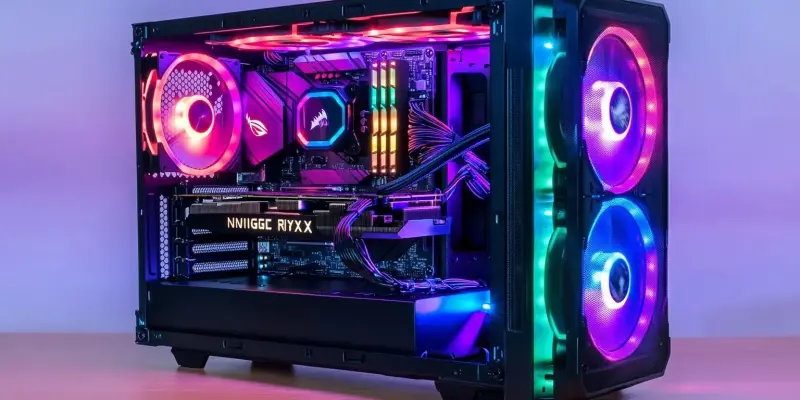
In a significant stride toward enhancing the gaming experience, NVIDIA’s upcoming GeForce RTX 5080 and RTX 5070 Ti graphics cards are slated to drive iBuyPower’s next-generation pre-built gaming PCs. Scheduled for an official unveiling at CES 2025 and a release in January, these GPUs are part of NVIDIA’s formidable GeForce RTX 50 “Blackwell” series, poised to reinforce the company’s dominance in the high-performance segment. iBuyPower’s decision to incorporate these powerful GPUs signifies their commitment to providing top-tier performance options, reflecting a dedication to high-end gaming specifications and addressing the escalating demand for robust graphical processing power.
Upcoming Integration of RTX 5080 and RTX 5070 Ti GPUs
iBuyPower is gearing up to launch at least four pre-built gaming systems that harness the potential of the RTX 5080 and RTX 5070 Ti GPUs. This move highlights the substantial performance capabilities of these new cards. Interestingly, the choice of the RTX 5070 Ti instead of the standard RTX 5070 signifies a deliberate push toward superior performance offerings, ensuring gamers have access to the most powerful components available. These forthcoming gaming systems will come equipped with either the latest Intel Arrow Lake “Core Ultra 200S” or AMD Zen 5 “Ryzen 9000” processors, demonstrating a blend of cutting-edge technology from both camps. Additionally, these PCs will boast up to 32 GB of DDR5-5200 MHz memory and 800W Gold-rated power supply units, further emphasizing iBuyPower’s focus on high-performance specifications.
The RTX 5080 will utilize the complete GB203 GPU die, featuring 84 Streaming Multiprocessors (SMs) and 10,752 cores, a notable 51% reduction in cores compared to the RTX 5090, suggesting a strategic segmentation within the lineup. This GPU will be equipped with 16 GB of GDDR7 memory operating over a 256-bit bus interface, achieving speeds up to 32 Gbps. This configuration translates to a substantial total memory bandwidth of 1 TB/s, alongside a Total Board Power (TBP) of 400W, marking a 25% power increase from the preceding models. Such specifications indicate that the RTX 5080 is designed for high-intensity gaming and rendering tasks, catering to enthusiasts and professional gamers who require top-tier performance.
Technical Specifications and Performances
The RTX 5070 Ti, while slightly less powerful than the RTX 5080, offers significant performance with 8960 CUDA cores and GDDR7 speeds reaching 28 Gbps. It maintains the same 256-bit memory interface as its counterpart, providing a bandwidth of 896 GB/s. The expected TBP for the RTX 5070 Ti falls between 300-350W, indicating a balance between power consumption and performance capabilities. This configuration ensures that the RTX 5070 Ti remains a formidable choice for gamers seeking high graphics performance without exceeding power limits. Both GPUs illustrate NVIDIA’s commitment to pushing the boundaries of gaming technology, delivering enhanced memory efficiency and high-bandwidth solutions to meet the growing demands of modern gaming.
iBuyPower’s pre-built PCs, featuring options with Intel and AMD processors, reflect a market-ready stance for NVIDIA’s upcoming GPU releases. The strategic inclusion of these components aligns with the trend of manufacturers quickly adapting to the latest hardware advancements in response to consumer demands. It’s worth noting that the absence of an RTX 50 series “SUPER” variant is likely a listing error, as the naming convention continues from prior generations. This oversight notwithstanding, the new RTX 5080 and RTX 5070 Ti are set to redefine performance benchmarks in the gaming industry.
Anticipation and Impact on the Gaming Community
NVIDIA is making a notable step forward in improving gaming experiences with its upcoming GeForce RTX 5080 and RTX 5070 Ti graphics cards. These GPUs will power iBuyPower’s next-generation pre-built gaming PCs. They are set to be officially unveiled at CES 2025, with a release date scheduled for January. Part of the powerful GeForce RTX 50 “Blackwell” series, these new GPUs are positioned to solidify NVIDIA’s leadership in the high-performance market. Their incorporation into iBuyPower’s gaming PCs highlights iBuyPower’s commitment to offering top-tier performance. This move reflects their dedication to high-end gaming setups and meeting the increasing demand for strong graphical processing capabilities. By selecting these advanced GPUs, iBuyPower aims to provide gamers with exceptional graphics performance, ensuring the best possible gaming experiences. This blend of cutting-edge technology and high-performance hardware underscores both NVIDIA and iBuyPower’s efforts to cater to the serious gaming community.