

Amid fervent anticipation, Nvidia’s GeForce RTX 5060 Ti 16GB has arrived as a standout addition to the 50-series Blackwell architecture, distinguishing itself within the mainstream GPU segment. Priced at $429 for the 16GB model, the GPU stirs debates regarding its value proposition, especially when juxtaposed with its 8GB counterpart and higher-end models. As Nvidia’s roster continues to evolve, the decision to release both 8GB and 16GB versions of the 5060 Ti adds layers of complexity, pushing consumers towards the more future-proof 16GB variant. This article assesses the intricacies of this GPU, evaluating its specifications, design, performance efficacy, and overall value to prospective buyers.
Specifications and Comparison
The Nvidia GeForce RTX 5060 Ti boasts 4608 CUDA cores, marking a six percent increase over its predecessor, the RTX 4060 Ti. This augmentation signifies notable strides in performance, yet the mid-tier card is notably outmatched by the higher-tier RTX 5070, which eclipses it with a staggering 33 percent more CUDA cores. Despite this, the 5060 Ti’s memory bandwidth has seen an appreciable enhancement, offering an improvement of 55.5 percent over the prior model. However, these gains are modest when measured against the substantial 50 percent higher memory bandwidth of the RTX 5070.
The comparison underlines a critical assessment for those in the market for a new GPU. While the RTX 5060 Ti’s generational improvements and Blackwell architecture’s advantages are evident, it is essential to recognize its limitations when placed beside its premium sibling. This suggests that although the 5060 Ti may bring competitive enhancements, it remains a mid-tier offering without surpassing the performance parameters set by the top-tier RTX 5070. Nevertheless, the GPU’s capabilities ensure it stands as a robust contender in its category, especially for users not necessitating the absolute peak performance offered by the 5070.
Design and Cooling
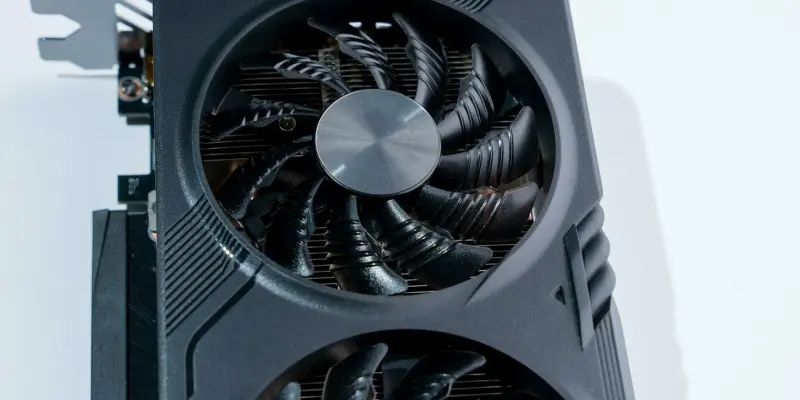
The review employs the Palit Infinity 3 version of the RTX 5060 Ti 16GB, characterized by a visually appealing design coupled with a robust heatsink and tri-fan configuration. These features collectively ensure optimal cooling efficiency, maintaining exceptionally low noise levels. Despite its mid-tier classification, the 5060 Ti’s design aligns with requirements for small form factor (SFF) builds, thanks to its dual-slot format and 292mm length, making it highly adaptable for compact setups. Moreover, the card’s connectivity reflects modern technological standards. It includes a single PCIe eight-pin input, three DisplayPort 2.1 ports, and one HDMI 2.1 port, ensuring seamless integration with contemporary monitors and peripherals. The cooling solution, while seemingly overkill for a mid-tier card, proves highly effective, facilitating quiet and efficient operation, which is particularly advantageous for users in noise-sensitive environments or seeking a clean, unobtrusive setup. This emphasis on modern design and compatibility underscores Nvidia’s commitment to providing practical solutions for a diverse array of user demands.
Performance and Efficiency
When evaluating the performance and efficiency of the RTX 5060 Ti, the card showcases notable power efficiency relative to its output. Demonstrating impressive power-to-performance ratios, particularly in demanding scenarios like Black Myth: Wukong, the GPU achieves 95 percent of the RTX 4070’s performance while consuming 81 percent of the power. This efficiency is further underscored during overclocking tests, where the 5060 Ti’s performance occasionally surpasses the 4070 with only an 85 percent power draw, affirming its status as a remarkably efficient mid-tier option. This efficiency persists across various performance benchmarks. Compared to its competitors, the RTX 5070, while offering superior speed by approximately 35 percent, necessitates 44 percent more power, positioning the 5060 Ti as a more power-conscious choice. This balance of performance and efficiency is a critical consideration for users aiming to maximize gaming or other graphical processing without excessively high power consumption. Furthermore, the ability to maintain high efficiency even during overclocking is indicative of the GPU’s resilient architecture and design.
Rasterized and Ray Tracing Performance
In rasterized gaming scenarios, the RTX 5060 Ti has demonstrated commendable efficacy, with titles like Forza Horizon 5 illustrating its consistent performance capabilities whether overclocked or at stock settings. However, it is imperative to consider the card’s limitations in Ray Tracing (RT) applications. In games that heavily rely on RT, such as Hitman: World of Assassination, the RTX 5060 Ti falls behind the RTX 4070, with the stock 4070 surpassing it by 16 percent. Even when overclocked, the 5060 Ti lags by roughly five percent behind the 4070, indicating areas where the card may not fully meet the high demands of RT-intensive environments. While the RTX 5060 Ti’s prowess in non-RT scenarios boasters its efficiency, potential buyers must weigh these considerations carefully, particularly if their usage heavily involves Ray Tracing. The 5070 model, for instance, outpaces the 5060 Ti by 35 percent in RT performance but requires 45 percent more power, presenting a clearer picture of what each tier offers. Ultimately, the 5060 Ti’s primary appeal lies in its balanced performance for rasterized tasks and satisfactory RT capabilities, though discerning users seeking peak RT performance might prefer the higher-tier models.
Testing Methodology
To accurately gauge the Nvidia GeForce RTX 5060 Ti 16GB’s performance, rigorous benchmark tests were conducted using a premium-grade system. This included components like the AMD Ryzen 7 9800X3D CPU, 32GB of Corsair DDR5-6000 CL30 memory, an Asus ROG Crosshair X870E Hero motherboard, and a 1000W Corsair PSU. This high-end setup ensures minimal system bottlenecks, isolating the GPU’s performance and providing clear insights into its strengths and weaknesses. Such a robust testing environment is crucial for delivering reliable, real-world performance metrics. It allows the GPU’s true capabilities to be showcased without external limitations skewing the results. These thorough tests offer prospective buyers invaluable data on what to expect from the RTX 5060 Ti under various conditions, reinforcing the importance of a thorough assessment before making an investment in a new GPU. This practical approach ensures the review maintains objectivity and precision, ultimately furnishing the reader with a comprehensive understanding of the GPU’s performance landscape.
Value Proposition
Amid much anticipation, Nvidia’s GeForce RTX 5060 Ti 16GB emerges as a notable addition to the 50-series Blackwell architecture, earning its spot in the mainstream GPU market. The 16GB model is priced at $429, sparking debates over its value, especially when compared to its 8GB counterpart and higher-end models. The evolving Nvidia lineup and the choice to release both 8GB and 16GB versions of the 5060 Ti bring complexity to consumers’ decisions, nudging many towards the more future-proof 16GB variant. This article delves into the nuances of this GPU, closely examining its specifications, design, performance, and overall value for potential buyers. It considers the significant advancements made over previous models and highlights the increased memory as a key selling point. As gamers and tech enthusiasts look for the best performance and longevity from their hardware, this analysis aims to provide a comprehensive understanding of where the GeForce RTX 5060 Ti 16GB stands within the ever-competitive GPU arena.